




Court Throws Out EPA Rule Allowing Navistar to Keep Making Engines
A federal appeals court has ruled that Navistar's business plight was not a good enough reason for the Environmental Protection Agency to allow Navistar continue selling engines that don't meet EPA's 2010 emissions rules simply by paying fines
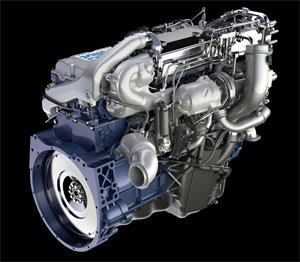
Navistar is still trying to get EPA 2010 certification for its MaxxForce engines.
A federal appeals court has ruled that Navistar's business plight was not a good enough reason for the Environmental Protection Agency to allow Navistar continue selling engines that don't meet EPA's 2010 emissions rules simply by paying fines.
Navistar is still working to try to get EPA certification certification for an engine that meets the NOx limit of 0.2 grams per horsepower-hour using only exhaust-gas recirculation and not the selective catalytic reduction technology used by other engine makers.
Last October, Navistar told EPA that it was likely to run out of emissions credits in the first quarter of this year. Those credits were allowing it to meet EPA 2010 emissions requirements even though its MaxxForce engines release up to 0.4 to 0.5 grams per brake-horsepower-hour of NOx. Navistar told the EPA that If it was not permitted to pay a nonconformance penalty for each engine, it would be forced to stop production of its domestic Class 8 engines and trucks.
So EPA granted permission in January in an interim rule for Navistar to pay up to $1,900 per engine while it considered a final rule.
Normally a decision to allow such penalties requires a formal notice and public comment, but EPA said that time was too short for that. It takes up to nine months to complete that process, and Navistar didn't have the credits to go that long.
So the agency invoked a "good cause" exception that allowed it to grant the penalties without going through the comment period.
The competition sued. Mack Trucks, Volvo Group North America, Daimler Trucks North America, Detroit Diesel Corp. and Cummins Inc. told the court that EPA erred when it allowed Navistar to pay the penalties without having a public comment process, and that the EPA didn't have "good cause."
The court agreed.
"The rule does not stave off any imminent threat to the environment or safety or national security," Judge Janice Rogers Brown wrote for the U.S. Court of Appeals for the District of Columbia Circuit. "It does not remedy any real emergency at all, save the 'emergency' facing Navistar's bottom line.
"Simply put, it bet on finding a way to make exhaust gas recirculation a feasible and compliant technology before its finite supply of credits ran out," Brown wrote.
Navistar said in its submission to the court that if it were to lose the engine certifications it gets by paying the penalty, it would quickly expend its remaining credits and be driven from the heavy-duty engine and truck market. This would threaten the company and its shareholders, employees, dealers, suppliers, retirees and customers, Navistar said.
In a statement, Navistar said it disagrees with the court's ruling and will ask for a rehearing.
"Navistar will work with EPA to fully understand the ruling and its impact on the use of NCPs until a final rule is implemented. At the same time, we will continue to cooperate with the EPA on the final NCP rule and will continue to work with the EPA on our 0.20g NOx certification.
"Navistar continues to make and ship engines and our customers will continue to receive the products they ordered with EPA certified engines."
The EPA still must make a final rule allowing for the notice and comment. The court ruling means it's likely the agency will need to make some different arguments to continue to allow Navistar to pay fines.
Some observers think the decision makes it more likely Navistar will abandon its EGR-only strategy.
Read the court documents here.
Related Stories:
1/31/2012 EPA Sets Penalties for Emissions Non-Compliance
5/17/2012 Court Papers: EPA Penalties Keep Navistar in Class 8 Business
More Drivers

EEOC Sues Texas Trucking Company Over Driver Age Limits
The agency says Trancasa USA rejected applicants over 65 and applied tougher driving-record standards to those over 60.
Read More →
Nussbaum, Roehl Announce Second Driver Pay Increase This Year
This year has seen a swath of major truck driver pay increases as freight capacity has tightened.
Read More →
From One Generation to the Next: How Mentorship Builds Safer Truck Drivers
After three decades in trucking, Harold Perry shares what he's learned about driver safety, mentorship, and helping the next generation build confidence behind the wheel.
Read More →
Truck Drivers Need More Than Another Alert
Fleets have more visibility into truck health, safety events, and driver activity than ever. The next challenge is turning all that information into useful guidance for the person who has to decide what to do next.
Read More →
FMCSA Removes 110 Truck Driver Training Schools from Certified ELDT List
Federal regulators also are targeting more than 160 additional training providers and launching a nationwide audit of third-party CDL skills testers as part of a broader crackdown on trucking fraud.
Read More →
Hours of Service Pilot Programs: FMCSA Readies for 2027 Rollout
Two pilot programs could eventually reshape hours-of-service rules, giving truck drivers options to pause their 14-hour clock or use longer split sleeper rest periods.
Read More →
Medical Cards, English Proficiency Reshape Roadcheck Violations
Medical-card violations jumped to the top of the driver out-of-service list during CVSA’s 2026 International Roadcheck, while English-language proficiency violations appeared among the leading violations for the first time.
Read More →
Driver Trust Can Make or Break the Success of Fleet Safety Technology
New Teletrac Navman research suggests that onboarding, transparency about driver data, and positive feedback can play a significant role in how commercial drivers respond to safety and coaching technology.
Read More →
EEOC Sues KLLM Over Alleged Sex Discrimination in Driver Training
KLLM is facing a federal sex-discrimination lawsuit over policies the EEOC alleges put female truck driver trainees at a disadvantage.
Read More →
FMCSA Moves to Codify English Language Requirements for Commercial Drivers
By changing regulations on English-language proficiency requirements for commercial drivers, rather than relying on a guidance memo, the FMCSA said future administrations won't be able to walk back the Trump administration's stricter enforcement with just a memo.
Read More →