




Countdown for Opening Mexican Border has Begun
The countdown has begun for opening the U.S.-Mexican border to long-distance trucking
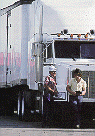
The countdown has begun for opening the U.S.-Mexican border to long-distance trucking.
The bell rang last week when an international arbitration panel ruled that the United States has been violating the North American Free Trade Agreement by keeping the border closed. Under the ruling, the U.S. can require Mexican truckers to meet U.S. safety standards but is subject to costly fines unless it gives Mexican trucks access.
Under NAFTA, the crossing was supposed to have been opened to border-state traffic in 1995, and to long-distance traffic in 2000. The Clinton administration, bowing to domestic concerns about jobs, environmental damage and highway safety, kept the crossing closed except for commercial zone drayage operations.
Now the pressure is on the Bush administration to negotiate a resolution. President Bush supports an open border, said White House spokesman Ari Fleischer. "The President is committed to making certain that we have free trade with Mexico. And he does believe that we need to have borders that make that possible, fully consistent with safety issues involving trucks."
While Mexican officials applauded the NAFTA panel's decision, some Mexican truckers have a different take. An important feature of NAFTA is that it is reciprocal: As Mexican trucks gain access to the U.S., U.S. trucks gain equal access to Mexico. The prospect of well-equipped U.S. fleets making deliveries throughout Mexico has alarmed Mexican companies that feel they will not be able to compete, even though NAFTA rules say foreign companies may haul only international freight.
As President Bush prepares for a mid-February meeting with Mexican President Vicente Fox, top officials at the U.S. Department of Transportation are huddling over strategies to make sure that Mexican trucks will meet U.S. safety standards. Considering the current level of Mexican performance, and the public outcry from labor unions and Capitol Hill, this will not be easy.
Mexican truck safety has improved recently, thanks to sustained efforts by both governments to bring the two national safety systems into balance, and to an increase in the number of U.S. safety inspectors. But there still are problems.
According to Julie Anna Cirillo, Assistant Administrator of the Federal Motor Carrier Safety Administration, the out-of-service rate for Mexican trucks in Texas is 38 percent. That is a considerable improvement from what it used to be – 70 percent – but still much higher than the national U.S. average of 25 percent.
Most of the Mexican trucks entering the U.S. – about 65 percent of them – cross the Texas border, although that proportion could change when today’s border drayage operations shift to 48-state delivery.
The situation is different in California. There, using its own money as well as federal funds, the state has built an enforcement system that has brought the Mexican out-of-service rate down to the U.S. level of 25 percent.
Cirillo, anticipating the move to open the border, has been working on suggestions for safety enforcement. One possibility is to require the 190 or so Mexican trucking companies that have applied for access to re-apply and pass a safety audit or a compliance review. Another is to bring Mexican trucking companies under the same rule that will soon be applied in the U.S.: All new entrants must pass a test to show that they understand the safety rules.
As DOT considers its options, opponents of the border opening are going public with their concerns. At a crowded press conference on Capitol Hill last week, Teamsters General President James P. Hoffa declared, "Our nation has surrendered control over access to U.S. highways to an outside panel that includes unelected representatives of foreign governments."
Opening the border will put Americans "directly in the path of unsafe Mexican trucks," Hoffa said. "Mexican drivers are paid third-world wages and have no basic worker protections."
Joining the chorus was Rep. Frank Wolf (R-Va.). In a letter to Transportation Secretary Norman Mineta, Wolf said he is "very troubled" by the move to open the border.
Wolf cited concerns about the Mexican safety regime, which he said lacks hours of service rules and drug testing requirements. "The United States and Mexico must establish, test and implement a comprehensive truck safety program at our borders," he said.
The Owner-Operator Independent Drivers Assn. also opposes the opening, until safety enforcement is improved.
The American Trucking Associations, on the other hand, applauded Bush's intent to open the border – as long as Mexican companies abide by U.S. safety standards.
Insiders predict that it will take most of this year to work out arrangements for a phased opening of the border.
More Equipment

How Volvo Updated Its D13 for EPA 2027 [Watch]
Volvo’s updated D13 promises lower emissions without sacrificing performance or fuel economy. Take a closer look at what changed inside the engine in this HDT Spotlight video.
Read More →
Michelin Tire Improves Efficiency and Durability for Regional Fleets
The Michelin X Multi Energy D2 is a regional haul drive tire engineered to help fleets improve fuel efficiency, durability and traction in demanding stop-and-go operations.
Read More →
ZF Expands Commercial Vehicle Push in North America
ZF is expanding its North American commercial-vehicle presence with new transmission applications, electrification, trailer technology and autonomous-driving systems.
Read More →
Tesla Wants a Self-Driving Semi. Are Cameras Enough?
Could Tesla’s camera-only autonomous driving technology work on an 80,000-pound Semi? In this commentary, HDT's Deborah Lockridge takes a look at Tesla, Cybercab, and how autonomous trucks see the road.
Read More →
Kodiak: Driverless Long-Haul Truck Launch on Track for 2026
Kodiak AI says its driverless long-haul safety case is 93% complete and it remains on track to begin commercial operations by year-end 2026.
Read More →
What DOT’s Automated Vehicle Strategy Means for Trucking
The U.S. Department of Transportation issued a new automated-vehicle strategy that outlines plans for driverless-truck regulations, cross-state freight corridors, and federal safety standards.
Read More →
East Coast Port Launches $45M Electric Truck Push
The Port Authority of New York and New Jersey announced millions in incentives for zero-emission drayage trucks, yard tractors, and new charging hubs near the port.
Read More →
PlusAI Going Public to Fund Autonomous Truck Launch
A SPAC deal could provide PlusAI with up to $300 million as it works toward a 2027 commercial launch of factory-built autonomous trucks.
Read More →
NHTSA Moves to Rewrite Truck Fuel-Economy Rules
The National Highway Traffic Safety Administration says it lacks authority to regulate medium- and heavy-duty truck engines separately from complete vehicles, but the existing standards have not yet been eliminated.
Read More →
Detroit Opens Orders for EPA 2027 Engines
Detroit isn’t starting from scratch to meet EPA 2027 diesel emissions standards. Its Gen 6 DD13 and DD15 engines keep much of today’s platform while updating the fuel and aftertreatment systems.
Read More →