




Could EPA Proposal Mean Trouble for Navistar 15-Liter Strategy?
UPDATED 9/29/09 -- A proposal from the Environmental Protection Agency could throw a monkey wrench into Navistar's plans to buy enough pre-2010-emissions 15-liter engines from other engine makers to get it through until its own 15-liter, 2010-certified engines are ready
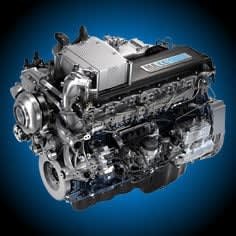
The MaxxForce 13
UPDATED 9/29/09 -- A proposal from the Environmental Protection Agency could throw a monkey wrench into Navistar's plans to buy enough pre-2010-emissions 15-liter engines from other engine makers to get it through until its own 15-liter, 2010-certified engines are ready.
Dow Jones Newswires, from the publishers of the Wall Street Journal, reported Sept. 11 that a pending EPA rule on stockpiling engines ahead of emissions-mandate deadlines (such as the industry faces in January 2010) "raises the potential for Navistar to be left without a 15-liter engine option until 2011."
At issue is a provision buried in an Aug. 28 EPA proposal that deals primarily with marine engine emissions. The agency is proposing to add language applicable to heavy-duty motor vehicles and heavy-duty engines used in motor vehicles, "which codifies that the 'stockpiling' of engines to avoid compliance with later, more stringent emission standards is considered a circumvention of the Clean Air Act and is prohibited," according to the Federal Register announcement of the proposed rule.
The EPA explains in the preamble to the proposed regulation that under the rule, "an engine manufacturer who sells engines to a vehicle manufacturer cannot sell engines in a current model year for the purpose of having them installed in a future model year's vehicles when the engine sale is beyond that required to meet normal production lead time requirements."
Navistar is offering its own 11-liter and 13-liter MaxxForce engines to meet the 2010 emissions standards. New to the market, the MaxxForce engines will use advanced EGR to meet 2010 emissions standards, whereas all other engine makers are using selective catalytic reduction, or SCR.
However, the 15-liter version of the Maxxforce isn't expected to be available until at least late 2010, so Navistar plans to use 2009-certified 15-liter engines from Cummins (and perhaps Caterpillar) in its trucks built in the first part of next year -- "transition engines," as it calls them. But the EPA proposal, if it goes into effect, would appear to limit the number of 2009 engines that could be used in this manner.
Navistar officials have said the EPA has already approved their plans. In addition, Dow Jones quoted an analyst with Northcoast Research, who said the EPA would have to prove Navistar was buying these 2009 engines intentionally to avoid the new emissions standards.
The issue raised its head again last week, Dow Jones Newswires reported, when "investors peppered Chief Executive Daniel Ustian with questions during a J.P. Morgan investor conference in New York. Ustian said the company believes many 15-liter owners could be transitioned to a 13-liter engine." About 60 percent of Navistar's heavy-duty trucks are purchased with 15-liter engines, according to the Dow Jones report.
Over the years, some 15-liter users have switched to 12- and 13-liter diesels to save on the up-front purchase cost as well as on weight and fuel. Caterpillar's C12 and 13 and Cummins' ISM, for instance, are common in dump trucks and mixers (which also use 9-liter engines) and some road tractors. But many large, over-the-road fleets want a million-mile engine and say they can't get it with the smaller engines.
When contacted by HDT editors about the report, a Navistar spokesman responded, "We've reviewed our engine transition strategy with the EPA and we remain confident that we will be able to meet customer demand for big-bore power through a combination of transition engines and by matching real-time applications to the right engine."
When contacted by HDT editors for comment on how the proposal would affect Navistar's plan to buy 15-liter 2009 Cummins engines to carry it through until its own 15-liter engine is ready later in 2010, an EPA spokesperson responded, "We can't comment on it at this particular time."
Senior Editor Tom Berg and Washington Editor Oliver B. Patton contributed to this story.
This story was updated 9/29/09 to include EPA's response to our request for comment.
More Drivers

From One Generation to the Next: How Mentorship Builds Safer Truck Drivers
After three decades in trucking, Harold Perry shares what he's learned about driver safety, mentorship, and helping the next generation build confidence behind the wheel.
Read More →
Truck Drivers Need More Than Another Alert
Fleets have more visibility into truck health, safety events, and driver activity than ever. The next challenge is turning all that information into useful guidance for the person who has to decide what to do next.
Read More →
FMCSA Removes 110 Truck Driver Training Schools from Certified ELDT List
Federal regulators also are targeting more than 160 additional training providers and launching a nationwide audit of third-party CDL skills testers as part of a broader crackdown on trucking fraud.
Read More →
Hours of Service Pilot Programs: FMCSA Readies for 2027 Rollout
Two pilot programs could eventually reshape hours-of-service rules, giving truck drivers options to pause their 14-hour clock or use longer split sleeper rest periods.
Read More →
Medical Cards, English Proficiency Reshape Roadcheck Violations
Medical-card violations jumped to the top of the driver out-of-service list during CVSA’s 2026 International Roadcheck, while English-language proficiency violations appeared among the leading violations for the first time.
Read More →
Driver Trust Can Make or Break the Success of Fleet Safety Technology
New Teletrac Navman research suggests that onboarding, transparency about driver data, and positive feedback can play a significant role in how commercial drivers respond to safety and coaching technology.
Read More →
EEOC Sues KLLM Over Alleged Sex Discrimination in Driver Training
KLLM is facing a federal sex-discrimination lawsuit over policies the EEOC alleges put female truck driver trainees at a disadvantage.
Read More →
FMCSA Moves to Codify English Language Requirements for Commercial Drivers
By changing regulations on English-language proficiency requirements for commercial drivers, rather than relying on a guidance memo, the FMCSA said future administrations won't be able to walk back the Trump administration's stricter enforcement with just a memo.
Read More →
Drivers Put Western Star Trucks to the Test at Star Nation Experience
Watch to get an inside look at the Western Star trucks, technology, and community behind the Star Nation Experience 2026!
Read More →
Trump Administration Looks to Put More Veterans Behind the Wheel
The Freedom Haulers program pulls together existing and expanded programs at several federal agencies to recruit veterans to drive commercial heavy-duty trucks and cut the red tape for them to get a CDL, training, and employment.
Read More →