




Convoy Go Offers Power-Only for Private Fleets
Convoy is making it easier for private fleets to access nationwide power-only capacity to haul preloaded and empty dry van trailers.

Convoy says it can improve trailer utilization for private fleets.
Photo: Convoy
Convoy is making it easier for private fleets to access nationwide power-only capacity to haul preloaded and empty dry van trailers.
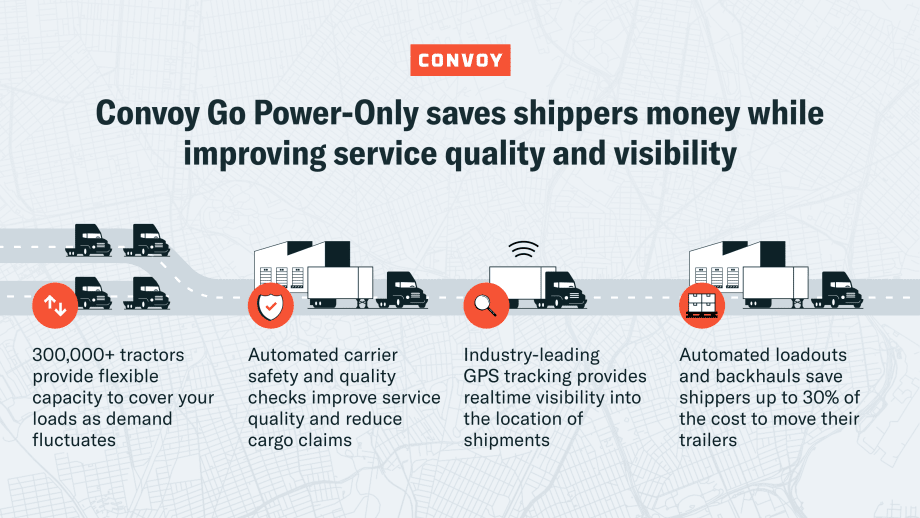
The digital freight network’s latest power-only service is part of its Convoy Go program. With a network of more than 300,000 tractors, Convoy says it now offers the largest on-demand fleet of power units on the market.
Through the use of machine learning across Convoy’s shipper network, backhauls and loadouts (when an empty trailer is filled with a live load) for trailer moves can be automatically identified, reducing shipping costs while eliminating empty miles.
Convoy estimates that shippers spend billions of dollars each year on empty trailer moves. Convoy’s power-only freight service can save up to 30% of the cost for these trailer moves, while also helping carriers maximize asset utilization and earn more money.
Private fleets currently account for more than half a million trailers in the United States, Convoy noted. There is a constant need to haul them from one location to another — either loaded with freight that needs to be delivered, or empty in cases where the trailer is being repositioned for its next load. In the last decade, the need to haul these trailers has only increased, as online commerce and supply chains require more short-haul, rapid-response fulfillment.
However, the process of moving trailers is highly inefficient and costly. With a 4:1 trailer-to-tractor ratio among private fleets, many shippers operate with a shortfall of power units and drivers. When demand surges, these shippers often have to rely on the spot market.
Over the last three years, Convoy has developed its own drop-and-hook service called Convoy Go, providing shippers with power-only tractors and a fleet of several thousand trailers. It also allows smaller carriers to take advantage of power-only opportunities.
Now the company has expanded the capabilities of Convoy Go, providing power-only capacity to haul private fleet trailers. Convoy supplements the private fleet’s existing tractor capacity to more efficiently rebalance trailer pools and deliver preloaded trailers.
This service is built on machine learning models that predict trailer demand weeks in advance and intelligently reroute trailers to facilities where they’re needed. This eliminates the costs of spillover to the live spot market when drop-and-hook demand increases and minimizes trailer underutilization when demand recedes.
More Fleet Management

Why Private Fleets Are Taking More Freight
Private fleets are putting their own trucks on demanding customers and high-cost lanes as companies seek greater control over service, costs, and capacity.
Read More →
Color Match Smarter: Tools That Restore & Perform
For fleet managers and collision repair professionals keeping heavy-duty trucks on the road, getting the color right the first time isn't just about appearance — it's about efficiency, turnaround time, and bottom-line results. Discover how today's digital color tools are transforming the repair process from guesswork to precision.
Read More →
FMCSA Pauses Biennial-Update Enforcement Amid Motus Transition
Carriers whose updates were due on or after June 1 have more time, while FMCSA works to stabilize its new registration system and warns of phishing sites impersonating its new carrier registration system, Motus.
Read More →


2026 Blueprint for Countering Smarter Supply Chain Theft
Cargo theft is no longer just the cost of doing business. It's a multi-billion-dollar criminal enterprise exploiting vulnerabilities across your fleet, drivers, and supply chain.
Read More →
How Telematics Improves Visibility, Control, and Performance in Refrigerated Fleets
Explore how telematics help refrigerated fleets improve visibility, uptime, efficiency, compliance, and cargo protection across connected cold chain operations.
Read More →
What the U.S.-Canada Trade War Means for Trucking
Escalating U.S.-Canada tariffs could disrupt cross-border freight, reduce truck volumes, raise costs, and create new uncertainty for carriers on both sides of the border.
Read More →
What Are Trucking’s Top Concerns for 2026?
The American Transportation Research Institute wants to know what's worrying trucking fleet managers, drivers, and other stakeholders in its annual Industry Issues survey.
Read More →
American Trucking Associations Looks for a New Leader
ATA President and CEO Chris Spear abruptly left his job at the association on August 21, at a pivotal time for the trucking industry.
Read More →
Public Wi-Fi Cybersecurity Risks: How Truck Drivers and Fleets Can Protect Their Data
Public Wi-Fi can expose truck drivers and fleets to credential theft, malware, and other cyber threats. Here’s how to reduce the risk on the road.
Read More →
For Nicky Cupp, Fleet Innovation Starts With Frustration
HDT Truck Fleet Innovator Nicky Cupp turns everyday pain points at Fraley & Schilling into opportunities for better technology and smarter processes.
Read More →