





Technology is Changing How Carriers, Shippers, and Brokers Connect
Convoy Claims Fully Automated Brokering Success in Top Freight Markets
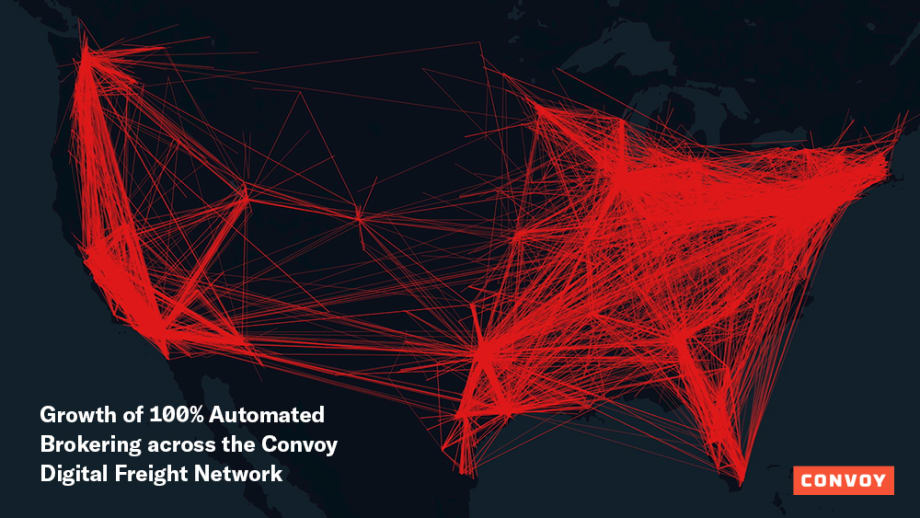
Digital freight-matching company Convoy said it’s achieved a trucking-industry first: 100% automated brokering of loads to carriers, including matching and pricing, on lanes in top freight markets.
December 18, 2019
“This breakthrough on automated platform pricing by Convoy on high-density cargo lanes is significant and definitive towards achieving a future of truly automated touch-of-a-single-button-type brokering.” said Silpa Paul with Frost and Sullivan.
Image: Convoy
2 min to read
Digital freight-matching company Convoy said it’s achieved a trucking-industry first: 100% automated brokering of loads to carriers, including matching and pricing, on lanes in top freight markets.
In February, Convoy announced 100% automated load matching. With this milestone milestone, Convoy said, it has achieved 100% automated load pricing in markets such as Atlanta, Boston, Dallas, and Los Angeles, completing full automation of the brokering process.
In the traditional process for matching a load to a truck, brokers and asset-based carriers manually negotiate the pricing for each load, typically via phone or email. Convoy contends that this process takes hours to complete, with an average of 10 back-and-forth emails and phone calls, and contributes to higher prices for shippers as well as more hassle for drivers and carriers.
Automated brokering addresses thousands of loads at a time, involves zero emails/calls, and takes minutes, according to the company. Convoy’s digital freight network combines its dense network of carriers with the use of machine learning models to fully automate the process of matching and pricing a truck to a load.
As freight volume increases across Convoy’s digital freight network, carriers get more load options, better routes, and fewer empty miles, allowing them to earn more. At the same time, as more carriers work with Convoy, capacity increases and costs decrease for shippers. Now, automated brokering accelerates this “flywheel effect,” Convoy said.
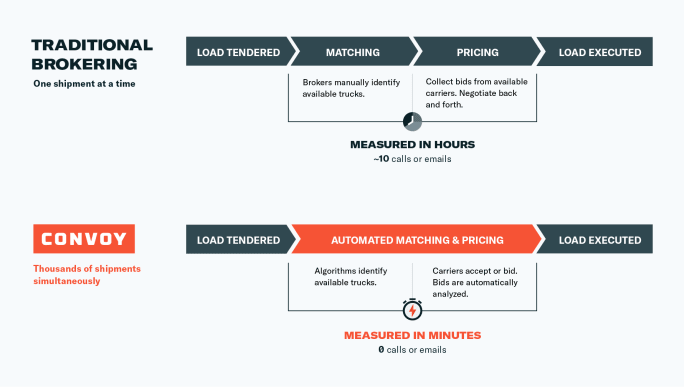
Convoy says traditional brokering addresses one load at a time and can take hours, but automated brokering addresses thousands of loads at a time and takes minutes.
Image: Convoy
“This breakthrough on automated platform pricing by Convoy on high-density cargo lanes is significant and definitive towards achieving a future of truly automated touch-of-a-single-button-type brokering.” said Silpa Paul, team lead of commercial vehicle research and consulting at Frost and Sullivan. “Digital freight providers have been around for years, but where they have struggled is precisely in automating pricing. Most have had to create a system of customer account executives with call support to actually complete the brokerage process. Thus they have been operating more or less like traditional brokers.”
Since its founding in 2015, Convoy has developed and refined machine learning models to automate otherwise manual processes. In November, Convoy announced it has raised $400 million.
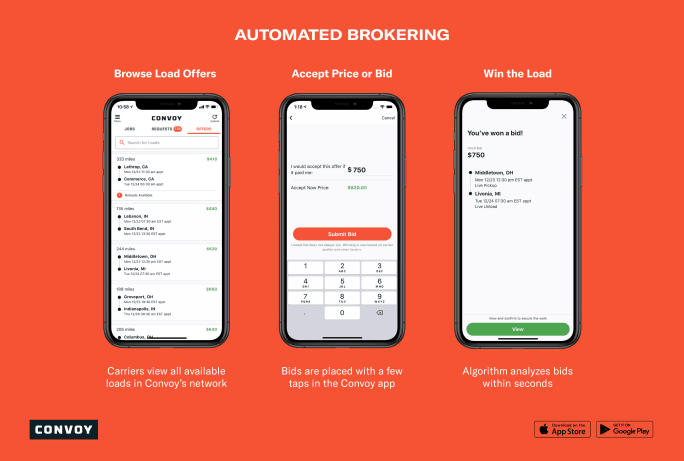
Instead of brokers and asset-based carriers manually negotiating pricing for each load, typically via phone or email, Convoy uses machine learning to automatically price loads.
Image: Convoy
“With automation reducing manual work, Convoy’s operations team can focus on establishing new markets and expanding our carrier base to meet our growing demand,” said Ziad Ismail, Convoy’s chief product officer.
Convoy claims shippers such Anheuser-Busch, CHEP, and Waiākea among the companies using its technology.
More Fleet Management

Sponsored•September 16, 2026
Color Match Smarter: Tools That Restore & Perform
For fleet managers and collision repair professionals keeping heavy-duty trucks on the road, getting the color right the first time isn't just about appearance — it's about efficiency, turnaround time, and bottom-line results. Discover how today's digital color tools are transforming the repair process from guesswork to precision.
Read More →
FMCSA Pauses Biennial-Update Enforcement Amid Motus Transition
Carriers whose updates were due on or after June 1 have more time, while FMCSA works to stabilize its new registration system and warns of phishing sites impersonating its new carrier registration system, Motus.
Read More →
Sponsored•September 14, 2026
2026 Blueprint for Countering Smarter Supply Chain Theft
Cargo theft is no longer just the cost of doing business. It's a multi-billion-dollar criminal enterprise exploiting vulnerabilities across your fleet, drivers, and supply chain.
Read More →


Sponsored•September 1, 2026
How Telematics Improves Visibility, Control, and Performance in Refrigerated Fleets
Explore how telematics help refrigerated fleets improve visibility, uptime, efficiency, compliance, and cargo protection across connected cold chain operations.
Read More →
What the U.S.-Canada Trade War Means for Trucking
Escalating U.S.-Canada tariffs could disrupt cross-border freight, reduce truck volumes, raise costs, and create new uncertainty for carriers on both sides of the border.
Read More →
What Are Trucking’s Top Concerns for 2026?
The American Transportation Research Institute wants to know what's worrying trucking fleet managers, drivers, and other stakeholders in its annual Industry Issues survey.
Read More →
American Trucking Associations Looks for a New Leader
ATA President and CEO Chris Spear abruptly left his job at the association on August 21, at a pivotal time for the trucking industry.
Read More →
Public Wi-Fi Cybersecurity Risks: How Truck Drivers and Fleets Can Protect Their Data
Public Wi-Fi can expose truck drivers and fleets to credential theft, malware, and other cyber threats. Here’s how to reduce the risk on the road.
Read More →
For Nicky Cupp, Fleet Innovation Starts With Frustration
HDT Truck Fleet Innovator Nicky Cupp turns everyday pain points at Fraley & Schilling into opportunities for better technology and smarter processes.
Read More →
Adam Buttgenbach’s Approach to Electric Trucks: Start With Where They Fit
HDT Truck Fleet Innovator Adam Buttgenbach helped PepsiCo build one of North America’s largest EV fleets by focusing on where electric trucks make operational sense.
Read More →