




Fleet Considerations for Building an EV Charging Strategy
Before receiving an electric vehicle order, fleets should build a solid strategy that can answer these important questions.


"Scaling Charging Infrastructure for Electric Trucks" panel at the Fleet Forward Conference. Left to right: Rob Hoysgaard of LeasePlan, Alec Cervenka of Kenworth, Brenden Harney of Proterra, Simon Horton of Edison Energy and Darrell Kong, of Cradle Mountain Advisors.
Photo: Ross Stewart, RMS3Digital
As more and more trucking fleets begin placing orders for battery-electric trucks, fleet managers must prepare for delivery and implementation into their operations. First step: charging infrastructure.
To avoid a scenario where assets are sitting upon delivery because proper charging isn’t in place, fleets should consider beginning to plan for infrastructure needs about two years in advance, said Rob Hoysgaard, vice president of truck and equipment at LeasePlan during a panel discussion on scaling charging infrastructure for electric trucks during the Fleet Forward Conference in California on Nov. 10.
Establishing charging requires long processes of permitting, coordinating with utilities, as well as financing progress payments for construction and hardware. This is a process that needs to start with a spelled-out strategy, said Simon Horton, the electric vehicle infrastructure lead for Edison Energy.
Before even deciding where the chargers will be located at an operation, fleets should have an answer to these questions:
What are you hoping these electric trucks are going to achieve?
Are these electric trucks designed to be a one-for-one replacement of existing vehicles in the fleet?
Are these electric trucks going to be operating in different applications than typical for your operation?
Are you looking to optimize fleet operations by making a transition to electric vehicles?
What percentage of the fleet at a given depot is going to go electric (or transition to another alternative fuel)? How is that percentage going to change over the years?
Will you be at this facility long-term?
Are you going to need a charger that is utilized by more than one class of vehicle?
“Learn about the product and learn about the technology,” Horton said. “Get driver buy-in, get operator buy-in, get site operator by-in, and learn that strategy as you go. Design the infrastructure based on that strategy and design the infrastructure to be able to scale so that you've got the chargers there when the vehicles arrive.”
On the other hand, planning too early or building too much is a similar problem. You wouldn’t want hundreds of thousands of dollars’ worth of infrastructure sitting idle either.
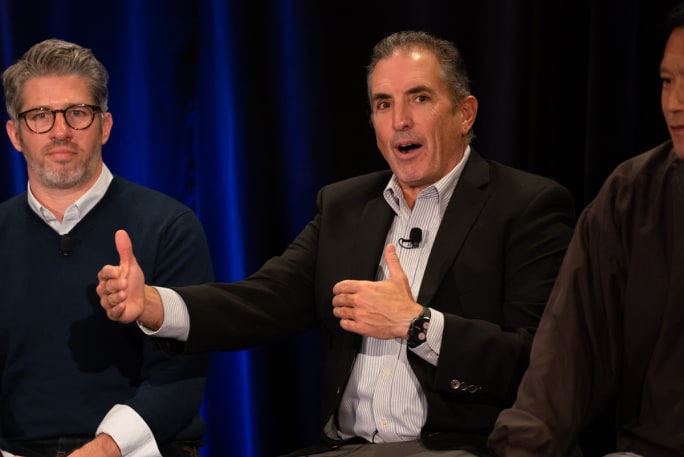
Simon Horton, electric vehicle infrastructure lead for Edison Energy, discusses creating a strategy for electric vehicle charging.
Photo: Ross Stewart, RMS3Digital
“There really is a sweet spot of vehicle delivery and charger availability,” Horton said.
Horton emphasizes that a strategy shouldn’t be static.
“Your strategy has to be revisited periodically at different points in time,” he said.
Setting up Charging for a Mixed Fleet
With some planning, fleets running a mixed fleet of passenger, medium- and heavy-duty fleets can plan to create charging infrastructure that serves all vehicle types, says Alec Cervenka, Kenworth’s zero emissions sales manager.
“You’re able to use the same charger for a Class 8 truck and a Class 6 box truck, a little Class 2 truck and a passenger car,” he said. “Yes, there's a lot of infrastructure that goes into it, a lot of plumbing… but you can conceivably fix all of your charging with one charger setup.”
Darrell Kong, principal for Cradle Mountain Advisors, said “a one-for-one strategy” [a single charger for a single type of vehicle] is expensive, and often means an underutilized asset.
“A fully utilized charger is a much better asset than a charger that is only utilize eight hours a day and sits for 16 hours,” he said.
More Fuel Smarts

Wex Adds Cardless Fuel Payments for Over-the-Road Customers
A new fuel card feature for Wex customers offers convenience and security.
Read More →
New California Law Could Shed Light on Electric Truck Prices
Why do battery-electric Class 8 trucks remain so expensive? A California bill signed by Gov. Gavin Newsom would give fleets and state agencies more visibility into what manufacturers charge.
Read More →
How Volvo Updated Its D13 for EPA 2027 [Watch]
Volvo’s updated D13 promises lower emissions without sacrificing performance or fuel economy. Take a closer look at what changed inside the engine in this HDT Spotlight video.
Read More →

Diesel Price Spike Shortens Payback for Natural Gas Trucks, Report Says
Energy Vision estimates fleets could recover the higher purchase price of an RNG-fueled Class 8 tractor in 1.3 to 2.8 years under current fuel-price scenarios.
Read More →
Calstart Becomes Catalyst Mobility, Reflecting Broader Focus
Calstart is now Catalyst Mobility, reflecting the nonprofit’s growing national role in clean transportation, including zero-emission trucks, infrastructure and incentive programs.
Read More →
Record Diesel Prices Squeeze Trucking Fleets
Average U.S. diesel prices have climbed to nearly $6 a gallon, surpassing the 2022 record as tight refinery capacity and Middle East disruptions keep fuel costs elevated.
Read More →
How Fuel Delivery Shapes Engine Performance
Fuel delivery depends on more than what happens at the injector. For fleet, maintenance and technical professionals, looking at the full path from pump to injector can provide useful context for understanding engine performance.
Read More →
East Coast Port Launches $45M Electric Truck Push
The Port Authority of New York and New Jersey announced millions in incentives for zero-emission drayage trucks, yard tractors, and new charging hubs near the port.
Read More →
Detroit Opens Orders for EPA 2027 Engines
Detroit isn’t starting from scratch to meet EPA 2027 diesel emissions standards. Its Gen 6 DD13 and DD15 engines keep much of today’s platform while updating the fuel and aftertreatment systems.
Read More →
Zero-Emission Truck Corridor Planned for West Coast
California, Oregon, Washington, British Columbia and Baja California are coordinating plans for truck charging and hydrogen fueling from Canada to Mexico.
Read More →