




Connecticut Moves to Beef Up State Ports, Maritime Business
Connecticut Gov. Dannel Malloy has signed legislation creating the Connecticut Port Authority, which will act as a quasi-public agency to market and coordinate the development of the state’s ports and maritime economy.
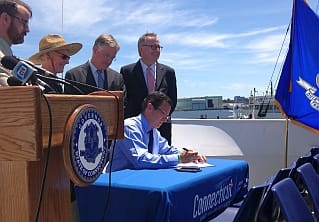

Connecticut Gov. Dannel Malloy has signed legislation creating the Connecticut Port Authority, which will act as a quasi-public agency to market and coordinate the development of the state’s ports and maritime economy.
Both chambers of the General Assembly passed the legislation unanimously in May.
The CPA's primary role will be to coordinate port and maritime economic development, establish a statewide port marketing strategy, and serve as the lead agency in seeking federal and state funding for infrastructure improvements such as dredging
“Connecticut's three deep water ports in New London, New Haven and Bridgeport are important assets for attracting investment, expanding business development and creating jobs, all of which are keys to our economic recovery,” said Malloy. “Working off of the recommendations of our Deep Water Port Strategy Study, we are taking steps to support Connecticut’s maritime industries by strengthening the economic potential of our deep water resources.”
He said with this new structure in place, a renewed focus at the state level and a comprehensive strategy, he believes Connecticut's ports will be in a stronger position to attract more private investment and import and export business while “also taking trucks off of our congested highways.”
The new authority will be established on October 1, 2015. In the interim, the legislation charges the Department of Economic and Community Development to develop, in partnership with state agencies, a business and operating plan for the consideration of the new Authority's board as well as to make recommendations to the Governor and Assembly with respect to additional legislation that would accelerate port development.
The legislation also creates a Port Authority Working Group comprised of representatives of the maritime industry, labor and the deep water port municipalities, which is charged with making recommendations for DECD to consider in the development of the business and operating plan and recommendations to the Governor and Assembly.
“Our ports are important intermodal gateways to Connecticut and New England highways and rail lines moving an array of consumer goods such as lumber, steel, salt and petroleum products,” said Connecticut Department of Transportation Commissioner James P. Redeker. “With a smart, coordinated marketing and promotional plan, we will be in a position to attract more business and further boost the regional economy.”
In 2011, Malloy commissioned the Connecticut Deep Water Port Strategy Study to guide the development of a long-term economic development strategy for the deep water ports in Bridgeport, New Haven, and New London. The study analyzes the strengths and deficiencies of Connecticut’s ports, makes recommendations to protect existing commercial operations at these ports, and identifies new opportunities for business growth.
More Fleet Management

Color Match Smarter: Tools That Restore & Perform
For fleet managers and collision repair professionals keeping heavy-duty trucks on the road, getting the color right the first time isn't just about appearance — it's about efficiency, turnaround time, and bottom-line results. Discover how today's digital color tools are transforming the repair process from guesswork to precision.
Read More →
FMCSA Pauses Biennial-Update Enforcement Amid Motus Transition
Carriers whose updates were due on or after June 1 have more time, while FMCSA works to stabilize its new registration system and warns of phishing sites impersonating its new carrier registration system, Motus.
Read More →
2026 Blueprint for Countering Smarter Supply Chain Theft
Cargo theft is no longer just the cost of doing business. It's a multi-billion-dollar criminal enterprise exploiting vulnerabilities across your fleet, drivers, and supply chain.
Read More →


How Telematics Improves Visibility, Control, and Performance in Refrigerated Fleets
Explore how telematics help refrigerated fleets improve visibility, uptime, efficiency, compliance, and cargo protection across connected cold chain operations.
Read More →
What the U.S.-Canada Trade War Means for Trucking
Escalating U.S.-Canada tariffs could disrupt cross-border freight, reduce truck volumes, raise costs, and create new uncertainty for carriers on both sides of the border.
Read More →
What Are Trucking’s Top Concerns for 2026?
The American Transportation Research Institute wants to know what's worrying trucking fleet managers, drivers, and other stakeholders in its annual Industry Issues survey.
Read More →
American Trucking Associations Looks for a New Leader
ATA President and CEO Chris Spear abruptly left his job at the association on August 21, at a pivotal time for the trucking industry.
Read More →
Public Wi-Fi Cybersecurity Risks: How Truck Drivers and Fleets Can Protect Their Data
Public Wi-Fi can expose truck drivers and fleets to credential theft, malware, and other cyber threats. Here’s how to reduce the risk on the road.
Read More →
For Nicky Cupp, Fleet Innovation Starts With Frustration
HDT Truck Fleet Innovator Nicky Cupp turns everyday pain points at Fraley & Schilling into opportunities for better technology and smarter processes.
Read More →
Adam Buttgenbach’s Approach to Electric Trucks: Start With Where They Fit
HDT Truck Fleet Innovator Adam Buttgenbach helped PepsiCo build one of North America’s largest EV fleets by focusing on where electric trucks make operational sense.
Read More →