





Related: Peloton Announces Level 4 Driverless Platooning System
Closing The Gap: Legislatures Urged to Address Truck Platooning Laws
Truck platooning technology has leapt far ahead of outdated laws designed to cut down on tailgating and convoys. A new, state-by-state initiative seeks to bring regulations in line with this new technology.
July 19, 2019
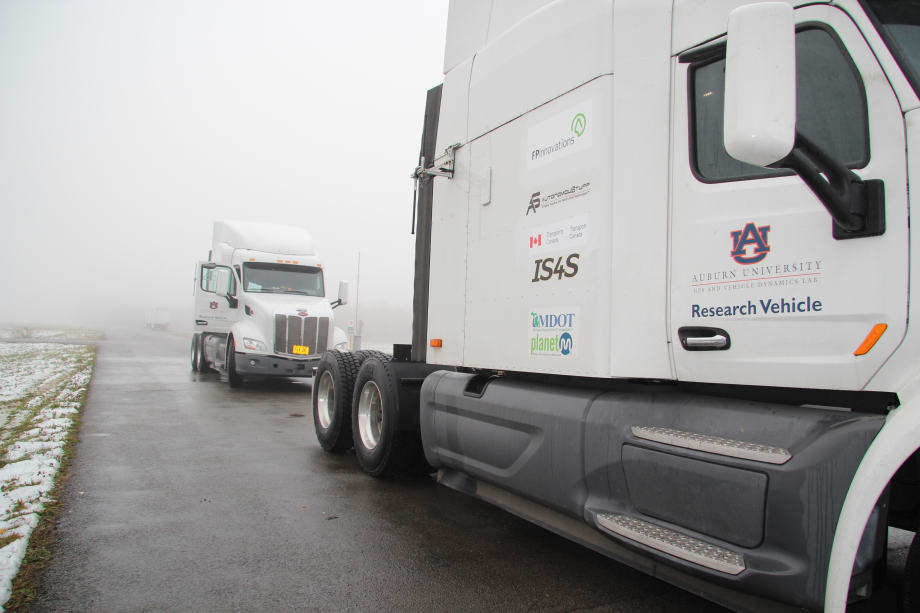
A new report issued by the Competitive Enterprise Institute breaks down current and outdated truck following distance and platooning laws in hopes of bringing them in line with recent technology advances.
Photo: PIT Group
4 min to read
Despite some OEMs backing away, truck platooning appears to remain on track as an autonomous truck technology with considerable potential for boosting fleet fuel economy, safety and productivity. But these gains can only happen if states update old laws against following too closely, according to a new report from the Competitive Enterprise Institute.
“Exempting platooning vehicles from tailgating laws is a no-brainer, and that’s why nearly two dozen states already made reforms over the last four years that permit commercial platooning deployments. The votes in favor of these laws were bipartisan and many were unanimous. The economic, safety, and environmental benefits of platooning should prompt other states to update their laws,” said Marc Scribner, CEI senior fellow and author of Authorizing Automated Vehicle Platooning: A Guide for State Legislators, 2019 Edition. This handbook, now in its fourth annual edition, is widely used by policymakers and researchers as the go-to source for state platooning policies.
So far, 20 states have taken some action to allow for new truck platooning technology, but another 36 states lag behind.
Automated platooning driver assistance technology coupled with automatic emergency braking allows trucks to safely travel closer together at highway speeds, thereby reducing aerodynamic drag. Reduced drag means reduced fuel consumption and tailpipe emissions. The necessary automatic emergency braking coupled with platooning technology will enhance road safety even when the platooning-enabled trucks operate independently outside of platoons.
The CEI report is a nationwide inventory of state “following too closely” rules that offers specific, state-by-state fixes to amend statutes in ways that exempt speed-coordinated vehicle platooning from those laws.
The report noted that state FTC rules vary by vehicle class and rule type. Most class-specific FTC rules are contained within a single statutory section. The three vehicle classes are:
Cars (including light-duty trucks)
Heavy trucks
Caravans (sometimes called motorcades)
The four FTC rule types are:
“Reasonable and prudent"
Time
Distance
“Sufficient space to enter and occupy without danger”
A “reasonable and prudent” rule requires a vehicle operator to follow the vehicle in front while allowing for sufficient space to stop in an emergency. In practice, this is a subjective standard that grants law enforcement a large degree of leeway. It is the most common FTC rule for cars and is sometimes combined with other types of rules.
Time-based FTC rules specify the time interval between vehicles, such as by barring drivers from following less than “at least two seconds behind the vehicle being followed.” This is the least common rule type and is limited to only two jurisdictions, Alaska and Utah.
Distance rules specify the precise safe following distance either by codifying a fixed distance interval or, in the case of Alabama, for example, a proportional distance interval requiring that “the driver of a vehicle shall leave a distance of at least 20 feet for each 10 miles per hour of speed between the vehicle that he or she is driving and the vehicle that he or she is following.” This rule type is most common among the heavy truck and caravan vehicle classes.
The “sufficient space to enter and occupy without danger” rule, which is most common among the heavy truck and caravan vehicle classes, aims to allow other road users to pass other vehicles safely and enter and exit the roadway.
The report then breaks down current following/platooning laws on a state-by-state basis, with notes on the strength or weakness of proposed or current legislation proposed to address existing discrepancies, as with this entry for Arkansas:
Arkansas
In April 2017, Arkansas enacted legislation to authorize automated truck platooning by exempting vehicles equipped with “driver-assistive truck platooning systems” from FTC rules.[13] Operators are required to submit an operating plan to the State Highway Commission, which then has 45 days to reject the plan. However, as this exemption only applies to heavy trucks, it could be improved to authorize platooning for all vehicle classes.
Citation: Ark. Code § 27-51-305
Following-Too-Closely Rule Types by Vehicle Class
Cars: Reasonable and prudent
Heavy Trucks: Distance, 200 feet
Caravans: Undefined
Strong Amendment:
Ark. Code § 27-51-305 is amended by striking subsections (c) and (d) and adding new subsection (c), which reads as follows:
(c) The preceding subsections do not apply to the operator of any non-leading vehicle traveling in a procession of vehicles if the speed of each vehicle is automatically coordinated.
Weak Amendment:
Ark. Code § 27-51-305 is amended by striking subsections (c) and (d) and adding new subsection (c), which reads as follows:
(c) The preceding subsections do not apply to connected vehicle technology testing and operations that use networked wireless communication among vehicles, infrastructure, or communication devices that are approved by the State Highway Commission. The commission shall promulgate rules in the least restrictive means for ensuring the safe and adequate operation of vehicles.
The full report can be accessed here.
More Fleet Management

Geotab Links Fleet Card to Vehicle Data
The new card combines fuel discounts with telematics-based purchase controls. Geotab’s analysis also points to potential savings from choosing lower-priced fuel stops.
Read More →
How MFA Helps Protect Trucking Fleets
Multi-factor authentication adds protection when passwords are stolen. Here’s how it works and where fleets should start.
Read More →
How Better Freight Data Helps Trucking Teams Get Ahead of Disruption
Trucking and logistics teams have plenty of data. The problem is getting the right information in front of the right people soon enough to act. Better-connected data can help teams spot trouble earlier and make smarter decisions before small problems become big ones.
Read More →

Trimble: Taking Artificial Intelligence in Trucking Beyond Faster Tasks
At Insight 2026, Trimble executives argued that fleets may need to redesign workflows to get more from AI as it introduced new products and enhancements. AI’s value will depend on how fleets combine automation with their people's knowledge.
Read More →
Sponsored•September 28, 2026
Build a bulletproof fleet: Uniting ELDs and dash cams for total compliance
An ELD can prove compliance, but it cannot always prove what happened on the road. Discover how uniting accurate ELD data with AI-powered dash cam video can help your fleet strengthen compliance, defend against liability, protect drivers and reduce operational costs.
Read More →
Nominations Open for HDT Emerging Leaders
Heavy Duty Trucking is looking for accomplished trucking fleet professionals under 40 who are making an impact and helping lead the industry forward.
Read More →
Why Private Fleets Are Taking More Freight
Private fleets are putting their own trucks on demanding customers and high-cost lanes as companies seek greater control over service, costs, and capacity.
Read More →
Sponsored•September 16, 2026
Color Match Smarter: Tools That Restore & Perform
For fleet managers and collision repair professionals keeping heavy-duty trucks on the road, getting the color right the first time isn't just about appearance — it's about efficiency, turnaround time, and bottom-line results. Discover how today's digital color tools are transforming the repair process from guesswork to precision.
Read More →
FMCSA Pauses Biennial-Update Enforcement Amid Motus Transition
Carriers whose updates were due on or after June 1 have more time, while FMCSA works to stabilize its new registration system and warns of phishing sites impersonating its new carrier registration system, Motus.
Read More →
Sponsored•September 14, 2026
2026 Blueprint for Countering Smarter Supply Chain Theft
Cargo theft is no longer just the cost of doing business. It's a multi-billion-dollar criminal enterprise exploiting vulnerabilities across your fleet, drivers, and supply chain.
Read More →