




Peloton Announces Level 4 Driverless Truck Platooning System
Peloton’s new Automated Following solution uses vehicle-to-vehicle technology to allow a single driver in a lead truck to control two platooning vehicles.

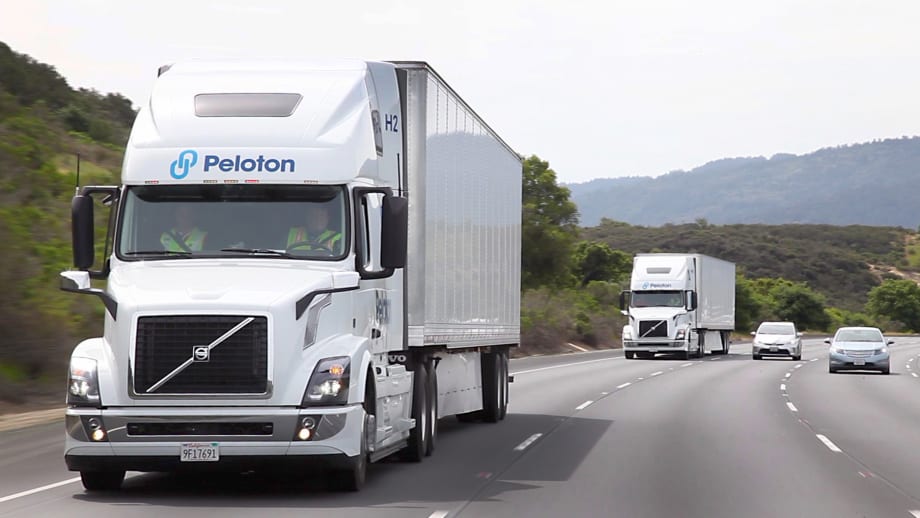
Peloton has announced a new Level truck platooning system that does not require a driver in the following truck.
Photo: Peloton
If you were wondering how platooning technology developer Peloton would respond to Daimler Truck and Bus chief Martin Daum's recent remarks casting doubt on the potential of truck platooning technology, wonder no more. According to CEO Josh Switkes, Peloton is doubling down on its technology efforts, announcing a new, Level 4 driverless platooning system at the Automated Vehicle Symposium in Orlando, Florida, on July 17.
“This is our first public report announcing what we’re seeing in our field testing,” Switkes said in an interview with HDT. “Daimler announced they’re not seeing good results with their platooning system. And we’re now ready to say publicly that we are absolutely seeing good results with ours – both in terms of fuel savings and enhanced safety.”
Peloton’s Automated Following, announced in Orlando, is an advanced platooning system, using vehicle-to-vehicle (V2V) technology to enable a single driver to drive a pair of vehicles. It marks the next major milestone in Peloton’s unique approach to deploying automation to increase the safety and productivity of commercial vehicles. Switkes said the new system can double the efficiency of a single driver, who will eventually be able to command premium pay and status for mastering this new transportation skill.
Peloton’s proprietary technologies link pairs of heavy trucks for connected driving that improves aerodynamics, fuel economy and safety, using V2V communications and radar-based active braking systems, combined with vehicle control algorithms.
“We’ve taken a different approach to commercial introduction of automation in Class 8 vehicles.” Switkes told HDT. “We see the drivers as the world’s best sensors, and we are leveraging this to enable today’s drivers to be more productive through automated following platoons.”
Related: Daimler Nixes Truck Platooning to Focus on Autonomous Technology
Automated Following is a Level 4 autonomous system that requires no driver in the following truck. “This essentially doubles the productivity of the driver in the lead truck,” Switkes told HDT. “Fleets will be able to effectively drive a pair of trucks down the road with only one driver, delivering a reduction in operation costs.
"The reason we can do with is because Automated Following leverages the skill, experience and intuition of professional drivers to take their skills to the next level. Those capabilities allow our system to handle a lot of situations and maneuvers – construction zones are a prime example – that are challenging for fully autonomous vehicles. That’s why we believe that drivers that learn and qualify to use Automated Following will be among the highest skilled professionals in the industry, able to offer fleets the ability to expand operations, create additional capacity while being more cost effective.”
Related: Does Truck Platooning Work in the Real World?
Switkes added that these benefits will result in improved work for drivers through better routes, schedules and compensation, as well as better quality of life through expanding hub-to-hub and relay-style operations that allow drivers to be home with their families every night.
Peloton’s existing Level 1 (driver assistive) system, PlatoonPro, has a driver in both the lead and follow trucks. The driver in the follow truck steers, but the system controls the powertrain and brakes to manage the following distance very precisely and to provide immediate reaction to whatever acceleration or braking the lead truck performs.
PlatoonPro is currently in operation with six customers and additional customer fleet trials are underway. In each case the customer and Peloton have seen a perfect safety record, according to the company. Switkes confirmed that in testing, Peloton’s customer trucks have shown fuel savings averaging over 7%.
“We have seen very high percentages of miles platooned, as high as 90%,” Switkes added. “Platooned miles per day have exceeded 700 miles per truck in some cases, resulting in projected fuel savings per truck up to $7,000-10,000 per year.”
Watch a short video demonstrating Peloton Automatic Following:
More Fleet Management

Color Match Smarter: Tools That Restore & Perform
For fleet managers and collision repair professionals keeping heavy-duty trucks on the road, getting the color right the first time isn't just about appearance — it's about efficiency, turnaround time, and bottom-line results. Discover how today's digital color tools are transforming the repair process from guesswork to precision.
Read More →
FMCSA Pauses Biennial-Update Enforcement Amid Motus Transition
Carriers whose updates were due on or after June 1 have more time, while FMCSA works to stabilize its new registration system and warns of phishing sites impersonating its new carrier registration system, Motus.
Read More →
2026 Blueprint for Countering Smarter Supply Chain Theft
Cargo theft is no longer just the cost of doing business. It's a multi-billion-dollar criminal enterprise exploiting vulnerabilities across your fleet, drivers, and supply chain.
Read More →


How Telematics Improves Visibility, Control, and Performance in Refrigerated Fleets
Explore how telematics help refrigerated fleets improve visibility, uptime, efficiency, compliance, and cargo protection across connected cold chain operations.
Read More →
What the U.S.-Canada Trade War Means for Trucking
Escalating U.S.-Canada tariffs could disrupt cross-border freight, reduce truck volumes, raise costs, and create new uncertainty for carriers on both sides of the border.
Read More →
What Are Trucking’s Top Concerns for 2026?
The American Transportation Research Institute wants to know what's worrying trucking fleet managers, drivers, and other stakeholders in its annual Industry Issues survey.
Read More →
American Trucking Associations Looks for a New Leader
ATA President and CEO Chris Spear abruptly left his job at the association on August 21, at a pivotal time for the trucking industry.
Read More →
Public Wi-Fi Cybersecurity Risks: How Truck Drivers and Fleets Can Protect Their Data
Public Wi-Fi can expose truck drivers and fleets to credential theft, malware, and other cyber threats. Here’s how to reduce the risk on the road.
Read More →
For Nicky Cupp, Fleet Innovation Starts With Frustration
HDT Truck Fleet Innovator Nicky Cupp turns everyday pain points at Fraley & Schilling into opportunities for better technology and smarter processes.
Read More →
Adam Buttgenbach’s Approach to Electric Trucks: Start With Where They Fit
HDT Truck Fleet Innovator Adam Buttgenbach helped PepsiCo build one of North America’s largest EV fleets by focusing on where electric trucks make operational sense.
Read More →