




Chinese Gliders Are Platforms for New American Class 7-8 Trucks
Alkane Truck Co. will install domestic propane and natural gas engines and fuel systems, and automatic or automated manual transmissions in Daimler Foton chassis for sale in the U.S.

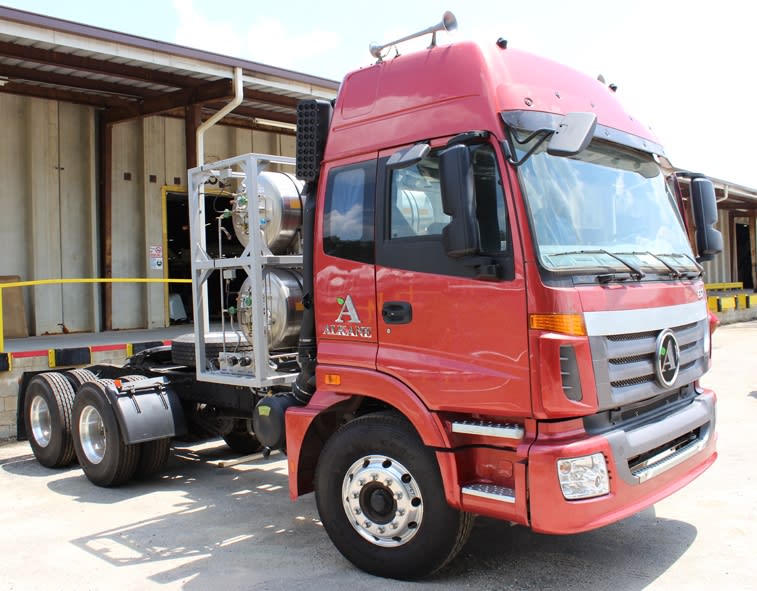
This Alkane prototype heavy tractor has a Cummins ISX12 G and Eaton UltraShift transmission. Its LNG system might be changed to easier-to-handle CNG. Photo: Alkane
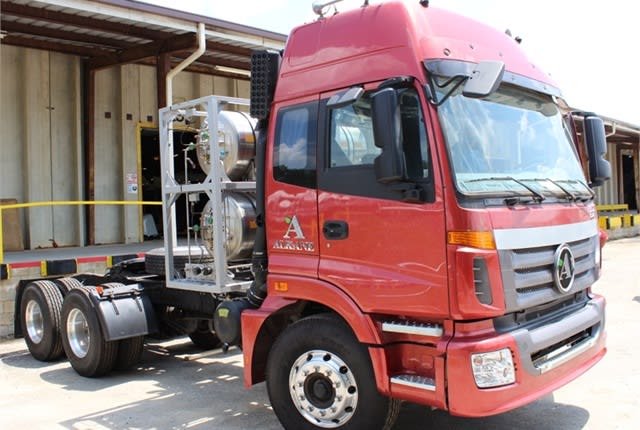
This Alkane prototype heavy tractor has a Cummins ISX12 G and Eaton UltraShift transmission. Its LNG system might be changed to easier-to-handle CNG. Photo: Alkane
An American start-up manufacturer has begun using Chinese-made glider kits for a line of medium- and heavy-duty alternative-fueled trucks for North America. It could be the first employment of Chinese commercial vehicles in the U.S., but they are only a means to an end for the new firm, Alkane Truck Co.
Alkane-brand cabover trucks will be based on Daimler Foton engineless gliders that are being shipped to the Port of Charleston, S.C., and then to a nearby “integration” plant. There workers will install propane and natural gas engines and fuel systems, and automatic or automated manual transmissions, said Steve Rayborn, the firm‘s national sales director.
He is one of a small team of people who founded the company in Myrtle Beach, S.C., about four years ago, and has been planning the products and how to market them. The low cost of alternative fuels prompted the decision to offer only propane and natural gas-powered trucks.
“We will be a niche marketer, and we don’t need to sell even 10,000 trucks a year to be a success,” Rayborn said. American and Canadian dealers representing 120 locations have signed memoranda of understanding contingent on their inspection of and satisfaction with production trucks.
He and Bob Smith, the company’s CEO, have varied business backgrounds but no experience in truck manufacturing, Rayborn said. They have hired experts to manage engineering, the acquisition of name-brand domestic components needed for the trucks, and the production of them.
Alkane will field P-33 Class 7 trucks using Power Solutions International 8.8-liter V-8 engines with propane fuel systems from Bi-Phase Technologies, an arm of Schwan’s Food Service, a user of propane since the 1970s. Allison 2000 and 3000 series automatic transmissions will send power to rear axles, which are included in the Foton gliders.
Also in the catalog is a P-26 model, which would be offered to those who wish to avoid CDL requirements for operators. It would be a P-33 with lower rated axles and other chassis equipment, and would stay at the heavy end of Class 6.
A yet unnamed Class 8 model will use the Cummins ISX12 G natural gas engine and an Eaton UltraShift automated gearbox. A prototype has a liquefied natural gas system, but Alkane might start production with compressed natural gas systems because more fleets have begun using it and more CNG stations now exist.
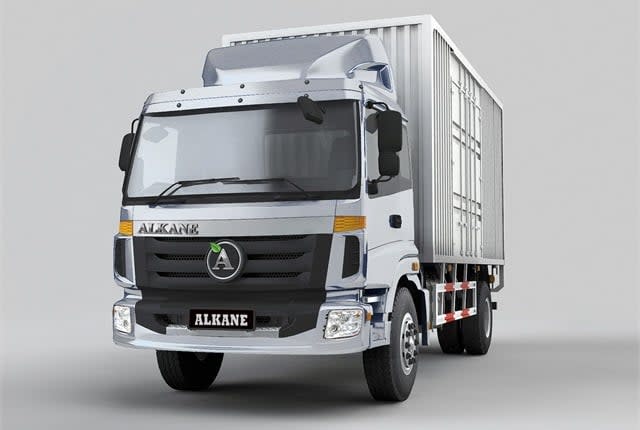
P-33 Class 7 truck has PSI V-8 engine with Bi-Phase propane fuel system, and an Allison transmission. Photo: Alkane
For medium-duty models, “We chose propane autogas because it’s the most-used alternative fuel in the world, and has the most filling stations in the U.S. – 2,700,” he said. “We can turn customers onto a variety of propane marketers, like Ferrellgas and Suburban, and they will put in a tank free and then wholesale the propane to the fleet.”
Triad Services Group of suburban Detroit assisted in designing the trucks and is managing the integration and assembly operations for the South Carolina plant. It is now being staffed and Rayborn expects that 60 employees will work there. Full production should begin in 60 to 90 days.
Part of the work at the plant will be to change the Chinese cabs’ window glass and lighting fixtures because they do not meet American performance standards, Rayborn said. They will be replaced with domestic products.
Alkane trucks will be displayed at the major truck shows early next year. Niche markets for the trucks include propane, beverage and snack delivery, Rayborn said. He has made contacts with major private fleets whose managers are interested in or already using alternative fuels.
“What we have found is that there is no one fuel, so we have to be ready to change,” he said. “We can do that quickly because we’re a small group of businessmen, not a big, bureaucratic corporation.” In addition to him and Smith, the company’s website (www.alkanetruckcompany.com) lists two other executives plus communications specialists.
The team picked Alkane as the company’s name because it’s in the Periodic Table of the Elements, where it comprises gaseous fuels, including propane and natural gas.
More Fuel Smarts

How Volvo Updated Its D13 for EPA 2027 [Watch]
Volvo’s updated D13 promises lower emissions without sacrificing performance or fuel economy. Take a closer look at what changed inside the engine in this HDT Spotlight video.
Read More →
Diesel Price Spike Shortens Payback for Natural Gas Trucks, Report Says
Energy Vision estimates fleets could recover the higher purchase price of an RNG-fueled Class 8 tractor in 1.3 to 2.8 years under current fuel-price scenarios.
Read More →
Calstart Becomes Catalyst Mobility, Reflecting Broader Focus
Calstart is now Catalyst Mobility, reflecting the nonprofit’s growing national role in clean transportation, including zero-emission trucks, infrastructure and incentive programs.
Read More →

Record Diesel Prices Squeeze Trucking Fleets
Average U.S. diesel prices have climbed to nearly $6 a gallon, surpassing the 2022 record as tight refinery capacity and Middle East disruptions keep fuel costs elevated.
Read More →
How Fuel Delivery Shapes Engine Performance
Fuel delivery depends on more than what happens at the injector. For fleet, maintenance and technical professionals, looking at the full path from pump to injector can provide useful context for understanding engine performance.
Read More →
East Coast Port Launches $45M Electric Truck Push
The Port Authority of New York and New Jersey announced millions in incentives for zero-emission drayage trucks, yard tractors, and new charging hubs near the port.
Read More →
California Bill Could Shed Light on Electric Truck Prices
Why do battery-electric Class 8 trucks remain so expensive? A California bill headed to Gov. Gavin Newsom would give fleets and state agencies more visibility into what manufacturers charge.
Read More →
Detroit Opens Orders for EPA 2027 Engines
Detroit isn’t starting from scratch to meet EPA 2027 diesel emissions standards. Its Gen 6 DD13 and DD15 engines keep much of today’s platform while updating the fuel and aftertreatment systems.
Read More →
Zero-Emission Truck Corridor Planned for West Coast
California, Oregon, Washington, British Columbia and Baja California are coordinating plans for truck charging and hydrogen fueling from Canada to Mexico.
Read More →
A Closer Look at Kenworth’s Electric T880E Vocational Truck [Video]
Learn more about Kenworth's T880E battery-electric vocational truck at the Paccar Technical Center, including its range, applications, upfitting considerations, and PTO options, in this HDT Spotlight video.
Read More →