




Chevy Unveils City Express Van, Expands Silverado HD Bi-Fuel Offerings
CNG-gasoline capability will be available in all cab and pickup bed sizes in 2500 and 3500 HD series, while compact van offers economy and cargo-carrying capability, GM says.

Chevy City Express will compete against Nissan’s NV200, on which the new small Chevy van is based, and against Ford’s Transit Connect.

Chevy City Express will compete against Nissan’s NV200, on which the new small Chevy van is based, and against Ford’s Transit Connect.
Chevrolet unveiled its compact City Express van and announced more bi-fuel versions of its Silverado Heavy Duty pickups, and is displaying them at the Chicago Auto Show.
The 2015 Silverado and GMC Sierra HD’s bi-fuel, gasoline-compressed natural gas offerings will be available in all cab configurations, short and long box and two- and four-wheel drive models, in 2500HD and 3500HD series, the company says. It was introduced last year only as a 2500HD crew-cab 4x4.
General Motors’ 6-liter V-8 with hardened valves and valve seats enables the vehicle to operate on gasoline or compressed natural gas.
A separate CNG fuel tank enables the driver to switch between fuels at the flip of a switch. When the CNG tank is depleted, the system automatically switches to gasoline.
The Chevrolet and GMC bi-fuel pickups have a standard combined gasoline-CNG range of more than 650 miles, GM officials say.
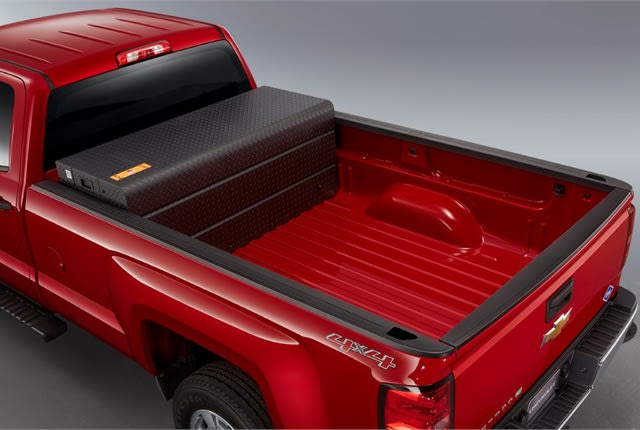
GM’s bi-fuel option puts the CNG tank in a bed box. Gasoline tank remains below, between the frame rails.
With CNG currently priced about 62% less per gallon than gasoline, a work truck driven 26,000 miles a year can realize a fuel-cost savings of more than $2,000 annually, based on 75% CNG usage and comparable efficiency to gasoline, GM officials say.
The bi-fuel pickup trucks are available to order for both retail and commercial customers through Chevrolet and GMC dealers.
City Express
The City Express is Chevrolet’s first entry into the small van segment, and owners will benefit from service and support from 3,000 Chevy dealers, company officials are saying.
The van will be aimed at small businesses like retail and wholesale merchants, tradesmen, computer services people, and food delivery operations.
Division execs are immediately claiming that the Nissan-made compact van compares favorably to Ford’s Transit Connect van, its main competitor, and even the Nissan NV200, from which it’s derived.
City Express features include a 36.7 ft. turning diameter makes for nimble maneuvering on tight city streets. A 2-liter 16-valve dual overhead camshaft 4-cylinder engine rated at 131 horsepower and 139 pound-feet of torque, and is matched with a responsive and efficient continuously variable transmission.
The powertrain is covered by a 5 year/100,000 mile powertrain warranty. The van also will come with a 3-year/36,000 bumper-to-bumper warranty and Chevrolet’s Complete Care, which includes 2-year/24,000 mile scheduled maintenance and roadside assistance.
The cargo area has 122.7 cubic feet of volume, and can be customized with bin and shelf packages to suit the specific needs of the customer. Six standard D-rings are affixed to the interior floor to secure cargo and there are six exterior roof rack mounting points.
Dual sliding side doors and 60-40 rear swing doors allow easy access to cargo. Floor height is less than 22 inches for easy loading and unloading.
The City Express can transform into a mobile office with a center console that can store a laptop and hanging folders, a passenger seat that folds flat to create a worktop space and a 12-volt power outlet for easy charging.
The City Express van will be at dealers this fall.
More Fuel Smarts

How Volvo Updated Its D13 for EPA 2027 [Watch]
Volvo’s updated D13 promises lower emissions without sacrificing performance or fuel economy. Take a closer look at what changed inside the engine in this HDT Spotlight video.
Read More →
Diesel Price Spike Shortens Payback for Natural Gas Trucks, Report Says
Energy Vision estimates fleets could recover the higher purchase price of an RNG-fueled Class 8 tractor in 1.3 to 2.8 years under current fuel-price scenarios.
Read More →
Calstart Becomes Catalyst Mobility, Reflecting Broader Focus
Calstart is now Catalyst Mobility, reflecting the nonprofit’s growing national role in clean transportation, including zero-emission trucks, infrastructure and incentive programs.
Read More →

Record Diesel Prices Squeeze Trucking Fleets
Average U.S. diesel prices have climbed to nearly $6 a gallon, surpassing the 2022 record as tight refinery capacity and Middle East disruptions keep fuel costs elevated.
Read More →
How Fuel Delivery Shapes Engine Performance
Fuel delivery depends on more than what happens at the injector. For fleet, maintenance and technical professionals, looking at the full path from pump to injector can provide useful context for understanding engine performance.
Read More →
East Coast Port Launches $45M Electric Truck Push
The Port Authority of New York and New Jersey announced millions in incentives for zero-emission drayage trucks, yard tractors, and new charging hubs near the port.
Read More →
California Bill Could Shed Light on Electric Truck Prices
Why do battery-electric Class 8 trucks remain so expensive? A California bill headed to Gov. Gavin Newsom would give fleets and state agencies more visibility into what manufacturers charge.
Read More →
Detroit Opens Orders for EPA 2027 Engines
Detroit isn’t starting from scratch to meet EPA 2027 diesel emissions standards. Its Gen 6 DD13 and DD15 engines keep much of today’s platform while updating the fuel and aftertreatment systems.
Read More →
Zero-Emission Truck Corridor Planned for West Coast
California, Oregon, Washington, British Columbia and Baja California are coordinating plans for truck charging and hydrogen fueling from Canada to Mexico.
Read More →
A Closer Look at Kenworth’s Electric T880E Vocational Truck [Video]
Learn more about Kenworth's T880E battery-electric vocational truck at the Paccar Technical Center, including its range, applications, upfitting considerations, and PTO options, in this HDT Spotlight video.
Read More →