




Chao Pitches Private Infrastructure Investment in Confirmation Hearing
During her Senate confirmation hearing on Jan. 11, Elaine Chao unequivocally signaled her willingness to cooperate with Congress to enact the trillion-dollar infrastructure investment plan floated by President-elect Trump if she is indeed confirmed as the next secretary of transportation.

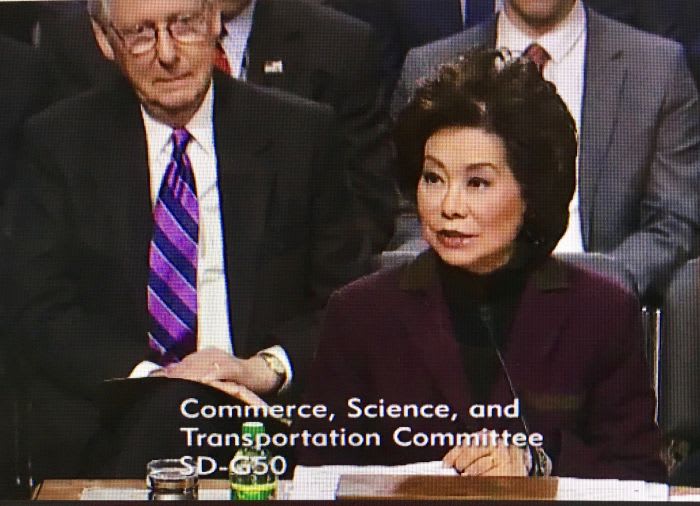
Elaine Chao at her Jan. 11 confirmation hearing. Looking on is her husband, Senate Majority Leader Mitch McConnell. Screenshot via Senate Commerce Committee
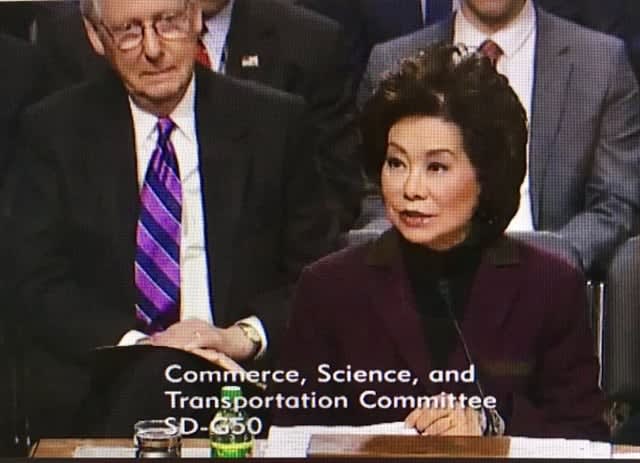
Elaine Chao at her Jan. 11 confirmation hearing. Looking on is her husband, Senate Majority Leader Mitch McConnell. Screenshot via Senate Commerce Committee
During her Senate confirmation hearing on Jan. 11, Elaine Chao unequivocally signaled her willingness to cooperate with Congress to enact the trillion-dollar infrastructure investment plan floated by President-elect Trump if she is indeed confirmed as the next secretary of transportation.
In her written testimony and in reply to questions posed by Senators from both sides of the aisle, Secretary Chao advocated strongly for “unleashing the potential for private investment in our nation’s infrastructure.”
Chao also affirmed that safety would remain DOT’s “primary objective” on her watch and asserted that, in her view, regularity decisions should be “based on sound science with solid underlying data.”
From start to finish of her three-and-a-half hour appearance before the Senate Commerce Committee, Chao was poised and certain in her remarks, as might be expected from someone who has already held Cabinet rank. Chao served as secretary of labor throughout both terms of President George W. Bush; she received her first major executive appointment as deputy secretary of transportation under President George H.W. Bush.
Members from both side of the aisle on the committee, which is known for its bipartisan bonhomie, lobbed little more than softballs at Chao and were largely satisfied with her oft-repeated response to one concern or another that she would “look forward to working with you on that if I am confirmed as secretary.”
Early in the hearing, Chao said she would form a task force to implement the “Trump vision for infrastructure.” She had no details to share on the Trump infrastructure plan. However, Chao stressed that she would seek to have DOT work with Congress to “develop the details” of that still nebulous plan.
More significantly, Chao emphasized the “significant difference between traditional program funding and other innovative financing tools, such as public-private partnerships.” Chao said getting private capital flowing into infrastructure projects will require “incentivizing” equity firms, pension funds, and endowments to invest in “a bold new vision” for building highways and other infrastructure.
She spoke of creating “a mix of practical solutions—both public and private-- that provide the greatest cost-benefit to the public. It’s also important to recognize that the way we build and deliver projects is as important as how much we invest. We want to seek your advice in identifying and addressing unnecessary bottlenecks" that affect transportation projects.
Referring to DOT’s primary goal of ensuring safe transportation, Chao said that necessary regulations needed to be “derived from sound science and data with risk-based analysis that prevents accidents before they happen” and that weighs both costs and benefits.
Chao also commented on emerging transportation technologies. She applauded the private sector for driving such innovative developments as drones and both autonomous cars and trucks. She said DOT should work with Congress “to position the federal government as a catalyst for safe, efficient technologies, not as an impediment.”
Summing up, Chao said she sees DOT as being responsible for “modernizing our transportation systems, strengthening our country’s competitiveness, and improving our quality of life.”
“To my colleagues, I would say that, if you were to imagine an ideal candidate to tackle these challenges, it would be hard to come up with a more qualified nominee than the one before us,” said Committee Chairman John Thune (R-SD) in his opening remarks at Chao’s hearing.
More Fleet Management

Why Private Fleets Are Taking More Freight
Private fleets are putting their own trucks on demanding customers and high-cost lanes as companies seek greater control over service, costs, and capacity.
Read More →
Color Match Smarter: Tools That Restore & Perform
For fleet managers and collision repair professionals keeping heavy-duty trucks on the road, getting the color right the first time isn't just about appearance — it's about efficiency, turnaround time, and bottom-line results. Discover how today's digital color tools are transforming the repair process from guesswork to precision.
Read More →
FMCSA Pauses Biennial-Update Enforcement Amid Motus Transition
Carriers whose updates were due on or after June 1 have more time, while FMCSA works to stabilize its new registration system and warns of phishing sites impersonating its new carrier registration system, Motus.
Read More →


2026 Blueprint for Countering Smarter Supply Chain Theft
Cargo theft is no longer just the cost of doing business. It's a multi-billion-dollar criminal enterprise exploiting vulnerabilities across your fleet, drivers, and supply chain.
Read More →
How Telematics Improves Visibility, Control, and Performance in Refrigerated Fleets
Explore how telematics help refrigerated fleets improve visibility, uptime, efficiency, compliance, and cargo protection across connected cold chain operations.
Read More →
What the U.S.-Canada Trade War Means for Trucking
Escalating U.S.-Canada tariffs could disrupt cross-border freight, reduce truck volumes, raise costs, and create new uncertainty for carriers on both sides of the border.
Read More →
What Are Trucking’s Top Concerns for 2026?
The American Transportation Research Institute wants to know what's worrying trucking fleet managers, drivers, and other stakeholders in its annual Industry Issues survey.
Read More →
American Trucking Associations Looks for a New Leader
ATA President and CEO Chris Spear abruptly left his job at the association on August 21, at a pivotal time for the trucking industry.
Read More →
Public Wi-Fi Cybersecurity Risks: How Truck Drivers and Fleets Can Protect Their Data
Public Wi-Fi can expose truck drivers and fleets to credential theft, malware, and other cyber threats. Here’s how to reduce the risk on the road.
Read More →
For Nicky Cupp, Fleet Innovation Starts With Frustration
HDT Truck Fleet Innovator Nicky Cupp turns everyday pain points at Fraley & Schilling into opportunities for better technology and smarter processes.
Read More →