




Celadon Faces Stock Delisting, Must Restate Financial Results
Troubles continue to mount for Indiana-based trucking company Celadon Group Inc. after it launched an internal investigation into its accounting practices nearly a year ago.


Celadon 2014 file photo
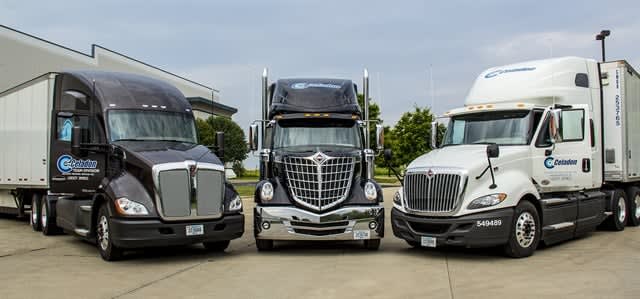
Celadon 2014 file photo
Troubles continue to mount for Indiana-based trucking company Celadon Group Inc. after it launched an internal investigation into its accounting practices nearly a year ago. Celadon’s stock will be delisted from the New York Stock Exchange after the company announced the accounting errors are so extensive that it will have to restate its financial results going back to 2014 and will not be able to issue revised results by an NYSE deadline.
Last May, Celadon’s auditor raised questions about its finances, especially those involving a joint venture and the sale of leased equipment.
At that time Celadon said financial statements for 2016, when the deal with completed, could no longer be relied upon. This week it announced the internal investigation and management review have identified errors that will require adjustments to the previously issued 2014, 2015, 2016, and 2017 financial statements.
“The income statement impacts relating to these adjustments are expected to reduce net income before income taxes by a range of $200 million-$250 million cumulatively over the three-year period ended June 30, 2016,” Celadon said this week in a statement. “In addition to considering the impact on these periods, the company is reviewing the impact for the first two quarters of 2017.”
Most of the accounting adjustments relate to equipment sales that took place between former Celadon subsidiary Quality Cos. and 19th Capital, a joint venture between Celadon and the Pennsylvania-based private equity firm Larsen MacColl Partners, according to the Indiana Business Journal. Also involved was another joint venture formed by Celadon and Canada-based Element Fleet Management.
Since that time, Celadon has disposed of Quality Cos., and most of the company’s senior leadership team has been replaced.
In the meantime, trading in Celadon stock has been halted, with it closing at $3.45 per share on Monday, the last day it was traded. That’s down from a 52-week high of $8.53 per share a little more than $27 per share nearly three years ago.
Before this week’s developments, the financial information website Seeking Alpha said Celadon’s stock was worthless.
The Wall Street Journal reported this week Celadon had about $380.5 million in total debt as of December 2016, the latest date for which figures are available, and about $136.7 million in liquidity, according to information it obtained.
Celadon has not publicly reported its earnings since it did so for the final quarter of 2016 in February 2017.
At least two law firms announced they are launching their own investigations into Celadon to determine whether previous management may have issued materially misleading business information to the investing public.
Last October, Celadon announced it was under investigation by the Securities Exchange Commission.
At one time it was estimated Celadon was the 33rd largest for-hire carrier in the U.S. based on annual 2017 revenue of a little more than $1 billion, with 6,000 employees, 7,050 tractors and 15,000 trailers, according to Transport Topics newspaper’s rankings. This week the company said it has cut its domestic truckload division fleet size by 20% to approximately 1,900 seated tractors, excluding those it owns but run under a banner other than Celadon. Last year it got out of the driver training business and sold its flatbed division.
Company founder Steve Russell died in April 2016 at age 76 after stepping away earlier from the business, which he started in 1985.
More Fleet Management

Color Match Smarter: Tools That Restore & Perform
For fleet managers and collision repair professionals keeping heavy-duty trucks on the road, getting the color right the first time isn't just about appearance — it's about efficiency, turnaround time, and bottom-line results. Discover how today's digital color tools are transforming the repair process from guesswork to precision.
Read More →
FMCSA Pauses Biennial-Update Enforcement Amid Motus Transition
Carriers whose updates were due on or after June 1 have more time, while FMCSA works to stabilize its new registration system and warns of phishing sites impersonating its new carrier registration system, Motus.
Read More →
2026 Blueprint for Countering Smarter Supply Chain Theft
Cargo theft is no longer just the cost of doing business. It's a multi-billion-dollar criminal enterprise exploiting vulnerabilities across your fleet, drivers, and supply chain.
Read More →


How Telematics Improves Visibility, Control, and Performance in Refrigerated Fleets
Explore how telematics help refrigerated fleets improve visibility, uptime, efficiency, compliance, and cargo protection across connected cold chain operations.
Read More →
What the U.S.-Canada Trade War Means for Trucking
Escalating U.S.-Canada tariffs could disrupt cross-border freight, reduce truck volumes, raise costs, and create new uncertainty for carriers on both sides of the border.
Read More →
What Are Trucking’s Top Concerns for 2026?
The American Transportation Research Institute wants to know what's worrying trucking fleet managers, drivers, and other stakeholders in its annual Industry Issues survey.
Read More →
American Trucking Associations Looks for a New Leader
ATA President and CEO Chris Spear abruptly left his job at the association on August 21, at a pivotal time for the trucking industry.
Read More →
Public Wi-Fi Cybersecurity Risks: How Truck Drivers and Fleets Can Protect Their Data
Public Wi-Fi can expose truck drivers and fleets to credential theft, malware, and other cyber threats. Here’s how to reduce the risk on the road.
Read More →
For Nicky Cupp, Fleet Innovation Starts With Frustration
HDT Truck Fleet Innovator Nicky Cupp turns everyday pain points at Fraley & Schilling into opportunities for better technology and smarter processes.
Read More →
Adam Buttgenbach’s Approach to Electric Trucks: Start With Where They Fit
HDT Truck Fleet Innovator Adam Buttgenbach helped PepsiCo build one of North America’s largest EV fleets by focusing on where electric trucks make operational sense.
Read More →