




Cass Freight Index Shows ‘Turmoil’
Some freight is having trouble entering the country and moving quickly to final end users while, the “transportation ecosystem is finding itself in turmoil” as freight shipments, particularly imports, climb in anticipation of a stronger holiday shopping season this year.

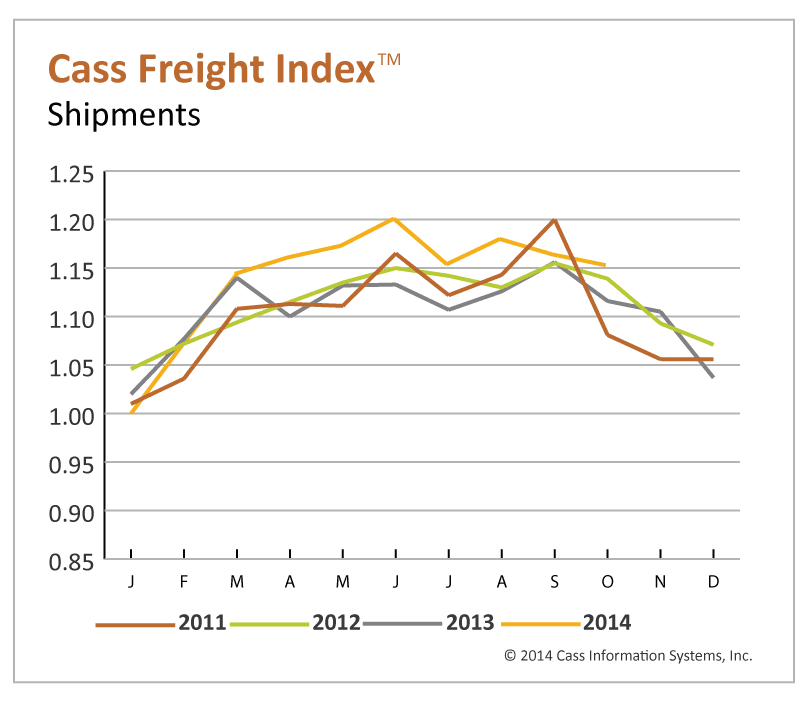
Graphic: Cass Information Systems
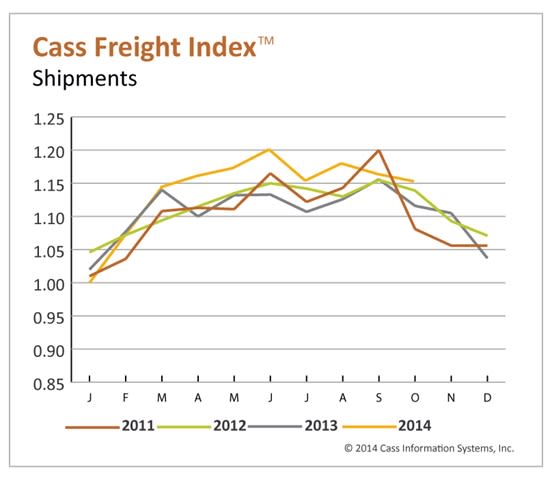
Graphic: Cass Information Systems
Some freight is having trouble entering the country and moving quickly to final end users while, the “transportation ecosystem is finding itself in turmoil” as freight shipments, particularly imports, climb in anticipation of a stronger holiday shopping season this year.
That’s the analysis of the U.S. freight market accompanying the just released Cass Freight Index for October, showing domestic freight shipment activity dipped again last month, while total freight spending rose slightly.
On the shipment activity side, the overall number of shipments fell another 0.9% from September to October, following a 1.4% decline in August to September reported a month ago. “The slide can be attributed to the [West Coast] port congestion and to a drop in new orders for manufactured goods in September,” said Rosalyn Wilson, supply chain expert, and senior business analyst with the management services firm Parsons, who provides analysis for the report.
When it comes to freight expenditures, the October freight payment index rose 0.1%, somewhat lower than the 0.8% rise last month.
Much of the reason for the decline, said Wilson, is diesel fuel prices continue to plummet, reducing the impact of fuel surcharges on carriers’ linehaul rates. She noted October 2014 freight expenditures are 6.4% higher than the same month a year ago and 11.8% higher than December 2013.
“Freight rates are finally starting to move and shippers are pushing back, but in most cases they have no choice but to accept the rate hikes due to parallel capacity issues,” Wilson said. “Most of the small parcel carriers have announced substantial rate increases in advance of the holiday season. With the scarcity of equipment and drivers, rates have only one way to move.”
Wilson goes on to characterize the nation’s freight transportation system as being turmoil due in large part to congestion and a slowdown that began in October and continues into the current month when it comes to moving freight out of the Ports of Los Angeles and Long Beach, which handle more than 40% of U.S. ocean imports.
“The underlying problem is primarily supply issues. Trucks, especially drayage trucks, are in short supply as the profitability of that segment continues to fall,” Wilson said. “But perhaps an even larger problem is a serious lack of chassis on which to move the containers from the ports to distribution centers and stores.”
According to Wilson the ports of New York/New Jersey, Houston and Norfolk are also experiencing congestion problems, though not as severe as L.A. and Long Beach. A contributing issue is the larger ships that bring more containers in a condensed time frame this time of year, as the current level of handling equipment is unable to keep pace.
“These larger vessels can be up to one-third larger than the vessels that arrived at Los Angeles and Long Beach just a few years ago. Drayage carriers are also reporting that they can make fewer turns because of the congestion,” Wilson said. “Truckers have reported waiting hours in line to pick up a container, only to find that no chassis is available to move the container out of the port."
She noted the lack of a contract for port workers represented by the International Longshore and Warehouse Union with ocean shipping companies is contributing to the slowdowns on the West Coast “as communication between parties has degenerated to trading barbs in the media.”
Data in the Cass Freight Index includes all domestic freight modes and is derived from $23 billion in freight transactions processed by Cass Information Systems annually on behalf of its client base of hundreds of large shippers.
More Fleet Management

Nominations Open for HDT Emerging Leaders
Heavy Duty Trucking is looking for accomplished trucking fleet professionals under 40 who are making an impact and helping lead the industry forward.
Read More →
Why Private Fleets Are Taking More Freight
Private fleets are putting their own trucks on demanding customers and high-cost lanes as companies seek greater control over service, costs, and capacity.
Read More →
Color Match Smarter: Tools That Restore & Perform
For fleet managers and collision repair professionals keeping heavy-duty trucks on the road, getting the color right the first time isn't just about appearance — it's about efficiency, turnaround time, and bottom-line results. Discover how today's digital color tools are transforming the repair process from guesswork to precision.
Read More →


FMCSA Pauses Biennial-Update Enforcement Amid Motus Transition
Carriers whose updates were due on or after June 1 have more time, while FMCSA works to stabilize its new registration system and warns of phishing sites impersonating its new carrier registration system, Motus.
Read More →
2026 Blueprint for Countering Smarter Supply Chain Theft
Cargo theft is no longer just the cost of doing business. It's a multi-billion-dollar criminal enterprise exploiting vulnerabilities across your fleet, drivers, and supply chain.
Read More →
How Telematics Improves Visibility, Control, and Performance in Refrigerated Fleets
Explore how telematics help refrigerated fleets improve visibility, uptime, efficiency, compliance, and cargo protection across connected cold chain operations.
Read More →
What the U.S.-Canada Trade War Means for Trucking
Escalating U.S.-Canada tariffs could disrupt cross-border freight, reduce truck volumes, raise costs, and create new uncertainty for carriers on both sides of the border.
Read More →
What Are Trucking’s Top Concerns for 2026?
The American Transportation Research Institute wants to know what's worrying trucking fleet managers, drivers, and other stakeholders in its annual Industry Issues survey.
Read More →
American Trucking Associations Looks for a New Leader
ATA President and CEO Chris Spear abruptly left his job at the association on August 21, at a pivotal time for the trucking industry.
Read More →
Public Wi-Fi Cybersecurity Risks: How Truck Drivers and Fleets Can Protect Their Data
Public Wi-Fi can expose truck drivers and fleets to credential theft, malware, and other cyber threats. Here’s how to reduce the risk on the road.
Read More →