




Cass Freight Index Posts November Drop, 2014 Still Looks Strong
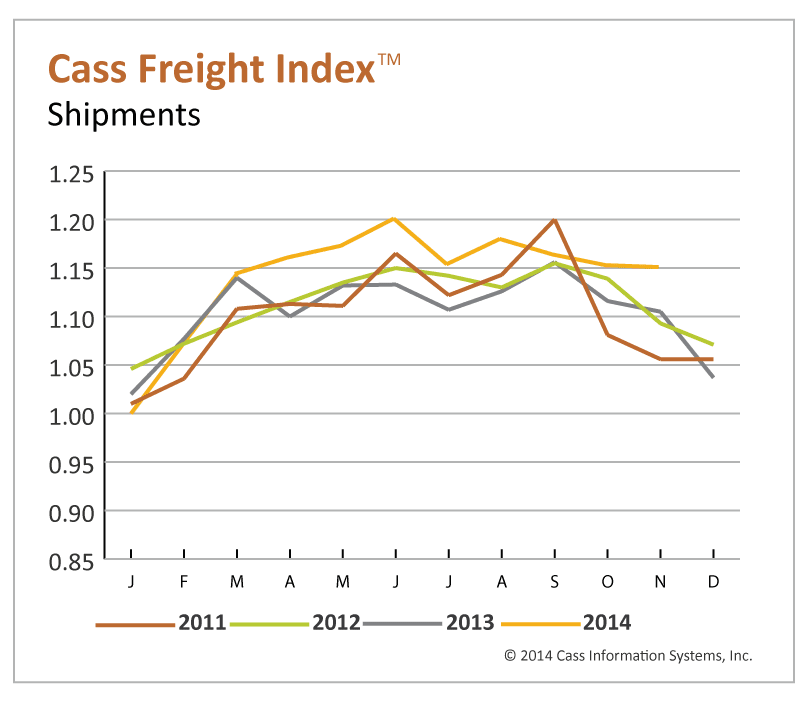
The newly released November Cass Freight Index shows a drop in total freight expenditures of 0.7% and a corresponding decline in shipment volumes of 0.2%, however the level was higher than expected, pointing to strong finish for 2014.
Graphic: Cass Information Systems
Graphic: Cass Information Systems
The newly released November Cass Freight Index shows a drop in total freight expenditures of 0.7% and a corresponding decline in shipment volumes of 0.2%, however the level was higher than expected, pointing to strong finish for 2014.
The index measures trends in North American shipping activity based on $23 billion in paid freight expenses for Cass' customer base of hundreds of large shippers.
“This was not unexpected given the fact that retailers stocked up early in anticipation of problems at the West Coast ports,” said Rosalyn Wilson, supply chain expert, and senior business analyst with the management services firm Parsons, who provides analysis for the report..“While November is generally a slower month for freight movement, the last several years have shown dramatic drop-offs in November. So, in context, this slight downward shift is an encouraging improvement that is helping to cap off a good year for freight.”
According to her, the drop in the number of freight shipments is the third since August, but is not cause for alarm.
“In fact, the November shipment level remained 4.2% higher than the same month a year ago and represents the highest point on our shipments index since the Great Recession,” she said. “Inventories remain high, as many retailers placed orders early to avoid expected transportation problems with ports and truck capacity."
However, she noted that not all shippers were able to avoid deliveries to West Coast ports in November and they are experiencing three week or longer delays in receiving their goods.The reason is labor issues, chassis shortages and inefficient chassis distribution, port throughput limitations due to heavily loaded, larger ships, and rail capacity problems have combined to create costly freight bottlenecks at the ports of L.A., Long Beach and Oakland.
“In addition, early price discounting made a dent in traditional Black Friday sales figures and traffic,” said Wilson. “Lower gas prices were expected to fuel more spending, but consumers are still behaving conservatively and holding out for even further discounting”
She said the good news is “Cyber Monday” sales soared again this year, rising between 8.5% and 16% percent depending on the measure you follow. Also, the National Retail Federation still predicts overall holiday sales will rise 4.1% this year over 2013 and small package and parcel shippers, such as UPS and FedEx, have dramatically expanded their capacities to avoid the spate of late deliveries experienced last year.
Meantime, the 0.7% decline in the November freight payment index mirrors the drop in shipment volumes.
“Diesel fuel prices continue to impact rates, mitigating much of the increases announced recently,” said Wilson. “November 2014 payments are 5% higher than the corresponding month a year ago and remain close to the record high established in June of this year. Capacity was not as tight throughout much of the supply chain, with the exception of port-related traffic, so spot prices were down.”
As far as the overall picture, Wilson said the first eleven months of 2014 have shown this to be the best year for freight that we have experienced since the recession.
“Freight volumes are up and costs to move that freight are also trending up,” she said. “This is good news for the nation’s carriers in spite of the headwinds being battled, such as port congestion, throughput capacity, and port labor problems.”
On the downside, she also noted the long-term weather forecast for this winter does not look much better than last year, so the transportation system could be faced with the same problems the railroads faced in the Northwest last year. Also, Wilson said truck equipment and driver capacity have been barely adequate at times this year and will be inadequate for the continued growth expected in 2015.
“It remains to be seen how this year’s holiday season will shake out, but there is no doubt that consumers are spending again, both on goods and services,” Wilson said. “Unlike the last six years, the fourth quarter of 2014 is not going to show a precipitous slide downward, only the normal seasonal slowdown we experienced in the years prior to the recession. 2014 will prove to be the banner year that was predicted and 2015 should be looking at a strong start."
More Fleet Management

How Telematics Improves Visibility, Control, and Performance in Refrigerated Fleets
Explore how telematics help refrigerated fleets improve visibility, uptime, efficiency, compliance, and cargo protection across connected cold chain operations.
Read More →
What the U.S.-Canada Trade War Means for Trucking
Escalating U.S.-Canada tariffs could disrupt cross-border freight, reduce truck volumes, raise costs, and create new uncertainty for carriers on both sides of the border.
Read More →
What Are Trucking’s Top Concerns for 2026?
The American Transportation Research Institute wants to know what's worrying trucking fleet managers, drivers, and other stakeholders in its annual Industry Issues survey.
Read More →

American Trucking Associations Looks for a New Leader
ATA President and CEO Chris Spear abruptly left his job at the association on August 21, at a pivotal time for the trucking industry.
Read More →
Public Wi-Fi Cybersecurity Risks: How Truck Drivers and Fleets Can Protect Their Data
Public Wi-Fi can expose truck drivers and fleets to credential theft, malware, and other cyber threats. Here’s how to reduce the risk on the road.
Read More →
For Nicky Cupp, Fleet Innovation Starts With Frustration
HDT Truck Fleet Innovator Nicky Cupp turns everyday pain points at Fraley & Schilling into opportunities for better technology and smarter processes.
Read More →
Adam Buttgenbach’s Approach to Electric Trucks: Start With Where They Fit
HDT Truck Fleet Innovator Adam Buttgenbach helped PepsiCo build one of North America’s largest EV fleets by focusing on where electric trucks make operational sense.
Read More →
Deen Albert: Let Automation Do the Math, People Make the Decisions
HDT Truck Fleet Innovator Deen Albert makes sure people are still at the heart of operations at Grand Island Express, even while adopting artificial intelligence tools. AI-assisted dispatch helped boost revenue 25% with the same number of trucks.
Read More →
Trimble’s New AI Agent Takes Aim at Fleet Back-Office Busywork
Arc Agent works across Trimble TMS products to automate repetitive tasks such as freight orders, maintenance, invoices, fuel costs and more.
Read More →
How HDT’s 2026 Truck Fleet Innovators Are Rethinking Fleet Operations
Meet five trucking leaders who are challenging assumptions, solving operational problems, and putting innovative ideas to work.
Read More →