




Cass Freight Index Performing Well Despite December Decline
A new report shows freight shipments and expenditures in shipping fell in the final month of 2014 but posted gains for the entire year.
A new report shows freight shipments and expenditures in shipping fell in the final month of 2014 but posted gains for the entire year.
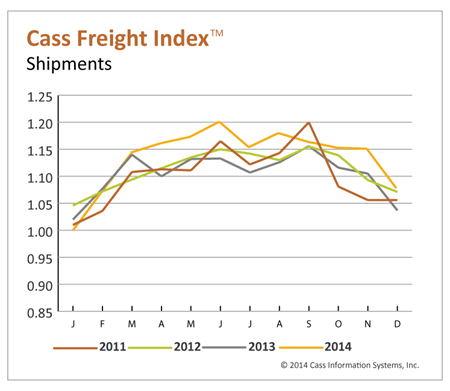
The December Cass Freight Index followed expected seasonal trends with a 6.3% drop in shipment volume from the month before and a 6.7% decline in freight spending. Despite the drops the December figures mark the highest end‐of‐year values for both indexes since the beginning of the recession in 2007.
The Cass Freight Index measures trends in North American shipping activity based on $23 billion in paid freight expenses for hundreds of large shippers.
While the number of North American freight shipments fell in December it was still 4% higher than the same period a year ago.
Despite the difficulties getting goods out of the ports of Los Angeles and Long Beach due to labor and capacity issues, both railroads and trucking companies posted shipment volumes that were significantly higher than for the same period in 2013, according to Rosalyn Wilson, supply chain expert, and senior business analyst with the management services firm Parsons, who provides analysis for the report.
The December freight expenditures decline reflected the drop in shipment volume and along with weaker spot freight prices while falling diesel fuel prices continue to lower freight costs, the she said. Additionally, the decline in volume relieved much of the pressure on capacity, which pushed down both the demand for trucks on the spot market and spot prices.
December expenditures were 3.6% higher than the corresponding month in 2013, according Wilson, while contract rates have been rising as carriers gain more pricing control, allowing them to pass on their increased costs, especially those for drivers.
“2014 proved to be the best year for the logistics industry in the now seven‐year recovery, with sustained growth in both freight volumes and revenues,” she said. “In fact, the industry’s performance in 2014 was markedly better that that of the previous two years. Freight rates have only recently begun to spike upward, especially spot market rates.”
Wilson said despite the gains in 2014, freight volume overall has not yet returned to prerecession values, however, costs to move the freight are substantially higher than 2006.
“The driver shortage is reaching the acute stage predicted since the recovery started. Even though the global economy is not growing as expected, the U.S. economy is expected to be even stronger in 2015, which will put more strain on carriers as volumes increase,” she said. “The trucking industry is ordering new equipment at record levels, but is finding it hard to train, seat and retain qualified drivers. Labor expenses other than driver pay and benefits are growing exponentially and will be passed through to customers in the form of rate increases.”
Given the banner year for the freight industry in 2014 and the strengthening of the underlying economy, Wilson predicted an even better year in 2015.
“Freight volumes and carrier revenues will grow steadily, which is good news for carriers operating on razor thin margins, less good for shippers and consumers as the higher rates will be passed through as increased goods costs,” she said.
More Fleet Management

How Telematics Improves Visibility, Control, and Performance in Refrigerated Fleets
Explore how telematics help refrigerated fleets improve visibility, uptime, efficiency, compliance, and cargo protection across connected cold chain operations.
Read More →
What the U.S.-Canada Trade War Means for Trucking
Escalating U.S.-Canada tariffs could disrupt cross-border freight, reduce truck volumes, raise costs, and create new uncertainty for carriers on both sides of the border.
Read More →
What Are Trucking’s Top Concerns for 2026?
The American Transportation Research Institute wants to know what's worrying trucking fleet managers, drivers, and other stakeholders in its annual Industry Issues survey.
Read More →

American Trucking Associations Looks for a New Leader
ATA President and CEO Chris Spear abruptly left his job at the association on August 21, at a pivotal time for the trucking industry.
Read More →
Public Wi-Fi Cybersecurity Risks: How Truck Drivers and Fleets Can Protect Their Data
Public Wi-Fi can expose truck drivers and fleets to credential theft, malware, and other cyber threats. Here’s how to reduce the risk on the road.
Read More →
For Nicky Cupp, Fleet Innovation Starts With Frustration
HDT Truck Fleet Innovator Nicky Cupp turns everyday pain points at Fraley & Schilling into opportunities for better technology and smarter processes.
Read More →
Adam Buttgenbach’s Approach to Electric Trucks: Start With Where They Fit
HDT Truck Fleet Innovator Adam Buttgenbach helped PepsiCo build one of North America’s largest EV fleets by focusing on where electric trucks make operational sense.
Read More →
Deen Albert: Let Automation Do the Math, People Make the Decisions
HDT Truck Fleet Innovator Deen Albert makes sure people are still at the heart of operations at Grand Island Express, even while adopting artificial intelligence tools. AI-assisted dispatch helped boost revenue 25% with the same number of trucks.
Read More →
Trimble’s New AI Agent Takes Aim at Fleet Back-Office Busywork
Arc Agent works across Trimble TMS products to automate repetitive tasks such as freight orders, maintenance, invoices, fuel costs and more.
Read More →
How HDT’s 2026 Truck Fleet Innovators Are Rethinking Fleet Operations
Meet five trucking leaders who are challenging assumptions, solving operational problems, and putting innovative ideas to work.
Read More →