




Cass Freight Index Mixed In September
The freight logistics sector was relatively flat in September, with a drop in North American shipment volume and a slight increase in total freight expenditures, or payments, according to the latest Cass Freight Index.

The freight logistics sector was relatively flat in September, with a drop in North American shipment volume and a slight increase in total freight expenditures, or payments, according to the latest Cass Freight Index.
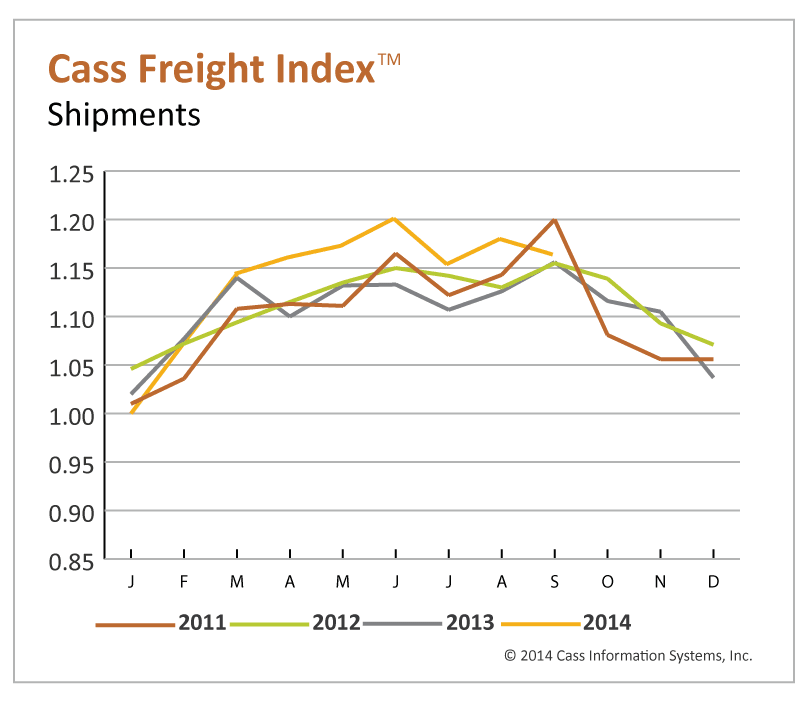
The number of shipments fell 1.4% in September compared to August levels, while compared to the same time a year earlier it was only 0.7% higher.
Since the end of 2013 the number of freight waybills has increased 12.2% according to Rosalyn Wilson, supply chain expert, who provides analysis for the report. She said this has recently been affected by new orders at U.S. factories falling 10.1% in August, the largest amount on record according to the U.S. Department of Commerce. But that is likely a short-term drop. This decline came on the heels of a record 10.5% increase in July, with almost all of these changes attributed to the commercial aircraft industry.
Wilson said the remaining sectors were largely unchanged in August, so the impact should be narrowly targeted on carriers moving aerospace materials. Other economic indicators affecting shipments are the Institute for Supply Chain Management’s Purchasing Managers Index falling 4.1% in September, a decline Wilson said is attributable to the recent drop in global demand and the relative strength of the U.S. dollar, which makes U.S.-produced goods more expensive overseas.
“Manufacturing slowed in August but inched back up in September, indicating that there should not be a dramatic fall‐off in freight as we have experienced in the final months of the last few years," she said. New export orders reached a four and a half-year high in China, supporting predictions of strong U.S. import activity to end the year.
Meantime, September freight expenditures index rose 0.8% from the month before, almost exclusively on increased tonnage. Diesel fuel prices have been falling since March, which reduced the fuel surcharges added to carriers’ linehaul rates and pushed down total expenditures for freight movement, according Wilson.
She noted September 2014 payments are 3.5% higher than the same month a year ago and 11.7% higher than December 2013. “It appears that for the last quarter we can expect a leveling off in freight shipment levels and more steady rates,” said Wilson.
Data in the Cass Freight Index includes all domestic freight modes and is derived from $23 billion in freight transactions processed by Cass annually on behalf of its client base of hundreds of large shippers.
According to Wilson, the freight industry continues to experience the strongest year since the recession ended, and while there are still headwinds, things should continue to improve for the industry.
“The rise in costs, especially related to labor, are pressing hard on rates and should break through in early 2015. The volume growth that has supported the strengthening in freight is still fragile and susceptible to outside forces,” she said. “Consumers, the missing key for recovery, are getting back in to the game. Consumer confidence and, more importantly, consumer spending have been on the rise along with household income. A good holiday season would be a big boost for the end of the year.”
By Evan Lockridge
More Fleet Management

Nominations Open for HDT Emerging Leaders
Heavy Duty Trucking is looking for accomplished trucking fleet professionals under 40 who are making an impact and helping lead the industry forward.
Read More →
Why Private Fleets Are Taking More Freight
Private fleets are putting their own trucks on demanding customers and high-cost lanes as companies seek greater control over service, costs, and capacity.
Read More →
Color Match Smarter: Tools That Restore & Perform
For fleet managers and collision repair professionals keeping heavy-duty trucks on the road, getting the color right the first time isn't just about appearance — it's about efficiency, turnaround time, and bottom-line results. Discover how today's digital color tools are transforming the repair process from guesswork to precision.
Read More →


FMCSA Pauses Biennial-Update Enforcement Amid Motus Transition
Carriers whose updates were due on or after June 1 have more time, while FMCSA works to stabilize its new registration system and warns of phishing sites impersonating its new carrier registration system, Motus.
Read More →
2026 Blueprint for Countering Smarter Supply Chain Theft
Cargo theft is no longer just the cost of doing business. It's a multi-billion-dollar criminal enterprise exploiting vulnerabilities across your fleet, drivers, and supply chain.
Read More →
How Telematics Improves Visibility, Control, and Performance in Refrigerated Fleets
Explore how telematics help refrigerated fleets improve visibility, uptime, efficiency, compliance, and cargo protection across connected cold chain operations.
Read More →
What the U.S.-Canada Trade War Means for Trucking
Escalating U.S.-Canada tariffs could disrupt cross-border freight, reduce truck volumes, raise costs, and create new uncertainty for carriers on both sides of the border.
Read More →
What Are Trucking’s Top Concerns for 2026?
The American Transportation Research Institute wants to know what's worrying trucking fleet managers, drivers, and other stakeholders in its annual Industry Issues survey.
Read More →
American Trucking Associations Looks for a New Leader
ATA President and CEO Chris Spear abruptly left his job at the association on August 21, at a pivotal time for the trucking industry.
Read More →
Public Wi-Fi Cybersecurity Risks: How Truck Drivers and Fleets Can Protect Their Data
Public Wi-Fi can expose truck drivers and fleets to credential theft, malware, and other cyber threats. Here’s how to reduce the risk on the road.
Read More →