




Cargo Theft Declines in 2014, Average Value Increases
Two separate reports show the number cargo thefts in the U.S. fell last year compared to 2013, but the average value of the heists increased.

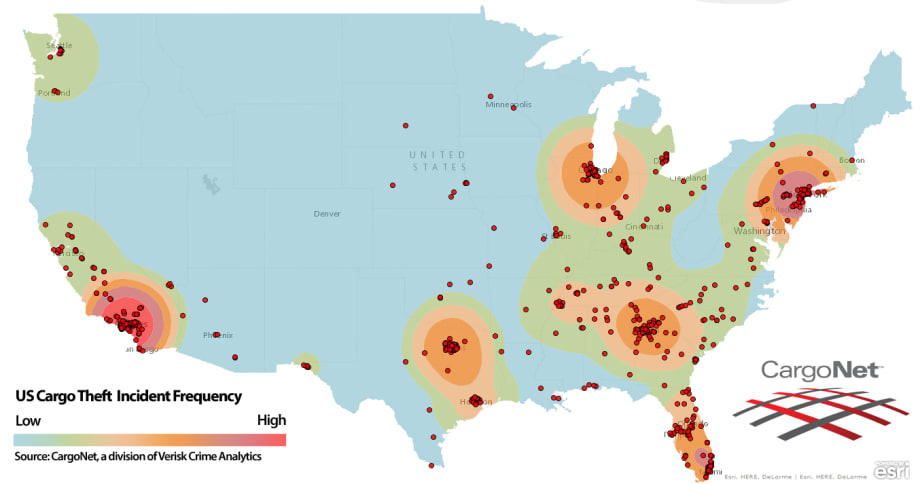
2014 U.S. cargo theft incident frequency. Graphic: CargoNet
2014 U.S. cargo theft incident frequency.Graphic: CargoNet
Two separate reports show the number cargo thefts in the U.S. fell last year compared to 2013, but the average value of the heists increased.
Cargo theft prevention and recovery service provider CargoNet said there were 844 cargo theft incidents last year, down sharply from 1,098 in 2013. Also, the average value per incident increased to $181,681.
For all of 2014, $89.5 million in stolen cargo in the U.S. was reported to CargoNet. Electronics losses were the costliest, with the average value at $549,539, and totaling more than $42 million for the year.
Cargo was most often stolen from warehouse locations, due in part to a significant amount of fraudulent pickups in the trucking industry, according to CargoNet. Truck stops were the second most common location, with 130 recorded. In 2014, Georgia recorded the most cargo thefts from truck stops with 26.
Meantime, a separate report from the logistics security services provider FreightWatch International showed the number of cargo theft was lower last year with 794, a 12% decline from 2013. The average value of each theft increased even more to $232,924, a 36% jump year-over-year.
The FreightWatch report said theft of high value electronics is the main reason the average loss for cargo thefts increased, due in large part to increased organization and innovation on the part of cargo thieves. One of the main reasons for continued cargo thefts is that cargo crime represents a lucrative criminal enterprise compared with activities yielding similar returns, such as armed bank robbery. Also penalties for cargo theft are modest when compared to other types of non-violent thefts.
In 2014, 87% of all thefts with a known location occurred within unsecured parking, most frequently being truckstops, with 42% of this total, according to FreightWatch, followed by thefts in public parking areas accounting for 23% and thefts at roadside making up a 15% share. Also, 90% of all cargo thefts in 2014 occurred when the truck was stationary and unattended.
The FreightWatch report also revealed after increasing from 2011 through 2013, the number of cargo theft by fictitious pickups (thieves posing as those who are supposed to pickup freight), fell in 2014 by 18% compared to 2013. It believes the drop is “an anomaly due to the fact that fictitious pickups are not always reported and are difficult to classify.”
The key hot spots for cargo thefts in the U.S. remained relatively unchanged last year from 2013, according to FreightWatch.
Florida, although dropping in total incident count, experienced an 8% uptick in its percentage of nationwide thefts, bringing it from third in 2013 into the top spot for 2014 with 21% of the total.
It was followed by California, through FreightWatch reported a shift in organized cargo activity from southern California to Washington State and the Pacific Northwest during the third quarter of last year. “While law enforcement entities confirmed this move, several arrests made in Washington appear to have hindered the ability of southern California thieves to operate at full capacity,” FreightWatch said in its report.
Rounding out the top five states for cargo thefts was Texas at number three, down from second place in 2013, followed by Georgia and New Jersey, while cargo theft activity in the New Jersey-Pennsylvania border region increased 38% since 2013.
As for expectations this year CargoNet is forecasting to see more than 200 cargo thefts in first-quarter 2015. So far, more than 120 incidents have been recorded and 9.5% have been high-value thefts in excess of $500,000.
More Fleet Management

Color Match Smarter: Tools That Restore & Perform
For fleet managers and collision repair professionals keeping heavy-duty trucks on the road, getting the color right the first time isn't just about appearance — it's about efficiency, turnaround time, and bottom-line results. Discover how today's digital color tools are transforming the repair process from guesswork to precision.
Read More →
FMCSA Pauses Biennial-Update Enforcement Amid Motus Transition
Carriers whose updates were due on or after June 1 have more time, while FMCSA works to stabilize its new registration system and warns of phishing sites impersonating its new carrier registration system, Motus.
Read More →
2026 Blueprint for Countering Smarter Supply Chain Theft
Cargo theft is no longer just the cost of doing business. It's a multi-billion-dollar criminal enterprise exploiting vulnerabilities across your fleet, drivers, and supply chain.
Read More →


How Telematics Improves Visibility, Control, and Performance in Refrigerated Fleets
Explore how telematics help refrigerated fleets improve visibility, uptime, efficiency, compliance, and cargo protection across connected cold chain operations.
Read More →
What the U.S.-Canada Trade War Means for Trucking
Escalating U.S.-Canada tariffs could disrupt cross-border freight, reduce truck volumes, raise costs, and create new uncertainty for carriers on both sides of the border.
Read More →
What Are Trucking’s Top Concerns for 2026?
The American Transportation Research Institute wants to know what's worrying trucking fleet managers, drivers, and other stakeholders in its annual Industry Issues survey.
Read More →
American Trucking Associations Looks for a New Leader
ATA President and CEO Chris Spear abruptly left his job at the association on August 21, at a pivotal time for the trucking industry.
Read More →
Public Wi-Fi Cybersecurity Risks: How Truck Drivers and Fleets Can Protect Their Data
Public Wi-Fi can expose truck drivers and fleets to credential theft, malware, and other cyber threats. Here’s how to reduce the risk on the road.
Read More →
For Nicky Cupp, Fleet Innovation Starts With Frustration
HDT Truck Fleet Innovator Nicky Cupp turns everyday pain points at Fraley & Schilling into opportunities for better technology and smarter processes.
Read More →
Adam Buttgenbach’s Approach to Electric Trucks: Start With Where They Fit
HDT Truck Fleet Innovator Adam Buttgenbach helped PepsiCo build one of North America’s largest EV fleets by focusing on where electric trucks make operational sense.
Read More →