




Cap-and-Trade Bill Slows in Senate
It appears unlikely that the Senate will complete work on its version of a cap-and-trade system to limit carbon emissions this year, despite pressure from the international community for the U.S. to address the issue before a global warming summi
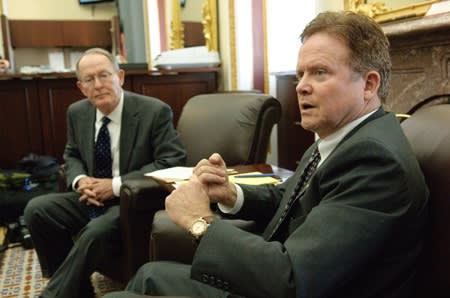
Senators Lamar Alexander (R-TN) and Jim Webb (D-VA) Monday introduced The Clean Energy Act of 2009, which abandons the cap-and-trade concept.
It appears unlikely that the Senate will complete work on its version of a cap-and-trade system to limit carbon emissions this year, despite pressure from the international community for the U.S. to address the issue before a global warming summit
in Copenhagen in December.
The Senate is considering a proposal by Sens. John Kerry, D-Mass., and Barbara Boxer, D-Calif., that is similar to a bill passed earlier this year by the House. The cap-and-trade mechanism would limit greenhouse gas emissions and set up a market in which emissions can be bought or sold. The idea is to make carbon-based energy more expensive in order to encourage investment in cleaner energy and promote more efficient use of energy, with the long-term objective of slowing global warming and decreasing U.S. dependence on foreign oil.
Strong opposition to the measure is slowing its progress. This week, Virginia Sen. Jim Webb and Tennessee Sen. Lamar Alexander introduced a new $20 billion energy bill that focuses on what they call "areas that are achievable," such as expanding nuclear power and funding research into alternative energy sources.
"This cap-and-trade is a turkey," said Sen. Kit Bond, R-Mo., at an October press conference. "I don't care how many gee gaws you put on it, that baby's never going to fly."
Trucking on Cap and Trade
Bond and Sen. Kay Bailey Hutchison, R-Texas, were unveiling a study that claims the Senate cap-and-trade proposal amounts to a $3.6 trillion fuel tax.
Also at the event was Barbara Windsor, President and CEO of Hahn Transportation. Windsor, who is First Vice Chairman of the American Trucking Associations and slated to become Chairman next October, said that cap-and-trade will not reduce trucking's carbon emissions because trucking is not a discretionary user of fuel.
"Proponents of an economy-wide cap and trade system believe that by increasing the price of fuel, fuel users will either purchase more fuel efficient vehicles or convert to alternative-fueled vehicles," she said. "These options are not currently available to the trucking industry in any meaningful manner."
Bond and Hutchison said their study shows the House cap-and-trade bill would impose a $2 trillion tax on gasoline, a $1.3 trillion tax on diesel and a $330 billion tax on aviation fuel, for the total of $3.6 trillion over 35 years. They said the Senate version of the bill would be even more expensive.
Winners and Losers
Neither is inclined to look for ways to work with a cap-and-trade system, mitigating its impact on core industries such as trucking and farming by carving out exceptions. It's the concept that's flawed, they said.
"When government gets in and tries to start picking winners and losers, who gets excepted, who doesn't, you're still going to wind up hitting people who should not be hit," said Sen. Bond.
Hutchison said it is hard to make exceptions because the proposal works by putting the cost of emissions on fuel refiners, who would have to pass that cost through to customers in trucking and elsewhere.
"We can improve the environment and economy through American ingenuity and technological advancement, not with taxes and mandates that increase costs and burden American families and businesses," Hutchison said.
More Drivers

From One Generation to the Next: How Mentorship Builds Safer Truck Drivers
After three decades in trucking, Harold Perry shares what he's learned about driver safety, mentorship, and helping the next generation build confidence behind the wheel.
Read More →
Truck Drivers Need More Than Another Alert
Fleets have more visibility into truck health, safety events, and driver activity than ever. The next challenge is turning all that information into useful guidance for the person who has to decide what to do next.
Read More →
FMCSA Removes 110 Truck Driver Training Schools from Certified ELDT List
Federal regulators also are targeting more than 160 additional training providers and launching a nationwide audit of third-party CDL skills testers as part of a broader crackdown on trucking fraud.
Read More →
Hours of Service Pilot Programs: FMCSA Readies for 2027 Rollout
Two pilot programs could eventually reshape hours-of-service rules, giving truck drivers options to pause their 14-hour clock or use longer split sleeper rest periods.
Read More →
Medical Cards, English Proficiency Reshape Roadcheck Violations
Medical-card violations jumped to the top of the driver out-of-service list during CVSA’s 2026 International Roadcheck, while English-language proficiency violations appeared among the leading violations for the first time.
Read More →
Driver Trust Can Make or Break the Success of Fleet Safety Technology
New Teletrac Navman research suggests that onboarding, transparency about driver data, and positive feedback can play a significant role in how commercial drivers respond to safety and coaching technology.
Read More →
EEOC Sues KLLM Over Alleged Sex Discrimination in Driver Training
KLLM is facing a federal sex-discrimination lawsuit over policies the EEOC alleges put female truck driver trainees at a disadvantage.
Read More →
FMCSA Moves to Codify English Language Requirements for Commercial Drivers
By changing regulations on English-language proficiency requirements for commercial drivers, rather than relying on a guidance memo, the FMCSA said future administrations won't be able to walk back the Trump administration's stricter enforcement with just a memo.
Read More →
Drivers Put Western Star Trucks to the Test at Star Nation Experience
Watch to get an inside look at the Western Star trucks, technology, and community behind the Star Nation Experience 2026!
Read More →
Trump Administration Looks to Put More Veterans Behind the Wheel
The Freedom Haulers program pulls together existing and expanded programs at several federal agencies to recruit veterans to drive commercial heavy-duty trucks and cut the red tape for them to get a CDL, training, and employment.
Read More →