




California Truckers Eye Clean Air Plans for Ports
Calling the current strategy to retrofit and replace trucks moving goods through the Ports of Los Angeles and Long Beach unfeasible, the California Trucking Association is pushing port officials to develop an alternative plan that will still meet emission goals.
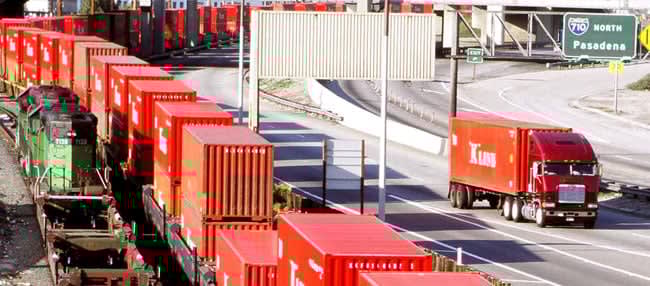
The Clean Air Action Plan targets PM, NOx, and SOx emissions from trucks operating in the southern California ports.
Photo: Port of Los Angeles
Calling the current strategy to retrofit and replace trucks moving goods through the Ports of Los Angeles and Long Beach unfeasible, the California Trucking Association is pushing port officials to develop an alternative plan that will still meet emission goals.
This collaboration needs to begin with the ports issuing a new timetable for implementation of their Clean Air Action Plan. CTA claims the proposed implementation date of Jan. 1, 2008, would substantially disrupt goods moving into and out of the ports, thereby causing a serious destabilization to the supply chain and economy.
"Everyone in the supply chain needs time to prepare and adjust to the potential impacts of this plan. Asking for a public timetable is not an extraordinary request but an essential one to businesses, consumers and the health of our economy," said C.J. Nord of the California Furniture Manufacturers Association.
Ideally, says the CTA, the Ports of Los Angeles and Long Beach will announce their intentions to lay out a revised timetable and to explore a new CAAP strategy when they hold a joint meeting this Friday, Oct. 12.
Besides real impacts to the national and international supply chain that runs through the ports, the plan as envisioned will also have grave economic impacts.
"The plan that is now under review has serious problems, particularly recognizing that local carriers won't remain in the industry should the employee provision stand. The impact of a large loss of drivers that move goods into and out of the ports would be immediately felt and negatively impact the local and state economies," said Julie Sauls of the CTA.
Of particular concern among independent operators was the key provision in the Port Truck Plan that would require truck drivers to become employees of a consolidated number of large concessionaires at the ports. Moreover, the plan called for an immediate implementation date of Jan. 1, 2008.
One study suggests that the results of the provisions and timeline would have meant higher transportation costs, fewer drivers and a backlog at the ports reminiscent of the dock workers strike five years ago that shut down all major West Coast ports for 10 days, costing the national economy an estimated $10 billion.
What has remained clear is that drivers are committed to protecting their choice of remaining independent. "Any plan that denies that choice is non-negotiable," noted Sauls.
CTA claims the trucking industry is responsible for only a tenth of the overall emissions at the port, and is committed to doing its fair share toward improving air quality at the ports. "We want to be a partner in creating solutions, but the trucking industry refuses to be continually mischaracterized as a primary source of emissions at the port and have the public sold on a port truck plan that, in reality, only focuses on a small part of total emissions," said Sauls.
More Fuel Smarts

How Volvo Updated Its D13 for EPA 2027 [Watch]
Volvo’s updated D13 promises lower emissions without sacrificing performance or fuel economy. Take a closer look at what changed inside the engine in this HDT Spotlight video.
Read More →
Diesel Price Spike Shortens Payback for Natural Gas Trucks, Report Says
Energy Vision estimates fleets could recover the higher purchase price of an RNG-fueled Class 8 tractor in 1.3 to 2.8 years under current fuel-price scenarios.
Read More →
Calstart Becomes Catalyst Mobility, Reflecting Broader Focus
Calstart is now Catalyst Mobility, reflecting the nonprofit’s growing national role in clean transportation, including zero-emission trucks, infrastructure and incentive programs.
Read More →

Record Diesel Prices Squeeze Trucking Fleets
Average U.S. diesel prices have climbed to nearly $6 a gallon, surpassing the 2022 record as tight refinery capacity and Middle East disruptions keep fuel costs elevated.
Read More →
How Fuel Delivery Shapes Engine Performance
Fuel delivery depends on more than what happens at the injector. For fleet, maintenance and technical professionals, looking at the full path from pump to injector can provide useful context for understanding engine performance.
Read More →
East Coast Port Launches $45M Electric Truck Push
The Port Authority of New York and New Jersey announced millions in incentives for zero-emission drayage trucks, yard tractors, and new charging hubs near the port.
Read More →
California Bill Could Shed Light on Electric Truck Prices
Why do battery-electric Class 8 trucks remain so expensive? A California bill headed to Gov. Gavin Newsom would give fleets and state agencies more visibility into what manufacturers charge.
Read More →
Detroit Opens Orders for EPA 2027 Engines
Detroit isn’t starting from scratch to meet EPA 2027 diesel emissions standards. Its Gen 6 DD13 and DD15 engines keep much of today’s platform while updating the fuel and aftertreatment systems.
Read More →
Zero-Emission Truck Corridor Planned for West Coast
California, Oregon, Washington, British Columbia and Baja California are coordinating plans for truck charging and hydrogen fueling from Canada to Mexico.
Read More →
A Closer Look at Kenworth’s Electric T880E Vocational Truck [Video]
Learn more about Kenworth's T880E battery-electric vocational truck at the Paccar Technical Center, including its range, applications, upfitting considerations, and PTO options, in this HDT Spotlight video.
Read More →