





Related: California Truckers to Protest Anti-Independent Contractor Ruling
California Posts List of Port Carriers with Unsettled Labor Violations
The California Labor Commissioner's Office has published a list of port trucking companies with unpaid final court judgements, tax assessments or tax liens as part of the state’s crackdown on what it views as unlawful employment practices at the ports.
January 3, 2019
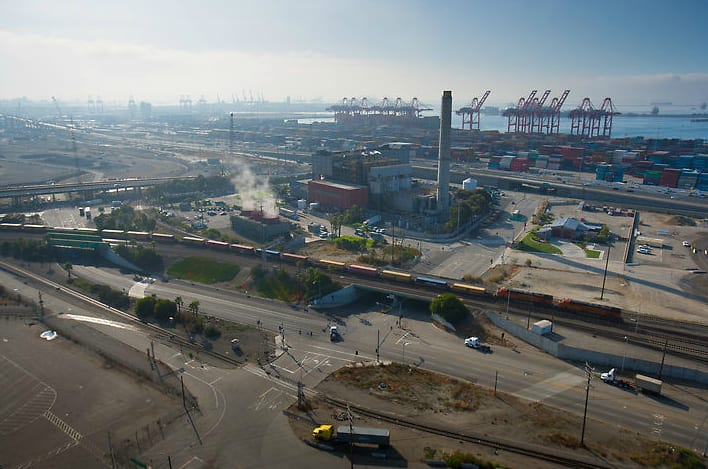
The California Labor Commisioner's Office has published a list of trucking companies with unpaid claims related to truck driver labor violations to discourage retailers from working with companies that engage in dishonest labor practices.
Photo via Port of Long Beach
3 min to read
The California Labor Commissioner's Office has published a list of port trucking companies with unpaid final court judgements, tax assessments or tax liens as part of the state’s crackdown on what it views as unlawful employment practices at the ports.
Outgoing California Governor Jerry Brown (D) signed a bill last September that would hold retailers partly accountable for working with trucking companies that had a record of labor violations.
Under that law, any retailer that works with one of the trucking companies on the published list will be risking liability should the company commit any more labor violations, such as failing to pay proper truck driver wages, imposing unlawful expenses on its employees, not remitting payroll taxes, failing to provide workers compensation insurance, or misclassifying employees as independent contractors.
"Companies are on notice that if they contract with a known wage thief, they will be held responsible for the exploitation of the drivers who carry their goods," said Julie A. Su, California Labor Commissioner. "This new law incentivizes trucking companies to pay up on judgments and put earned wages into drivers' pockets.”
Companies on the list were given advanced notice before it was published and the Labor Commissioner’s Office will remove companies who have paid any money owned or approved a settlement agreement within 15 days of a confirmation.
The list will be updated at least once a month.
By discouraging retailers from working with companies that engage in these practices, the hope is that companies will be put under more pressure to comply with state labor laws. The law faced opposition from the Harbor Trucking Association, a group that represents port trucking companies and other drayage stakeholders on the West Coast.
While the HTA worked with lawmakers to address its concerns with the bill while it was being drafted, it opposed the final version of the law and told Heavy Duty Trucking when it was passed that the bill could hurt businesses and may set a precedent for excessive regulation in the future.
According to the Labor Commissioner’s Office, there have been more than 1,000 port trucking wage claims since 2011.
Of those claims, the state ruled in favor of the truck drivers in 448 cases, resulting in more than $50 million in wages owed. Many of these claims stemmed from the practice of port trucking companies using independent contractor drivers rather than full employees.
While independent drivers are commonplace in the trucking industry, California has consistently ruled against trucking companies that use independent contractors as a tactic to avoid paying drivers proper wages and benefits that would be owed to a full employee, a practice labeled driver misclassification.
It is argued in these cases that the drivers are not independent of the companies at all since they can only work for a single company at a time and often lease trucks from the same company, resulting in wages that are below the state’s minimum wage.
More Drivers

Truck Drivers Need More Than Another Alert
Fleets have more visibility into truck health, safety events, and driver activity than ever. The next challenge is turning all that information into useful guidance for the person who has to decide what to do next.
Read More →
FMCSA Removes 110 Truck Driver Training Schools from Certified ELDT List
Federal regulators also are targeting more than 160 additional training providers and launching a nationwide audit of third-party CDL skills testers as part of a broader crackdown on trucking fraud.
Read More →
Hours of Service Pilot Programs: FMCSA Readies for 2027 Rollout
Two pilot programs could eventually reshape hours-of-service rules, giving truck drivers options to pause their 14-hour clock or use longer split sleeper rest periods.
Read More →
Medical Cards, English Proficiency Reshape Roadcheck Violations
Medical-card violations jumped to the top of the driver out-of-service list during CVSA’s 2026 International Roadcheck, while English-language proficiency violations appeared among the leading violations for the first time.
Read More →
Driver Trust Can Make or Break the Success of Fleet Safety Technology
New Teletrac Navman research suggests that onboarding, transparency about driver data, and positive feedback can play a significant role in how commercial drivers respond to safety and coaching technology.
Read More →
EEOC Sues KLLM Over Alleged Sex Discrimination in Driver Training
KLLM is facing a federal sex-discrimination lawsuit over policies the EEOC alleges put female truck driver trainees at a disadvantage.
Read More →
FMCSA Moves to Codify English Language Requirements for Commercial Drivers
By changing regulations on English-language proficiency requirements for commercial drivers, rather than relying on a guidance memo, the FMCSA said future administrations won't be able to walk back the Trump administration's stricter enforcement with just a memo.
Read More →
Drivers Put Western Star Trucks to the Test at Star Nation Experience
Watch to get an inside look at the Western Star trucks, technology, and community behind the Star Nation Experience 2026!
Read More →
Trump Administration Looks to Put More Veterans Behind the Wheel
The Freedom Haulers program pulls together existing and expanded programs at several federal agencies to recruit veterans to drive commercial heavy-duty trucks and cut the red tape for them to get a CDL, training, and employment.
Read More →
Putting Mack’s Command Steer to the Test
A test drive of Mack’s Command Steer active steering system evaluates how it can make truck driving easier and less tiring.
Read More →