




Related: California’s new ‘ABCs’ Spell Bad News for Owner-Operator Fleets
New California Law Holds Retailers Liable for Truck Driver Misclassification
California Governor Jerry Brown has signed into law a bill that aims to hold retailers partly accountable for working with trucking companies that have a record of labor violations.

Steven Martinez・Web Editor
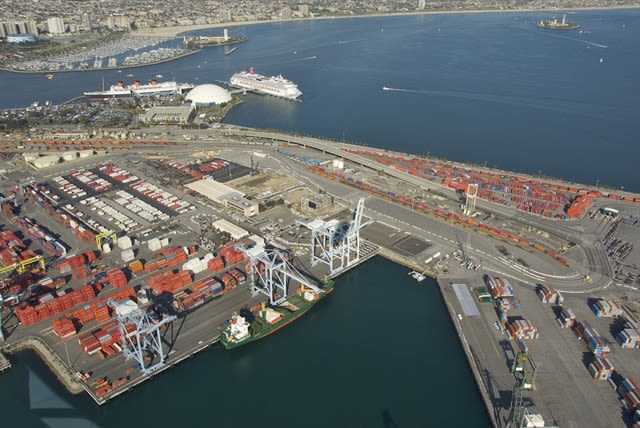
A new California law would hold retailers liable for working with port trucking companies that have unpaid judgements related to driver misclassificaiton lawsuits.
Photo via Port of Long Beach
3 min to read
California Governor Jerry Brown (D) has signed into law a bill that aims to hold retailers partly accountable for working with trucking companies that have a record of labor violations.
The bill, SB 1402, makes retailers jointly liable for violations of state labor and employment laws when they hire trucking companies with unpaid final judgements for failure to pay truck driver wages, imposing unlawful expenses on employees, failure to remit payroll taxes or to provide worker’s compensation insurance, misclassifying employees as independent contractors, and other labor law violations.
“Governor Brown’s signing of SB 1402 will allow port truck drivers to share in the benefits from California’s leading role in global trade,” said California State Senator Ricardo Lara (D), whose district includes the Port of Long Beach. “Retailers using their power to end exploitation and restore good jobs for workers at our ports will mean port truckers are left behind no more.”
Lara introduced the bill earlier this year, proposing it as a way for the state to curb a practice at the ports of Los Angeles and Long Beach that the labor department has repeatedly deemed a misclassification of truck drivers as independent contractors. The California Division of Labor standards Enforcement has won more than $45 million on behalf of 400 truck drivers in cases involving driver misclassification.
Under SB 1402, the Division of Labor Standards Enforcement will create a list of port trucking companies that have failed to pay final judgments. Retailers hiring port trucking companies on that list would be liable for future state labor and employment law violations incurred by these companies.
Harbor Trucking Association, a group that represents port trucking companies and other drayage stakeholders on the West Coast, opposes the new law, despite working with lawmakers to address concerns. In a statement to Heavy Duty Trucking, HTA CEO Weston LaBar said that the bill could hurt business in the state and may set the stage for excessive regulation in the future.
“The HTA appreciates the author’s office working with industry to remove many of the initial concerns and clarifying certain provisions,” said LaBar. “However, we were unable to remove our opposition for two main reasons. First, we feel that this bill will cause shippers to pursue cargo gateways outside of California solely on the unknown unintended consequences and mere perception of being anti-competitive. Second, because the California State Legislature routinely takes reasonable legislative measures and over time turns them into unmanageable over-regulation, with a series of trailer bills that attach new unreasonable provisions to the initial legislation.”
Proponents of the new law believe that truck drivers who are classified as independent contractors and not employees are not truly independent from the companies for which they contract. Therefore, it is contended that by misclassifying these drivers as independent, they are denying them proper wages and benefits. Other alleged practices by these companies include placing drivers in truck leases that leave them with little take home pay and no ability to work for other companies.
More Drivers
When Language Stops the Truck: The Return of ELP Out-of-Service Orders
English language proficiency rules for commercial drivers aren’t new, but renewed out-of-service enforcement has raised the stakes. Here’s what carriers need to know before a driver reaches a roadside inspection.
Read More →
Samsara Launches Custom AI Agent Builder
Agent Studio lets fleets create AI tools for hours-of-service monitoring, reporting and driver support, including agents that communicate by phone.
Read More →
Trucker Path Expands Reserved Parking Network
Trucker Path has added close to 6,000 more truck parking spaces to its Trucker Path Reserved Parking Network with the addition of Safe Truck Parking.
Read More →
EEOC Sues Texas Trucking Company Over Driver Age Limits
The agency says Trancasa USA rejected applicants over 65 and applied tougher driving-record standards to those over 60.
Read More →
Nussbaum, Roehl Announce Second Driver Pay Increase This Year
This year has seen a swath of major truck driver pay increases as freight capacity has tightened.
Read More →
From One Generation to the Next: How Mentorship Builds Safer Truck Drivers
After three decades in trucking, Harold Perry shares what he's learned about driver safety, mentorship, and helping the next generation build confidence behind the wheel.
Read More →
Truck Drivers Need More Than Another Alert
Fleets have more visibility into truck health, safety events, and driver activity than ever. The next challenge is turning all that information into useful guidance for the person who has to decide what to do next.
Read More →
FMCSA Removes 110 Truck Driver Training Schools from Certified ELDT List
Federal regulators also are targeting more than 160 additional training providers and launching a nationwide audit of third-party CDL skills testers as part of a broader crackdown on trucking fraud.
Read More →
Hours of Service Pilot Programs: FMCSA Readies for 2027 Rollout
Two pilot programs could eventually reshape hours-of-service rules, giving truck drivers options to pause their 14-hour clock or use longer split sleeper rest periods.
Read More →
Medical Cards, English Proficiency Reshape Roadcheck Violations
Medical-card violations jumped to the top of the driver out-of-service list during CVSA’s 2026 International Roadcheck, while English-language proficiency violations appeared among the leading violations for the first time.
Read More →