




California Approves New Transport Refrigeration Emissions Rules
New California emissions regulations for transport refrigeration units kick in starting this December, on the way to a requirement for all truck TRUs operating in California to be zero‑emission by the end of 2029.

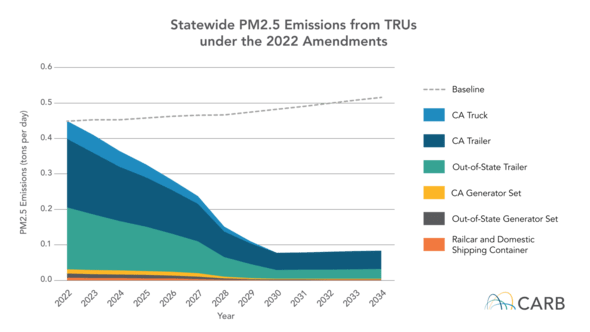
CARB says the health benefits from the new TRU emissions rules are more than twice the total estimated net cost of the 2022 amendments (estimated at $850 million).
Graph: CARB
New California emissions regulations for transport refrigeration units kick in starting this December, on the way to a requirement for all truck TRUs operating in California to be zero‑emission by the end of 2029.
The California Air Resources Board approved amendments to its rule for TRUs operating in the state. The 2022 amendments will require a variety of actions designed to reduce the pollution these units produce and accelerate their transition to zero-emission technologies.
The new requirements include the transition of diesel-powered truck TRUs to zero‑emission, a particulate matter emission standard for newly manufactured non-truck TRU engines (on trailers, domestic shipping containers, railcars, and generator set units), the use of lower global warming potential refrigerants, facility registration and reporting, expanded reporting and labeling, and fees.
CARB said the new rules build on progress achieved by the existing rule, which requires TRUs operating in California to meet in-use particulate matter performance standards after they turn seven years old.
New CARB TRU Emissions Rules
Key elements of the newly-adopted requirements include:
Beginning Dec. 31, 2022:
Newly-manufactured truck TRUs, trailer TRUs, and domestic shipping container TRUs are required to use a refrigerant with a global warming potential less than or equal to 2,200 — or no refrigerant at all. (Both Carrier and Thermo King offer R-452A refrigerant, which has a GWP of 2,140, and Thermo King recently made it standard.)
Model-year 2023 and newer trailer TRUs, domestic shipping container TRUs, railcar TRUs, and TRU generator set engines are required to meet a lower particulate matter emission standard that aligns with the United States Environmental Protection Agency Tier 4 final off‑road particulate matter emission standard for 25‑50 hp engines.
Beginning Dec. 31, 2023:
Owners of refrigerated warehouses and distribution centers, grocery stores, seaport facilities, and intermodal railyards (building size of at least 20,000 square feet) must register with CARB, pay fees every three years, and report all TRUs that operate at their facility. Alternatively, they may attest that only compliant TRUs operate at their facility.
TRU owners are required to report all TRUs (including those based out-of-state) that operate in California to CARB, pay TRU operating fees, and affix CARB compliance labels to their TRU every three years.
TRU owners are required to turn over at least 15% of their truck TRUs operating in California to zero-emission technology each year (for seven years). All truck TRUs operating in California are required to be zero‑emission by Dec. 31, 2029.
What ZEV Technology is Available?
CARB identified several zero-emissions TRU technologies as part of its proposed regulations:
Battery-electric: The diesel engine powering the compressor and fans is removed and replaced with electric motors powered by a battery pack. To recharge the battery pack after daily operations, truck TRU owners may rely on publicly accessible chargers or choose to install chargers at their home base facility.
Cold plate: These systems consist of a sheet metal shell, with cooling coils built inside to hold the eutectic fluid. They are similar to the gel packs used in lunch boxes and ice chests, but larger. These would require access to electrical plugs to refreeze cold plates after daily operations.
Indirect cryogenic: A cryogenic fluid (liquid CO2 or liquid nitrogen) is the cooling agent, replacing the diesel engine‑driven refrigeration system used in a conventional TRU. These units would require access to a liquid CO2 or liquid nitrogen fueling station.
From 2022 to 2034, the amendments are expected to reduce harmful PM2.5 and NOx emissions by approximately 1,258 tons and 3,515 tons, respectively, and result in estimated statewide health benefits (savings from avoided health care costs) of approximately $1.75 billion. The health benefits are more than twice the total estimated net cost of the 2022 amendments estimated at $850 million. Reductions of PM2.5 and NOx emissions will also reduce cancer risk to individual residents and off-site workers near facilities where TRUs operate, including those located in and near disadvantaged communities.
More Equipment

How Volvo Updated Its D13 for EPA 2027 [Watch]
Volvo’s updated D13 promises lower emissions without sacrificing performance or fuel economy. Take a closer look at what changed inside the engine in this HDT Spotlight video.
Read More →
Michelin Tire Improves Efficiency and Durability for Regional Fleets
The Michelin X Multi Energy D2 is a regional haul drive tire engineered to help fleets improve fuel efficiency, durability and traction in demanding stop-and-go operations.
Read More →
ZF Expands Commercial Vehicle Push in North America
ZF is expanding its North American commercial-vehicle presence with new transmission applications, electrification, trailer technology and autonomous-driving systems.
Read More →
Tesla Wants a Self-Driving Semi. Are Cameras Enough?
Could Tesla’s camera-only autonomous driving technology work on an 80,000-pound Semi? In this commentary, HDT's Deborah Lockridge takes a look at Tesla, Cybercab, and how autonomous trucks see the road.
Read More →
Kodiak: Driverless Long-Haul Truck Launch on Track for 2026
Kodiak AI says its driverless long-haul safety case is 93% complete and it remains on track to begin commercial operations by year-end 2026.
Read More →
What DOT’s Automated Vehicle Strategy Means for Trucking
The U.S. Department of Transportation issued a new automated-vehicle strategy that outlines plans for driverless-truck regulations, cross-state freight corridors, and federal safety standards.
Read More →
East Coast Port Launches $45M Electric Truck Push
The Port Authority of New York and New Jersey announced millions in incentives for zero-emission drayage trucks, yard tractors, and new charging hubs near the port.
Read More →
PlusAI Going Public to Fund Autonomous Truck Launch
A SPAC deal could provide PlusAI with up to $300 million as it works toward a 2027 commercial launch of factory-built autonomous trucks.
Read More →
NHTSA Moves to Rewrite Truck Fuel-Economy Rules
The National Highway Traffic Safety Administration says it lacks authority to regulate medium- and heavy-duty truck engines separately from complete vehicles, but the existing standards have not yet been eliminated.
Read More →
Detroit Opens Orders for EPA 2027 Engines
Detroit isn’t starting from scratch to meet EPA 2027 diesel emissions standards. Its Gen 6 DD13 and DD15 engines keep much of today’s platform while updating the fuel and aftertreatment systems.
Read More →