




Bush Losing Ground In Battle Over Mexican Trucks
The Senate rebuffed President Bush Thursday, voting for a bill that places tough restrictions on Mexican trucks that want long-distance access to the U.S
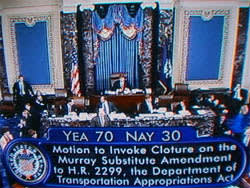
Senate votes 70 to 30 in favor of amendment imposing stricter regulations on Mexican trucks.
The Senate rebuffed President Bush Thursday, voting for a bill that places tough restrictions on Mexican trucks that want long-distance access to the U.S.
Negotiations are continuing, but yesterday afternoon the Senate voted 70-30 in favor of an amendment that requires the U.S. Department of Transportation to conduct an on-site compliance review of each Mexican company that wants access to the U.S.
Administration officials and their allies in the Senate, including Sen. John McCain, R-Ariz., had argued that the plan is too stringent and violates terms of the North American Free Trade Agreement. But the Senate voted with the provision's sponsors, Sens. Patty Murray, D-Wash., and Richard Shelby, R-Ala.
"All we are saying (in the amendment) is that the level of safety should be equal on either side of the border," Sen. Murray said in remarks on the Senate floor.
As the afternoon wore on, opponents continued to resist. Sen. Phil Gramm, R-Texas, offered an amendment that said the Murray-Shelby provisions would be binding unless President Bush finds they violate NAFTA. Gramm was not optimistic, however. He said he did not expect his measure to be adopted but vowed to continue the fight against the Murray-Shelby provision. Once the Senate adjourned for the day, Gramm expressed his outrage at the situation, saying, "We're not going to have the administration run over."
Supporters of the tougher safety standards say the vote yesterday signals they can put together the 67 votes need to override a promised veto of their plan by President Bush.
As of yesterday evening, Senate Majority leader Tom Daschle, D-S.D., said he hoped to wrap up the legislation by the end of the week, but McCain and Gramm said they would continue to use procedures to slow the legislation unless the other side was willing to compromise.
Opponents of the more stringent Mexican trucks rules say they are unfair because the proposal would require tougher safety standards for Mexican trucks than for Canadian trucks operating in the U.S. Supporters, however, say the real issue is safety. They point to statistics that show Mexican trucks are far more likely to fail inspections in the U.S. than their American on Canadian counterparts.
The Bush proposal calls for letting Mexican trucks in beginning Jan. 1 and then taking up to 18 months to conduct safety checks of Mexican motor carriers. Most recently, facing increased pressure on the issue, the administration also conceded it would require periodic inspections of Mexican vehicles as they cross the border.
The tougher Mexican trucking regulations are contained in a more than $60 million transportation spending bill for the next fiscal year, which is also filled with popular projects for lawmakers' home states.
According to the Associated Press, some senators are privately worried that these projects for their states could be in trouble if they oppose the tougher trucking rules. That's because Sens. Shelby and Murray are the senior members of the Senate Appropriations transportation subcommittee, which gives them a big say in which home state appropriations will survive in the final version of the bill.
AP also reported that GOP leaders even went so far as to circulate comments to farm state Democratic senators from an unnamed Mexican official, saying that if the U.S. was not fully opened to Mexican trucks, they might retaliate by restricting imports from the U.S. of certain farm products.
More Drivers

Competition Heating Up for Truck Drivers
New report reveals rising driver hiring costs, the return of sign-on bonuses, growing AI advantages, and the operational factors shaping driver retention.
Read More →
How Fraley & Schilling Improved Logbook Compliance by Over 50%
Fraley & Schilling needed a way to close a compliance workflow gap in its ELD system without adding more work from driver training, reminders, and back-office follow-ups. It found the answer in a custom driver app.
Read More →
Volvo Goes Gaming
Volvo has roared into American Truck Simulator with two new flagship trucks.
Read More →
What the Best Fleets to Drive For Teach About Driver Retention
Survey fatigue, AI-powered routing, owner-operator expectations, and the decline of social media all emerged as themes from this year's Best Fleets to Drive For program.
Read More →
Driver Retention Lessons From the Best Fleets to Drive For
What separates trucking's best workplaces from the rest? Jane Jazrawy shares the biggest lessons from this year's Best Fleets to Drive For program on driver retention, communication, AI, and workforce trends on the HDT Talks Trucking podcast.
Read More →
Farewell, CDL: Why I'm Giving Up My Commercial Driver's License
After more than 20 years as a CDL holder, HDT Executive Editor Jack Roberts is letting his commercial license expire. Not because he wants to — but because trucking's nuclear verdict crisis has made the risks of public-road test drives too great for editors, manufacturers, and everyone involved.
Read More →
How Top Trucking Fleets Improve Driver Retention [Video]
What do healthy snacks, optimized routing, and just picking up the phone have in common? They're all strategies the Best Fleets to Drive For are using to retain truck drivers.
Read More →
Trucker Path Adds Verisk CargoNet Theft Data to Navigation Platform
Trucker Path’s new cargo theft risk overlays give drivers and fleets visibility into high-risk areas, stolen commodity trends, and theft hotspots.
Read More →
Netradyne Intelligence Uses New AI Agents to Automate Response to In-Cab Camera Data
The company called the next-generation in-cab camera safety platform "a fundamental shift from systems that report on what happened to systems that actively drive what should happen next."
Read More →
Why Truck Detention Keeps Costing Fleets Time and Money
A 2024 ATRI study found detention affects nearly 40% of truckload stops and costs the industry more than $15 billion annually. Despite the toll on drivers, fleets, and supply chains, the problem remains stubbornly persistent.
Read More →