




Related: Self-Driving Trucks and the Platooning Stepping Stone: How Soon?
Budweiser Delivers First Shipment Using Autonomous Truck
Otto and Budweiser announced Tuesday that they have reached a major milestone on the road to autonomous trucking with the completion of the world’s first shipment using a self-driving truck.
by Staff
October 25, 2016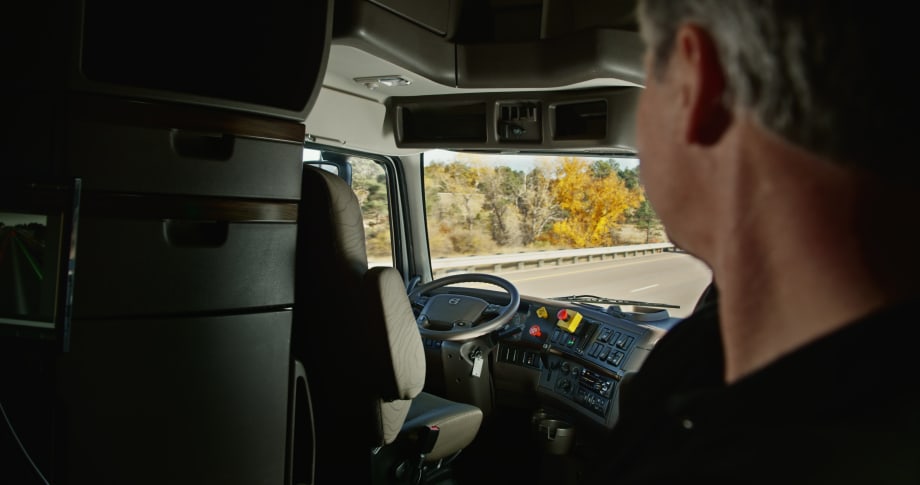
The driver monitored the 120-mile trip on I-25 from the sleeper. Photo courtesy Otto.
2 min to read
If you're in Colorado Springs, you might buy a can of beer that was shipped by a self-driving truck.
Otto and Budweiser announced Tuesday that they have reached a major milestone on the road to autonomous trucking with the completion of the world’s first shipment using a self-driving truck.
Otto, which is now owned by Uber, teamed up with Anheuser-Busch to haul 51,744 cans of Budweiser from Fort Collins, through downtown Denver, to Colorado Springs. By using cameras, radar, and lidar sensors mounted on the vehicle to “see” the road, Otto’s system controlled the acceleration, braking, and steering of the truck to carry the beer exit-to-exit without any human intervention.
Walter Martin, a professional truck driver since 2007, monitored the 120-mile journey down I-25 on October 20 from the sleeper berth in the back. Otto says the project had full support from the State of Colorado.
“We are always looking for new innovations and technology,” explained Anheuser Busch’s James Sembrot in a video posted by Otto. “Otto’s trucks are the next area of transportation innovation.”
The driver is still involved in picking up the load, making sure the freight is secured in the trailer. Once the truck is on the Interstate, he flips a switch and the truck drives itself down the road.
As HDT's Rolf Lockwood reported earlier this year, Otto hardware and software is tuned for the consistent patterns and easy-to-predict road conditions of highway driving. Sensors are installed high atop the truck, which offers an unobstructed view of the road ahead. With highways making up only 5% of U.S. roads, Otto says this allows a tight testing focus on a specific set of trucking routes critical for the American economy.

The driver monitored the 120-mile trip on I-25 from the sleeper. Photo courtesy Otto.
More Fleet Management

Why Private Fleets Are Taking More Freight
Private fleets are putting their own trucks on demanding customers and high-cost lanes as companies seek greater control over service, costs, and capacity.
Read More →
Sponsored•September 16, 2026
Color Match Smarter: Tools That Restore & Perform
For fleet managers and collision repair professionals keeping heavy-duty trucks on the road, getting the color right the first time isn't just about appearance — it's about efficiency, turnaround time, and bottom-line results. Discover how today's digital color tools are transforming the repair process from guesswork to precision.
Read More →
FMCSA Pauses Biennial-Update Enforcement Amid Motus Transition
Carriers whose updates were due on or after June 1 have more time, while FMCSA works to stabilize its new registration system and warns of phishing sites impersonating its new carrier registration system, Motus.
Read More →


Sponsored•September 14, 2026
2026 Blueprint for Countering Smarter Supply Chain Theft
Cargo theft is no longer just the cost of doing business. It's a multi-billion-dollar criminal enterprise exploiting vulnerabilities across your fleet, drivers, and supply chain.
Read More →
Sponsored•September 1, 2026
How Telematics Improves Visibility, Control, and Performance in Refrigerated Fleets
Explore how telematics help refrigerated fleets improve visibility, uptime, efficiency, compliance, and cargo protection across connected cold chain operations.
Read More →
What the U.S.-Canada Trade War Means for Trucking
Escalating U.S.-Canada tariffs could disrupt cross-border freight, reduce truck volumes, raise costs, and create new uncertainty for carriers on both sides of the border.
Read More →
What Are Trucking’s Top Concerns for 2026?
The American Transportation Research Institute wants to know what's worrying trucking fleet managers, drivers, and other stakeholders in its annual Industry Issues survey.
Read More →
American Trucking Associations Looks for a New Leader
ATA President and CEO Chris Spear abruptly left his job at the association on August 21, at a pivotal time for the trucking industry.
Read More →
Public Wi-Fi Cybersecurity Risks: How Truck Drivers and Fleets Can Protect Their Data
Public Wi-Fi can expose truck drivers and fleets to credential theft, malware, and other cyber threats. Here’s how to reduce the risk on the road.
Read More →
For Nicky Cupp, Fleet Innovation Starts With Frustration
HDT Truck Fleet Innovator Nicky Cupp turns everyday pain points at Fraley & Schilling into opportunities for better technology and smarter processes.
Read More →