




Bosch Technology Slashes NOx Emissions with Little Impact on Fuel Economy
New developments from Bosch could enable vehicle manufacturers to reduce emissions of nitrogen oxides (NOx) so drastically that they already comply with future limits.

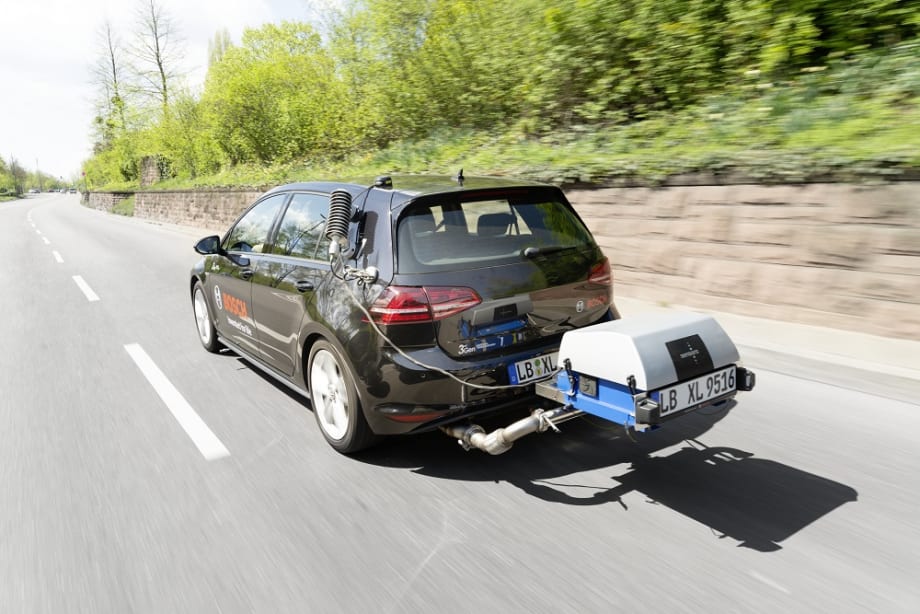
Bosch has developed new technology that could signifcantly reduce NOx emissions without impacting fuel economy.
Photo courtesy Bosh
FLAT ROCK, MICHIGAN — Bosch has pioneered an emissions reduction technology it says can cut NOx emissions to 10% of current diesel passenger car levels without any additional components. Further, Bosch says the technology can be scaled up for use in medium and heavy-duty diesel engines. The Stuttgart, Germany-based automotive technology supplier made that announcement in April at the company’s annual press conference and provided an update here on Tuesday.
Speaking at the Bosch Mobility Experience press event, Alex Freitag, director of engineering, Bosch powertrain solutions group said the new approach to NOx emissions will keep diesel engines in the game for years to come without adding significant cost to the vehicle.
"The value proposition of the diesel engine is maintained with a minimal impact on fuel economy," he said.
In tests conducted in Germany, a passenger car equipped with a 1.7 liter, 145 hp diesel engine achieved an average NOx output of just 13 mg per kilometer over several test cycles in what Europeans define as an RDE test; that's real driving emissions. The test cycle includes a combination of urban, rural and highway driving.
Since 2017, European legislation has required that new RDE-compliant passenger car models emit no more than 168 milligrams of NOx per kilometer. As of 2020, that limit will be cut to 120 milligrams. While it's difficult to translate these numbers into a useable American emissions regulation comparison, the emission reductions achieved with this new technology are already 10 times lower than limits set to kick in four years from now.
"It's a combination of technologies that made these reductions possible," said Freitag. "We keep NOx low in the cylinder through better air management and injection strategies, while using low- and high-pressure EGR, along with a temperature controlled aftertreatment system using a [diesel oxidation catalyst], [selective catalytic reduction] on the DPF and a downstream SCR with [diesel exhaust fluid] dosing and low-pressure EGR."
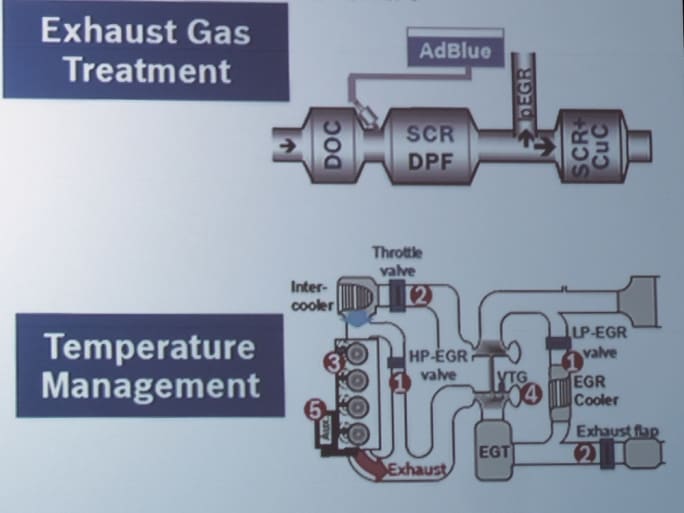
A schematic of Bosch's new aftertreatment system, showing the combination DPF/SCR downstream of the DEF doser, and the second SCR unit. The lower diagram shows the proprietary temperature management system.
Image via Bosch
According to Freitag, the emissions reduction technology uses no new hardware, just improvements and variations on existing technology.
The system uses a high-pressure (2,200 bar or 32,000 psi) common rail fuel injection with multiple injection events to shape the heat release rate of combustion. The demands of high-transient cycle urban driving forced Bosch to optimize the turbocharger for all driving conditions and specifically for low-speed high-torque operation (similar to downspeeding). The new software functions allow for better transient control to minimize emissions and reduce the peaks of NOx production associated with aggressive acceleration and stop and go driving.
The technological solution developed by Bosch is a highly responsive air-flow management system for the engine. A dynamic driving style demands an equally dynamic recirculation of exhaust gases. Bosch says this can be achieved with the use of an RDE-optimized turbocharger that reacts more quickly than conventional turbochargers. Thanks to a combination of high- and low-pressure exhaust-gas recirculation, the air-flow management system becomes even more flexible. This means drivers can drive off at speed without a spike in emissions.
The aftertreatment system consists of a diesel oxidation catalyst followed by a combination DPF and SCR devices. There's a DEF injector inline before the DPF/SCR device. Next in line is a low-pressure EGR return from the engine and then a second SCR device with a "clean-up catalyst" to remove any unconsumed ammonia from the SCR process.
Most importantly, the entire aftertreatment system is tightly temperature controlled to optimize its efficiency. To ensure optimum NOx conversion, the exhaust gases must be hotter than 200 degrees Celsius. In urban driving, vehicles frequently fail to reach this temperature. Bosch uses a sophisticated thermal management system for the diesel engine that actively regulates the exhaust-gas temperature, thereby ensuring that the exhaust system stays hot enough to function within a stable temperature range and that emissions remain at a low level.
"The optimum temperature of the entire system is usually 200 degrees Celsius," said Freitag. "We can heat or cool the system with a combination of EGR and post-injection hydrocarbon dosing and a proprietary air management technology on the engine side, not the aftertreatment system itself."
The test on which Bosch returned the astonishing 13 mg per kilometer NOx output was a recognized test procedure using multiple drivers and multiple runs over a prescribed test course in real-world driving, not in a controlled test track environment. When driving in particularly challenging urban conditions, where test parameters are well in excess of legal requirements, the average emissions of the Bosch test vehicles are as low as 40 milligrams per kilometer, Bosch noted in a press release announcing this technology in April.
At that press event in Stuttgart, Bosch allowed dozens of journalists to drive test vehicles equipped with mobile measuring equipment in heavy city traffic, under especially challenging conditions. The results recorded by the journalists were in keeping with the published test results.
Bosch’s new diesel system is based on components that are already available in the market. It is available to customers effective immediately and can be incorporated into production projects.
As for cost and fuel economy, Bosch says it will not make diesel vehicles "any less affordable," nor will it impact diesel's fuel efficiency and thus CO2 output. "As the measures to reduce NOx emissions do not significantly impact consumption, the diesel retains its comparative advantage in terms of fuel economy, CO2 emissions, and therefore climate-friendliness. Diesel will thus remain a climate-friendly option," the company said in a press release.
And Bosch says the technology is scalable.
"This was tested on a 1.7 liter, four-cylinder passenger car diesel engine, but we see no reason why it can't be introduced in larger vehicles," said Freitag.
One of the big hurdles faced by truck and engine makers going into Phase II of the Greenhouse Gas Reduction rules will be the demand for simultaneous cuts to NOx and CO2. It's accepted that fuel mileage usually suffers with efforts to reduce NOx in-cylinder, but this solution may offer opportunities to achieve both, without significant penalties.
Related: Zero Emissions Vehicles Can Still Impact the Environment
More Fuel Smarts

How Volvo Updated Its D13 for EPA 2027 [Watch]
Volvo’s updated D13 promises lower emissions without sacrificing performance or fuel economy. Take a closer look at what changed inside the engine in this HDT Spotlight video.
Read More →
Diesel Price Spike Shortens Payback for Natural Gas Trucks, Report Says
Energy Vision estimates fleets could recover the higher purchase price of an RNG-fueled Class 8 tractor in 1.3 to 2.8 years under current fuel-price scenarios.
Read More →
Calstart Becomes Catalyst Mobility, Reflecting Broader Focus
Calstart is now Catalyst Mobility, reflecting the nonprofit’s growing national role in clean transportation, including zero-emission trucks, infrastructure and incentive programs.
Read More →

Record Diesel Prices Squeeze Trucking Fleets
Average U.S. diesel prices have climbed to nearly $6 a gallon, surpassing the 2022 record as tight refinery capacity and Middle East disruptions keep fuel costs elevated.
Read More →
How Fuel Delivery Shapes Engine Performance
Fuel delivery depends on more than what happens at the injector. For fleet, maintenance and technical professionals, looking at the full path from pump to injector can provide useful context for understanding engine performance.
Read More →
East Coast Port Launches $45M Electric Truck Push
The Port Authority of New York and New Jersey announced millions in incentives for zero-emission drayage trucks, yard tractors, and new charging hubs near the port.
Read More →
California Bill Could Shed Light on Electric Truck Prices
Why do battery-electric Class 8 trucks remain so expensive? A California bill headed to Gov. Gavin Newsom would give fleets and state agencies more visibility into what manufacturers charge.
Read More →
Detroit Opens Orders for EPA 2027 Engines
Detroit isn’t starting from scratch to meet EPA 2027 diesel emissions standards. Its Gen 6 DD13 and DD15 engines keep much of today’s platform while updating the fuel and aftertreatment systems.
Read More →
Zero-Emission Truck Corridor Planned for West Coast
California, Oregon, Washington, British Columbia and Baja California are coordinating plans for truck charging and hydrogen fueling from Canada to Mexico.
Read More →
A Closer Look at Kenworth’s Electric T880E Vocational Truck [Video]
Learn more about Kenworth's T880E battery-electric vocational truck at the Paccar Technical Center, including its range, applications, upfitting considerations, and PTO options, in this HDT Spotlight video.
Read More →