




Big UPS Order for NG Tractors Follows 300 Million Successful ‘Green’ Miles
United Parcel Service is so committed to using low-emissions fuels that all of the 700 Class 8 vehicles it has ordered for delivery late this year and into 2014 will run on liquefied natural gas.

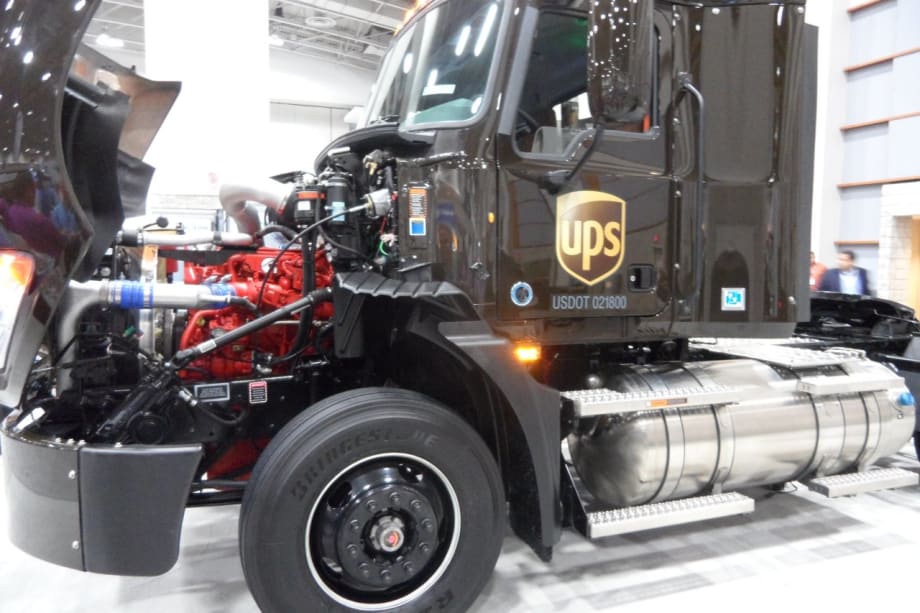
At the ACT Expo in Washington, D.C., Mack displayed a Pinnacle tractor like the 122 just ordered by UPS. It has a Cummins ISX12 G engine that runs on liquefied natural gas instead of compressed NG.
At the ACT Expo in Washington, D.C., Mack displayed a Pinnacle tractor like the 122 just ordered by UPS. It has a Cummins ISX12 G engine that runs on liquefied natural gas instead of compressed NG.
United Parcel Service is so committed to using low-emissions fuels that all of the 700 Class 8 vehicles it has ordered for delivery late this year and into 2014 will run on liquefied natural gas. The order follows five years and 300 million miles of successful experience with 2,700 trucks and package cars fueled by natural gas, said David Abney, chief operating officer of the giant package carrier and logistics company.
But one of the things UPS managers learned in those 300 million “green” miles is that “the greenest miles are the ones you never run,” he commented. The company uses computerized route planning and a “smart pick-up” system based on communications with customers to avoid needless miles.
“There was a time when we used to stop everywhere every day, even if there were no pick ups” from regular customers, related Abney, who began his career with UPS as a part-time loader and later worked as a route driver. “Those days are gone.” About 364 million miles were saved in 2011 and ’12.
UPS has worked with natural gas since 1989, and now has about 3,000 alternative-fuel trucks among the 90,000 it runs worldwide, Abney told an audience at the Alternative Clean Transportation Expo in Washington, D.C. , on Wednesday morning. In addition to about 1,000 package cars running on compressed natural gas, it also has some on propane, others with diesel-electric hybrids, and still others with electric-drive powertrains.
Altogether, UPS expects to cover 500 million green miles by 2015 and 1 billion by 2017. To help support that, it plans to build nine LNG fueling stations this year and next.
The 700 LNG road tractors will use dual-fuel gas-and-diesel vehicles from Cummins Westport and Kenworth, as well as straight-gas engines, the latter spark-ignited Cummins models in Mack chassis. These are the first Macks built with Cummins’ ISX12 G engines that are fueled by LNG instead of CNG, a Mack source said.
The Mack order follows a test of one tractor in regular service in Greensboro, N.C., a Mack announcement said. It has been running two 350- to 400-mile shifts per day, pulling single-semi and doubles combinations grossing up to 80,000 pounds. The 11.9-liter ISX12 G is rated at 400 horsepower and 1,450 pounds-feet, which has proven sufficient for such road duty.
Abney said UPS pays about $100,000 extra for a natural-gas-fueled road tractor. That premium is paid off because gas is cheaper than diesel and the tractors run high miles over which high amounts of the cheaper fuel are used.
UPS and other fleets might buy more such vehicles except for the penalty of taxation, he said. Some of those upcharges are the 12% federal excise tax on the extra gas equipment, which he thinks the government should exempt to encourage use of the clean-burning fuel.
And the federal road tax on LNG amounts to 17 cents per gallon extra, because it’s taxed as a liquid, like diesel, even though it has less energy than diesel. LNG should be taxed on its energy content, not its liquid volume, Abney said.
More Fuel Smarts

How Volvo Updated Its D13 for EPA 2027 [Watch]
Volvo’s updated D13 promises lower emissions without sacrificing performance or fuel economy. Take a closer look at what changed inside the engine in this HDT Spotlight video.
Read More →
Diesel Price Spike Shortens Payback for Natural Gas Trucks, Report Says
Energy Vision estimates fleets could recover the higher purchase price of an RNG-fueled Class 8 tractor in 1.3 to 2.8 years under current fuel-price scenarios.
Read More →
Calstart Becomes Catalyst Mobility, Reflecting Broader Focus
Calstart is now Catalyst Mobility, reflecting the nonprofit’s growing national role in clean transportation, including zero-emission trucks, infrastructure and incentive programs.
Read More →

Record Diesel Prices Squeeze Trucking Fleets
Average U.S. diesel prices have climbed to nearly $6 a gallon, surpassing the 2022 record as tight refinery capacity and Middle East disruptions keep fuel costs elevated.
Read More →
How Fuel Delivery Shapes Engine Performance
Fuel delivery depends on more than what happens at the injector. For fleet, maintenance and technical professionals, looking at the full path from pump to injector can provide useful context for understanding engine performance.
Read More →
East Coast Port Launches $45M Electric Truck Push
The Port Authority of New York and New Jersey announced millions in incentives for zero-emission drayage trucks, yard tractors, and new charging hubs near the port.
Read More →
California Bill Could Shed Light on Electric Truck Prices
Why do battery-electric Class 8 trucks remain so expensive? A California bill headed to Gov. Gavin Newsom would give fleets and state agencies more visibility into what manufacturers charge.
Read More →
Detroit Opens Orders for EPA 2027 Engines
Detroit isn’t starting from scratch to meet EPA 2027 diesel emissions standards. Its Gen 6 DD13 and DD15 engines keep much of today’s platform while updating the fuel and aftertreatment systems.
Read More →
Zero-Emission Truck Corridor Planned for West Coast
California, Oregon, Washington, British Columbia and Baja California are coordinating plans for truck charging and hydrogen fueling from Canada to Mexico.
Read More →
A Closer Look at Kenworth’s Electric T880E Vocational Truck [Video]
Learn more about Kenworth's T880E battery-electric vocational truck at the Paccar Technical Center, including its range, applications, upfitting considerations, and PTO options, in this HDT Spotlight video.
Read More →