




ATRI Study Examines the Scale and Causes of Growing Trucking Litigation Awards
Many factors, including inherent jury bias, can drive jury awards higher in trucking litigation cases, a new ATRI study has found.

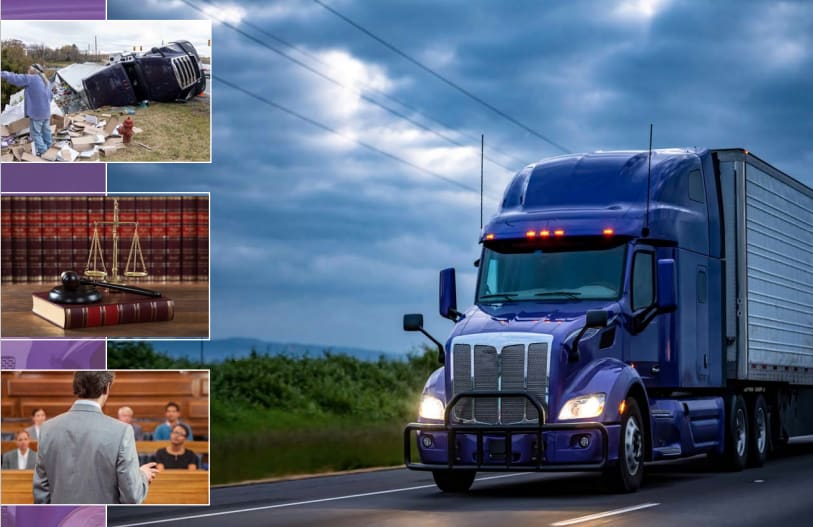
ATRI found that the largest half of awards – those most damaging to the industry – have been rising at an average rate of 5.7 percent per year.
Photo: ATRI
The American Transportation Research Institute (ATRI) today released new research on the scope of tort litigation in the trucking industry and the factors that influence case outcomes.
Also included in the report are new updates on third-party litigation financing, carrier policies and procedures that impact the likelihood of lawsuits.
The study also examines whether Federal Motor Carrier Safety Regulations represent full compliance or minimum standards, and a new plaintiff focus on product liability suits.
Numerous Factors Feed Larger Monetary Awards
Using a variety of federal and industry litigation data sources, the research analyzes six years of truck tort cases.
In 2022 alone, the report estimates that there were 12,817 state truck-tractor tort cases, as many as 147 of which were improperly prevented from reaching federal court – where cases are often more protected from potential bias.
The largest half of awards – those most damaging to the industry – rose at an average rate of 5.7 percent per year.
The report identifies numerous factors that statistically lead to higher awards. These include types of negligence (such as improper hiring or onboarding) and injuries (such as moderate and severe traumatic brain injury).
It found that settlements were lower than verdicts in cases with awards of $5 million or more but higher than verdicts with awards under $1 million.
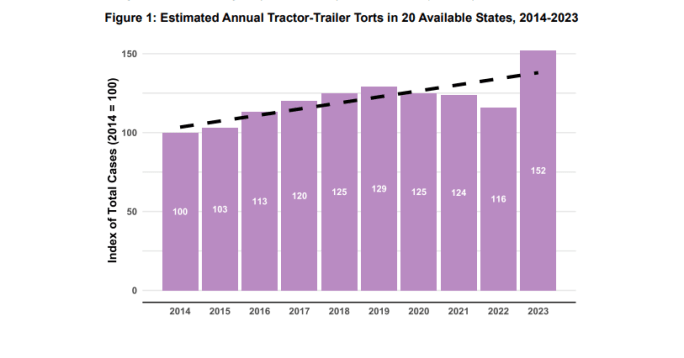
Chart: ATRI
Three types of alleged negligence were statistically correlated with defense victories, including improper turn, improper merge, and failure to yield.
Jury Bias a Factor
Trial strategies were analyzed, and it was discovered that counterclaims – where evidence of plaintiff negligence was presented – did not result in statistically lower awards. This underscores jury bias faced by motor carriers, the report said.
Nonmedical awards were more than 10 times higher than medical awards in 17.8 percent of cases, indicating the presence of exaggerated nonmedical claims.
Moreover, the report found that motor vehicle litigation cases have been trending upward for a decade now.
The report notes that since 2014, the estimated number of filed cases has increased at an average rate of 3.7 percent per year (231 cases in the 20-state sample).
This rate of increase in litigation was slightly higher than the rate of increase in nationwide large truck injury and fatal crashes during the same period, which rose by 3.6 percent per year, according to the National Highway Traffic Safety Administration (NHTSA).
Four key related factors were at play, according to the study:
In the period from 2014 through 2019, annual truck crashes and litigation both increased at steady rates. The COVID-19 pandemic disrupted this trend, as the resulting reduction in passenger vehicle mileage caused a reduction in large-truck crashes. As litigation is often not initiated until well after a crash, this reduction in crashes had a lagging impact on the number of incoming cases. For this reason, the total number of incoming cases in 2022 was atypically low.
Pandemic-related public safety protocols and social attitudes contributed not only to case backlogs but to filing delays as well.48 The median time that passed between a case’s crash and docket closure rose from 3.0 years in 2019 to 3.3 years in 2021 to 4.0 years in 2023.
Increased litigation activity in 2023 corresponds with a return to more typical highway conditions from 2022 onward as well as a push by the plaintiff bar in several states to file cases prior to the passage of substantial tort reform legislation (including in Florida and Georgia, two highly litigious states).For this reason, the total number of incoming cases in 2023 was atypically high and may experience a downward correction in subsequent years as conditions normalize.
Crashes declined once again in 2023 – in both raw total and frequency per 100 million truck miles – with preliminary data showing an additional decline in 2024.This factor could also result in a decrease in incoming cases over the subsequent years.
ATRI found that litigation awards have trended upward over the past decade as well. The median award amount for cases of $1 million or more for each year from 2011 to 2023.
Since 2011, the median award has increased at an average rate of $59,122 per year.
The conclusion evident in these two trends over time, ATRI said, is that, while the number of awards in trucking litigation are increasing in general, the upper 50 percent of awards are increasing at a particularly alarming rate.
This confirms the general marketplace perspective that litigation volatility and large awards are escalating even faster.
Alleged Negligence a Key Driver of Cases
ATRI found that tort cases are filed on the basis of a plaintiff alleging negligence on the part of a defendant. In tort litigation, negligence is understood as a failure to exercise reasonable care, whether by action or inaction, that leads to injury or harm.
There are two generally accepted degrees of severity for negligence. With ordinary negligence, an individual failed to exercise the level of care expected from a reasonable person.
Gross negligence implies a heightened degree of recklessness along with a willful disregard for potential repercussions.
However, any given type of negligence could qualify as gross negligence, but no type of negligence is inherently gross negligence.
While most types of negligence arise from truck driver actions or inactions, ATRI found that 15.2 percent of cases involved some form of employer negligence.
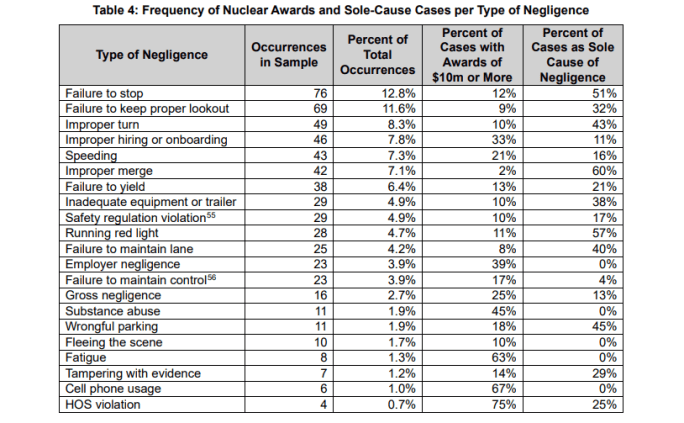
Chart: ATRI
While only an employer can commit improper hiring or onboarding, many other types of negligence – such as inadequate equipment, tampering with evidence, or HOS violation – can involve employers, drivers, or both.
ATRI found that the types of negligence with the largest percentage of awards at or above $10 million were also among the least common: HOS violations, cell phone usage, and fatigue.
Among types of negligence with more than 10 occurrences in the data, substance abuse, employer negligence, and improper onboarding most often resulted in awards at or above $10 million.
Plaintiffs typically present these high-award types of negligence as broader, systemic negligence within a company, ATRI noted.
Additionally, the report noted, 12 types of negligence had a median award greater than the national median of $1.3 million. Of these, the highest – HOS, cell phone use, and fatigue – were very uncommon.
Improper hiring or onboarding had the second-highest expected increase in total award, at 272.3 percent.
In many cases with improper hiring or onboarding, the defendant employer had some level of prior knowledge and still proceeded negligently.
In these instances, employers were typically accused of one of the following negligent hiring or onboarding procedures: hiring the driver despite an extensive history of unsafe driving, failing to thoroughly vet or verify prior employment, knowingly hiring the driver from an illegitimate CDL school, not conducting a road test because technically not required for CDL holders, or failing to properly train the driver.
Gross negligence refers to cases in which the defendant was explicitly accused of knowingly and recklessly disregarding the safety or rights of others.
Gross negligence is expected to result in a 193.4 percent increase in total award when controlling for all other forms of negligence.
Speeding resulted in a 56.1 percent increase in expected award size. While speeding is infrequently the sole type of negligence in a plaintiff victory, it thus significantly increases awards when combined with another type of negligence.
Some types of negligence with very high median awards were not included in the analysis because they were too uncommon in the dataset – including HOS violations, cell phone usage, and fatigue – despite being likely contributors to high awards
Plaintiff Injuries Cause Award Amounts to Rise Dramatically
Not surprisingly, ATRI found that plaintiff injuries – their type, degree, and number – are a primary subject of litigation in trucking tort cases and can have a significant impact on total award.
Severe Injuries Had Higher Awards than Soft-Tissue Injuries in Cases Over $1 Million.
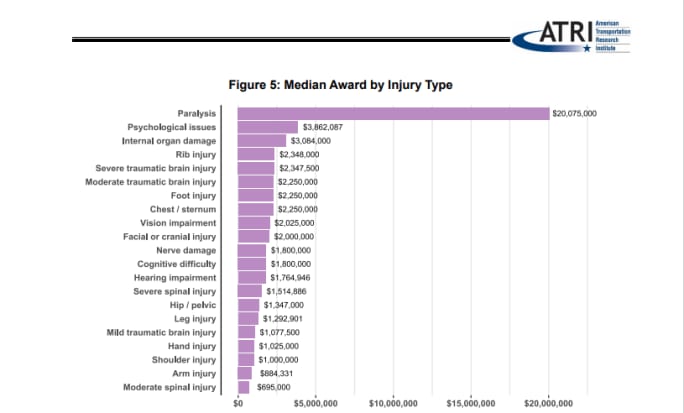
Chart: ATRI
Nonfatal injuries were classified into two categories based on whether or not surgical intervention was necessary: severe injuries and soft-tissue injuries. In cases with awards of $1 million or more, cases with severe injuries had significantly higher total awards than cases with soft-tissue injuries.
The median award for cases with severe injuries was $3.0 million, while the median award for cases with soft-tissue injuries was $2.0 million.
In cases with awards under $1 million, however, there was no statistically significant difference in the total award for cases with severe injuries versus cases with soft-tissue injuries.
Injuries were categorized into 24 unique types across all cases in the litigation dataset. All injury type variables were dichotomous and nonexclusive, meaning that multiple injuries could have occurred in one case.
Cases with fatalities can include other injuries if they occurred before the fatality or to another party in the same crash.
“ATRI’s report underscores the need for fair and balanced reforms to the legal system and the importance of remaining vigilant in this challenging legal environment,” said Renee Amar, Louisiana Motor Transport Association executive director. “Its assessment of the current litigation environment serves as an important wake-up call for policymakers.”
“Both frivolous and excessive litigation pose grave challenges to the trucking industry today. They drain significant time and resources that could otherwise be spent on improving industry operations and safety,” said Nathan J. Meisgeier, Werner Enterprises president and chief legal officer. “ATRI’s data-driven insights on case outcomes are a valuable resource for decision-makers.”
The full report can be downloaded here.
More Safety & Compliance

FMCSA Pauses Biennial-Update Enforcement Amid Motus Transition
Carriers whose updates were due on or after June 1 have more time, while FMCSA works to stabilize its new registration system and warns of phishing sites impersonating its new carrier registration system, Motus.
Read More →
ZF Expands Commercial Vehicle Push in North America
ZF is expanding its North American commercial-vehicle presence with new transmission applications, electrification, trailer technology and autonomous-driving systems.
Read More →
Truck Drivers Need More Than Another Alert
Fleets have more visibility into truck health, safety events, and driver activity than ever. The next challenge is turning all that information into useful guidance for the person who has to decide what to do next.
Read More →
Tesla Wants a Self-Driving Semi. Are Cameras Enough?
Could Tesla’s camera-only autonomous driving technology work on an 80,000-pound Semi? In this commentary, HDT's Deborah Lockridge takes a look at Tesla, Cybercab, and how autonomous trucks see the road.
Read More →
What DOT’s Automated Vehicle Strategy Means for Trucking
The U.S. Department of Transportation issued a new automated-vehicle strategy that outlines plans for driverless-truck regulations, cross-state freight corridors, and federal safety standards.
Read More →
NYC Expands Speed, Pedestrian Safety Tech Across Fleet
New York City is expanding intelligent speed assistance and pedestrian-alert systems across its municipal fleet, moving the technologies from pilot programs into vehicle procurement and retrofit requirements.
Read More →
FMCSA Removes 110 Truck Driver Training Schools from Certified ELDT List
Federal regulators also are targeting more than 160 additional training providers and launching a nationwide audit of third-party CDL skills testers as part of a broader crackdown on trucking fraud.
Read More →
Beyond DOT Compliance: What Makes a Trucking Fleet Truly Safe?
A trucking fleet can follow every rule and still make unsafe decisions. The real test comes when safety conflicts with freight, productivity, or cost.
Read More →
Hours of Service Pilot Programs: FMCSA Readies for 2027 Rollout
Two pilot programs could eventually reshape hours-of-service rules, giving truck drivers options to pause their 14-hour clock or use longer split sleeper rest periods.
Read More →
New Guide Offers Pet Safety Tips for Truck Drivers
Hundreds of thousands of pets travel in truck cabs. A new safety guide from Volvo Trucks and the Center for Pet Safety offers practical advice for truck drivers who bring dogs and cats along for the ride.
Read More →