




ATRI: Reclassification Would Decrease Owner-Operator Job Satisfaction, Income
How would reclassification of owner-operators as company drivers impact drivers? Find out what drivers think in this ATRI study.

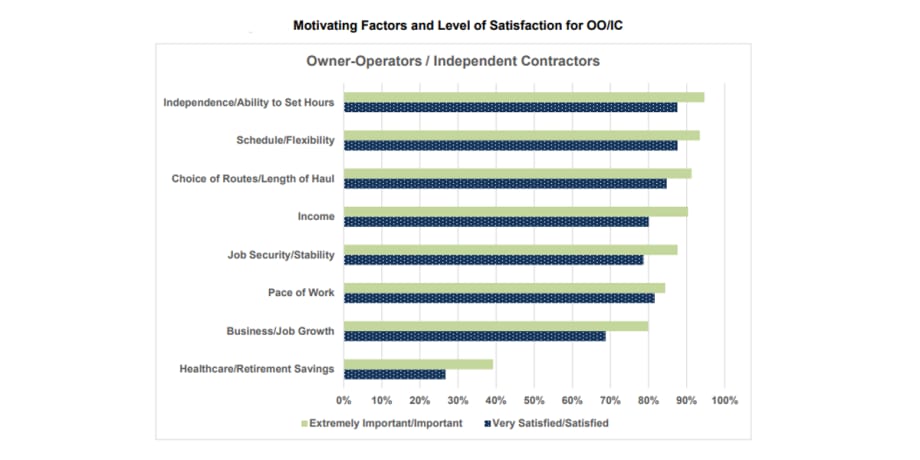
The ability for owner-operators to essentially control their own workplace environment is such a strong incentive that over 90% of owner-operator respondents ranked the top four motivating factors as ‘extremely important’ or ’important.’
Graph: ATRI
The majority of owner-operators indicated that they would expect to experience significant decreases in their job satisfaction and annual income if they were reclassified to a company driver, according to a recent study conducted by the American Transportation Research Institute’s Research Advisory Committee.
The study, which surveyed 2,097 drivers, aimed to better understand the existing role of owner-operators/independent contractors in the supply chain, and the impact that labor classification laws could have on commercial truck drivers.
Motivating Factors Behind Becoming a Company Driver or Owner-Operator
The top three motivating factors behind the decision to become a company driver were job security/stability (nearly 90% rated this factor has ‘extremely important’ or ‘important’), income (83%), and healthcare/retirement savings (nearly 80%).
Meanwhile, the top motivating factors behind becoming an owner-operator/independent contractor were independence/ability to set hours, schedule/flexibility, and choice of routes/length of haul.
The ability for owner-operators to essentially control their own workplace environment is such a strong incentive that over 90% of owner-operator respondents ranked the top four motivating factors as ‘extremely important’ or ’important.’
In contrast, the least important motivating factors for company drivers were choice of routes/length of haul, independence/ability to set hours, and business/job growth.
Compensation: Company Drivers Versus Owner-Operators
Among company drivers, the primary compensation models are paid by the mile (46%) and paid by the hour (nearly 28%).
About 74% of company drivers who are paid by the hour, and 66% of company drivers who are paid by the mile, indicated they were ‘very satisfied/satisfied’ with their income.
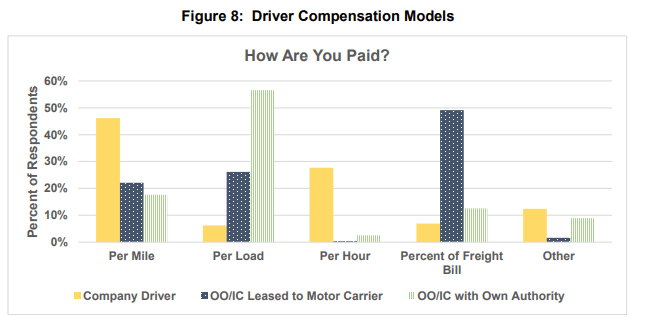
Among owner-operators leased to a motor carrier, the primary compensation method is percent of freight bill, and among owner-operators with their own operating authority, the majority are paid by the load.
Graph: ATRI
Among owner-operators leased to a motor carrier, the primary compensation method is percent of freight bill (49%), and among owner-operators with their own operating authority, the majority (nearly 57%) are paid by the load.
Nearly 81% of owner-operators paid by percent of freight bill, and 81% of owner-operators paid on a per load basis, reported being ‘very satisfied’ or ‘satisfied’ with their income level.
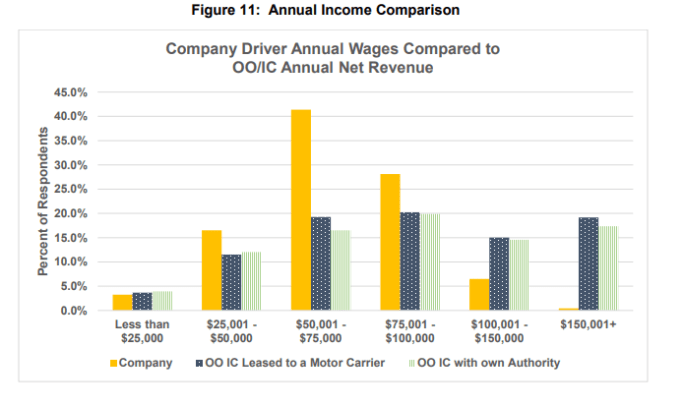
Nearly 70% of company drivers indicated their annual wages fell in the $50,000 to $100,000 range.
Graph: ATRI
Nearly 70% of company drivers indicated their annual wages fell in the $50,000 to $100,000 range. About 55% of owner-operators leased to a motor carrier, and nearly 52% of owner-operators with their own operating authority, reported annual net income for the previous year of $75,000 or higher.
The Impact of Reclassification of Owner-Operators
In recent years, new legislation pertaining to employment status classification has been introduced in various states that threatens the eligibility of drivers to work as owner-operators/independent contractors.
For example, Assembly Bill No. 5, commonly referred to as AB 5, was signed into law by the California Governor in September 2019 and went into effect in January of 2020. With a few exceptions, the bill limits when workers can be considered independent contractors and will require companies that hire workers as independent contractors to reclassify them as employees if they do not pass a three-part test.
The majority of owner-operators expect that they would experience significant decreases in their job satisfaction (73%) and annual income (68%) if they were reclassified to a company driver.
Fewer than one in five company drivers indicated a desire to become an owner-operator in the future. Among those who did desire to become an owner-operator, nearly 85% believe they would experience an increase in their income and 71% indicated they believe they would experience an increase in their job satisfaction.
Among company drivers who indicated that they had been an owner-operator in the past (about 36%3), 30% indicated that their income had decreased since becoming a company driver and 20% indicated that their job satisfaction had decreased.
More Drivers

Truck Drivers Need More Than Another Alert
Fleets have more visibility into truck health, safety events, and driver activity than ever. The next challenge is turning all that information into useful guidance for the person who has to decide what to do next.
Read More →
FMCSA Removes 110 Truck Driver Training Schools from Certified ELDT List
Federal regulators also are targeting more than 160 additional training providers and launching a nationwide audit of third-party CDL skills testers as part of a broader crackdown on trucking fraud.
Read More →
Hours of Service Pilot Programs: FMCSA Readies for 2027 Rollout
Two pilot programs could eventually reshape hours-of-service rules, giving truck drivers options to pause their 14-hour clock or use longer split sleeper rest periods.
Read More →
Medical Cards, English Proficiency Reshape Roadcheck Violations
Medical-card violations jumped to the top of the driver out-of-service list during CVSA’s 2026 International Roadcheck, while English-language proficiency violations appeared among the leading violations for the first time.
Read More →
Driver Trust Can Make or Break the Success of Fleet Safety Technology
New Teletrac Navman research suggests that onboarding, transparency about driver data, and positive feedback can play a significant role in how commercial drivers respond to safety and coaching technology.
Read More →
EEOC Sues KLLM Over Alleged Sex Discrimination in Driver Training
KLLM is facing a federal sex-discrimination lawsuit over policies the EEOC alleges put female truck driver trainees at a disadvantage.
Read More →
FMCSA Moves to Codify English Language Requirements for Commercial Drivers
By changing regulations on English-language proficiency requirements for commercial drivers, rather than relying on a guidance memo, the FMCSA said future administrations won't be able to walk back the Trump administration's stricter enforcement with just a memo.
Read More →
Drivers Put Western Star Trucks to the Test at Star Nation Experience
Watch to get an inside look at the Western Star trucks, technology, and community behind the Star Nation Experience 2026!
Read More →
Trump Administration Looks to Put More Veterans Behind the Wheel
The Freedom Haulers program pulls together existing and expanded programs at several federal agencies to recruit veterans to drive commercial heavy-duty trucks and cut the red tape for them to get a CDL, training, and employment.
Read More →
Putting Mack’s Command Steer to the Test
A test drive of Mack’s Command Steer active steering system evaluates how it can make truck driving easier and less tiring.
Read More →