





California Ups the Ante on ZEVs with Advanced Clean Fleets Rule
ATA's Spear: Emission Reduction Timelines Unrealistic
ATA President Chris Spear addressed the challenges of government timelines for reducing emissions and praised the industry for what it has accomplished in reducing diesel emissions over the last four decades, in a speech during a Pressure Systems International fleet technology event.
November 20, 2023
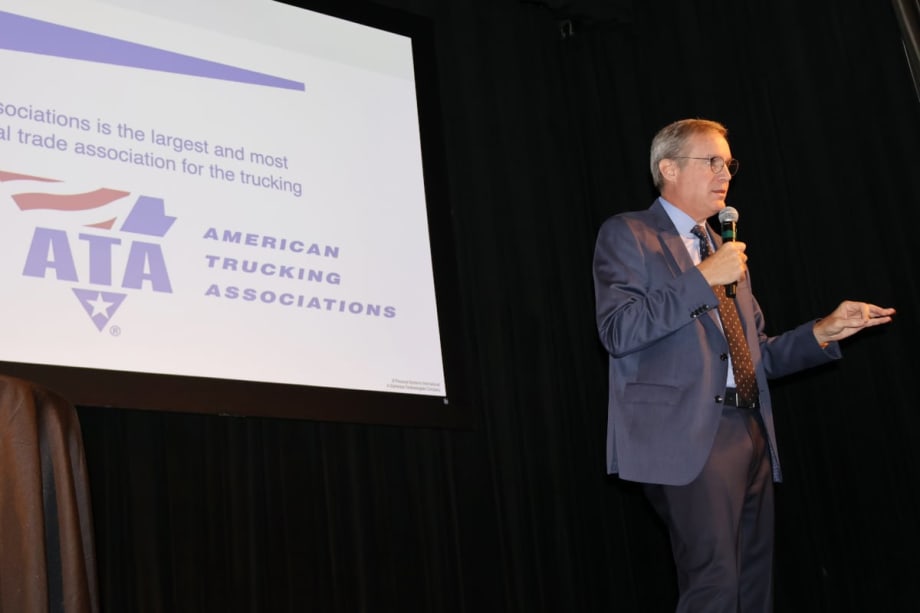
ATA President Chris Spear talks about emissions reductions and trucking during the Cummins-Meritor and Pressure Systems International fleet technology event last week.
Photo: Pressure Systems International
4 min to read
Chris Spear, president and CEO of the American Trucking Associations, said energy and the environment will be the biggest issues defining the trucking industry over the next decade. Although he pointed to the infrastructure challenges in making alternative-fuel trucking widely available, he praised the industry for ongoing significant reductions of tailpipe emissions from traditionally fueled trucks.
“I would like to start with a good: Our story is amazing on this issue. In 40 years, our OEMs, Cummins, have helped remove 98% of everything that comes out of the tailpipe,” Spear told trucking leaders while speaking last week at the Cummins-Meritor and Pressure Systems International fleet technology event in San Antonio, Texas.
He pointed to how the trucking industry has significantly reduced emissions. Today, the emissions from 60 trucks equal the emissions of just one truck in 1988.
“That's innovation. That's empowerment. That's an industry that is doing the right things,” Spear said.
He said it is up to the trucking industry to share the story, and let the president, legislators, governors, and state houses know that the trucking industry is not saying “no” to lowering emissions. He emphasized that through innovation, the industry has said “yes.”
CARB Influence
Spear said elected officials are putting emissions reduction timelines and targets out that are "unrealistic." Sixteen states have already adopted emissions standards crafted by the California Air Resources Board, he said.
“What this administration has done is hand California the keys to not only set national environmental policy, but regulate it,” Spears added. “We do not have the infrastructure in place to charge.”
Spear publicly pondered what it would be like if trucks, and cars, could charge anywhere, with plenty of parking, and plenty of available chargers.
“Where's the power from? Nuclear? Coal? Definitely not. Wind, solar, hydro, I don't care. ASHRAE (American Society of Heating, Refrigerating and Air-Conditioning Engineers) tells us that to charge every car and truck currently on the road would take 40% more capacity on the grid."
He also pointed to California, home of CARB, saying there is already insufficient energy and rolling blackouts are prevalent.
Other BEV Challenges
Sourcing the minerals used for battery-electric vehicles is also a challenge, Spear said. Materials such as graphite, nickel, cobalt, and lithium will be in great demand if U.S. vehicles are to be electrified on a large scale.
"Where's it all coming from? China and Congo, not two very reliable sources long term."
The ATA president said if such minerals were permitted to be mined domestically, it would take 10 years from start to finish for those to reach the market.
“You've got to have your OEMs having a steady source to build that capability, and it doesn't exist right now."
Another consideration, he said, is cost parity. Battery-electric trucks now cost three to four times that of a new diesel truck. Battery-electric trucks will need to become more competitively priced.
Also, there needs to be more parity between charging and fueling. Spear said in just 15 minutes a diesel truck can be filled and ready to travel 1,200 miles, yet it may take six hours or even longer to charge a battery-electric truck to travel 250 miles.
Where to Start?
“We need to be sequencing this. Don't make it applicable to everybody, especially long haul,” Spear said.
He suggested that the logical approach to electrification will be by beginning with drayage, then school buses, garbage trucks, and other vehicles that can be charged overnight and ready to go the next morning. He said the charging infrastructure should be built first around those vehicles and then expand.
“It's just common sense. It takes time. You're not going to get there starting in 2030, not going to meet that by 2035. It ain't gonna happen, and when it fails, it's not only going to be embarrassing, it's going to cost a lot of people their jobs,” said Spear. “To me, that's just not acceptable.”
Standing Together
Spear said the trucking industry really is like a family, and all members should stand together. And that family should tell the story of its success that have already had an impact in reducing emissions.
“It is absolutely critical that we speak as one voice,” he added, noting how the current environment is divisive when it comes to energy and transportation.
Trucking and transportation should not be politicized, he stressed.
“The political divisiveness, the uncertainty in the market, global geopolitical tensions, these are all forces that we don't control,” Spear said.
“What we do control is our own ability to tell our story. And if it's unified, if it plays to all political spectrums. It sells. Trucking is not a partisan issue. It's an American issue.”
More Fuel Smarts

How Volvo Updated Its D13 for EPA 2027 [Watch]
Volvo’s updated D13 promises lower emissions without sacrificing performance or fuel economy. Take a closer look at what changed inside the engine in this HDT Spotlight video.
Read More →
Diesel Price Spike Shortens Payback for Natural Gas Trucks, Report Says
Energy Vision estimates fleets could recover the higher purchase price of an RNG-fueled Class 8 tractor in 1.3 to 2.8 years under current fuel-price scenarios.
Read More →
Calstart Becomes Catalyst Mobility, Reflecting Broader Focus
Calstart is now Catalyst Mobility, reflecting the nonprofit’s growing national role in clean transportation, including zero-emission trucks, infrastructure and incentive programs.
Read More →

Record Diesel Prices Squeeze Trucking Fleets
Average U.S. diesel prices have climbed to nearly $6 a gallon, surpassing the 2022 record as tight refinery capacity and Middle East disruptions keep fuel costs elevated.
Read More →
Sponsored•September 9, 2026
How Fuel Delivery Shapes Engine Performance
Fuel delivery depends on more than what happens at the injector. For fleet, maintenance and technical professionals, looking at the full path from pump to injector can provide useful context for understanding engine performance.
Read More →
East Coast Port Launches $45M Electric Truck Push
The Port Authority of New York and New Jersey announced millions in incentives for zero-emission drayage trucks, yard tractors, and new charging hubs near the port.
Read More →
California Bill Could Shed Light on Electric Truck Prices
Why do battery-electric Class 8 trucks remain so expensive? A California bill headed to Gov. Gavin Newsom would give fleets and state agencies more visibility into what manufacturers charge.
Read More →
Detroit Opens Orders for EPA 2027 Engines
Detroit isn’t starting from scratch to meet EPA 2027 diesel emissions standards. Its Gen 6 DD13 and DD15 engines keep much of today’s platform while updating the fuel and aftertreatment systems.
Read More →
Zero-Emission Truck Corridor Planned for West Coast
California, Oregon, Washington, British Columbia and Baja California are coordinating plans for truck charging and hydrogen fueling from Canada to Mexico.
Read More →
A Closer Look at Kenworth’s Electric T880E Vocational Truck [Video]
Learn more about Kenworth's T880E battery-electric vocational truck at the Paccar Technical Center, including its range, applications, upfitting considerations, and PTO options, in this HDT Spotlight video.
Read More →