




ATA Rep Calls For Improvement in Border Infrastructure
In a testimony before a congressional panel, Stephen Russell, chairman and CEO of Celadon Group, said there needs to be an improvement to border infrastructure and procedures in order to up security and efficiency of freight transportation across borders
In a testimony before a congressional panel, Stephen Russell, chairman and CEO of Celadon Group, said there needs to be an improvement to border infrastructure and procedures in order to up security and efficiency of freight transportation across borders.
Russell, who spoke on behalf of the American Trucking Associations, called for more funds for infrastructure, more enforcement of trade security program rules, and an increased role in coordinating federal efforts to the Department of Homeland Security (DHS) and its Customs and Border Protection (CBP) agency.
He told the House Subcommittee on Border, Maritime and Global Counterterrorism, House Homeland Security Committee that "closer cooperation and understanding between industry and government will yield an even higher degree of security at our nation's borders and will improve cross-border operations and the international supply chain."
Russell applauded such programs as Free and Secure Trade (FAST) and the Customs-Trade Partnership Against Terrorism program (C-TPAT). To participate in FAST, motor carriers must become C-TPAT certified and their drivers must undergo a background check. Carriers can get expedited clearance of their equipment, driver, and cargo - as long as it belongs to a C-TPAT importer - in addition to getting access to a lane dedicated for FAST participants.
"The biggest challenge trucking companies continue to face with the C-TPAT/FAST program is the lack of 'true' FAST lanes," said Russell. "This results in low-risk C-TPAT carriers being stuck in the same traffic as non-C-TPAT certified carriers."
"The end goals of security and efficiency are not mutually exclusive. Though it is impossible to achieve absolute security without bringing trade to a standstill, we can greatly reduce the potential of being targeted by our enemies by managing risk, increasing security awareness among company personnel, and implementing simple cost-effective security measures," Russell said.
In addition, if a carrier has a single security incident, its C-TPAT status is immediately take away, even before an investigation takes place. If an inspection finds contraband on a C-TPAT carrier's truck, the carrier can be suspended from the program without knowing if the contraband was placed on the truck during loading of freight or at another point in the supply chain.
Russell urged Congress to address these issues, suggesting that the carrier get an investigation first, instead of being suspended immediately. If after an investigation the carrier is found not at fault, the company would be put on probation. If it is found to be at fault, the government can suspend the carrier and require it to reapply and undergo again a full validation of program requirements.
Russell also voiced his support of the development of Automated Commercial Environment (ACE), an electronic manifest system that captures trade data, clears cargo entering the U.S., and provides Customs and Border Protection with an improved system for targeting, risk analysis, and release of cargo.
"The trucking industry encourages the U.S. government, in cooperation with both Canada and Mexico, to improve and to facilitate the capture and exchange of information on goods and people crossing our land borders," Russell said. ATA recommends that the U.S. government quickly implement the Smart Border Accord between the U.S. and Canada, the 22 Point Plan between the U.S. and Mexico, and recommendations of the North American Security and Prosperity Partnership.
More Drivers
Platform Science Adds Dispatch and Safety Tools
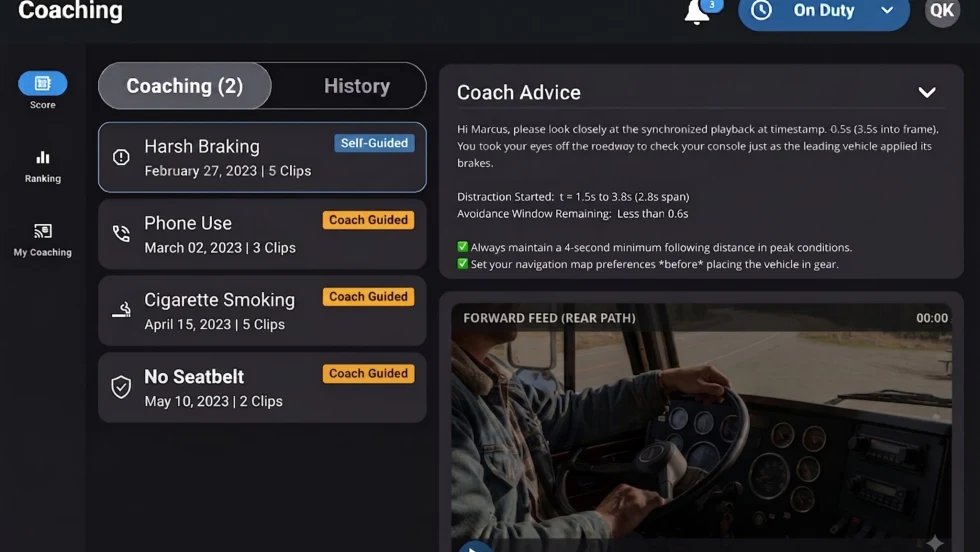
Four additions to PS Fleet help fleets monitor loads, manage driver coaching, share truck locations and adjust video system settings.
Read More →
When Language Stops the Truck: The Return of ELP Out-of-Service Orders
English language proficiency rules for commercial drivers aren’t new, but renewed out-of-service enforcement has raised the stakes. Here’s what carriers need to know before a driver reaches a roadside inspection.
Read More →
Samsara Launches Custom AI Agent Builder
Agent Studio lets fleets create AI tools for hours-of-service monitoring, reporting and driver support, including agents that communicate by phone.
Read More →
Trucker Path Expands Reserved Parking Network
Trucker Path has added close to 6,000 more truck parking spaces to its Trucker Path Reserved Parking Network with the addition of Safe Truck Parking.
Read More →
EEOC Sues Texas Trucking Company Over Driver Age Limits
The agency says Trancasa USA rejected applicants over 65 and applied tougher driving-record standards to those over 60.
Read More →
Nussbaum, Roehl Announce Second Driver Pay Increase This Year
This year has seen a swath of major truck driver pay increases as freight capacity has tightened.
Read More →
From One Generation to the Next: How Mentorship Builds Safer Truck Drivers
After three decades in trucking, Harold Perry shares what he's learned about driver safety, mentorship, and helping the next generation build confidence behind the wheel.
Read More →
Truck Drivers Need More Than Another Alert
Fleets have more visibility into truck health, safety events, and driver activity than ever. The next challenge is turning all that information into useful guidance for the person who has to decide what to do next.
Read More →
FMCSA Removes 110 Truck Driver Training Schools from Certified ELDT List
Federal regulators also are targeting more than 160 additional training providers and launching a nationwide audit of third-party CDL skills testers as part of a broader crackdown on trucking fraud.
Read More →
Hours of Service Pilot Programs: FMCSA Readies for 2027 Rollout
Two pilot programs could eventually reshape hours-of-service rules, giving truck drivers options to pause their 14-hour clock or use longer split sleeper rest periods.
Read More →