





Dig Deeper: How to Get the Most from Your Truck Batteries
Are Dead Batteries About to Become a Thing of the Past?
Clarios has developed a connected battery that provides real-time updates on battery cell life and can even predict when failures will occur.
January 20, 2023
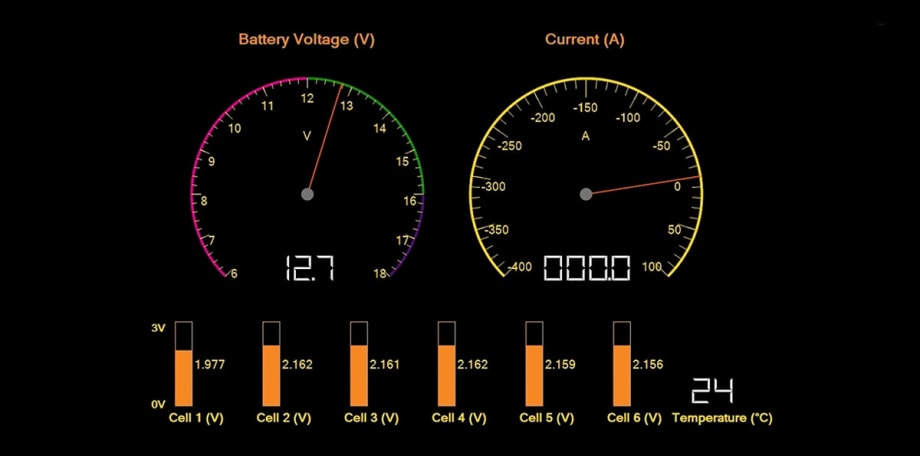
Clarios’ Smart AGM battery monitoring system gives real-time data on a truck’s battery life, including overall voltage, current and individual cell life.
Photo: Clarios
4 min to read
In an age of increasingly connected and smart vehicle components, one system has remained infuriatingly difficult to divine when it comes to health and predicting time-to-failure: The humble, 12-volt, automotive battery.
Clarios, the largest manufacturer of automotive batteries in North America, announced a new Smart AGM (absorbed glass mat) battery during the recent CES electronics show in Las Vegas. It features electronic sensors embedded deep inside that can monitor battery cell life in real time and even alert fleets and drivers when a battery failure is imminent.
Accurately gauging battery life has always been a stumbling block for good fleet maintenance practices because there hasn’t been a reliable way to determine how much life a battery has left. Yes, you can use 100-amp load testers and other state-of-charger testers. But all these do is tell you the battery’s current charge level: Simply whether it’s good or bad. They can’t help you understand how much useful life a battery has left. All they really do is confirm that a bad battery is, in fact, dead.
“Every 12-volt automotive battery has six cells – but we’ve never been able to understand what’s going on inside those cells in real time,” explained Jason Searl, vice president, products, Clarios, in an interview. “But now, with our patent-pending new technology, fleet managers, technicians and drivers will be able to look at, and monitor, cell life in real time. The system can identify weak cells that eventually drag a battery down and allows for a predictive assessment as to how many days, weeks or months that battery has left before cellular failure occurs.”
The reason it’s been so hard to get inside a battery and monitor cell life in real time, Searl added, is because the inside of an automotive battery is a hellish place. Positive and negative plates are awash with sulfuric acid. And finding delicate electronic sensors that could survive in that environment without corroding was difficult to do.
“What we’ve done is create connection points inside the battery,” Searl said. “Over time, we refined that process to the point and produce tight enough tolerances that we could make additional connections with sensors that can survive not just inside a battery, but in a trucking environment with vibration, alternating hot, cold, humid and dry conditions. We were able to do that by leveraging Clarios aerial lithium-ion battery technologies. So, we are essentially bringing aircraft-level technologies into trucking with this system.”
Maintenance, Spec’ing and Component Life Implications
John Bania, product line leader for heavy duty and specialty batteries, Clarios, said the Smart AGM system can be easily integrated into any fleet maintenance system, using either a web portal or dashboard.
“We are working on interfaces that will work for large fleets that need to identify issues, trends or get alerts on high-risk batteries,” he said. “We’re also working on versions for smaller fleets that use portal access or other alert avenues like text alerts or emails.”
The screen displaying battery information is simple and intuitive to use. Two large gauges at the top display the battery’s overall voltage rating and current in amps. Below, each two-volt cell is displayed as a bar graph, with the cell’s current voltage to the right and a colored graph showing how much life is left in each cell. Healthy cells will be colored green, aging cell graphs colored yellow, and cells in danger of failure colored red. Technicians can access the system during vehicle maintenance to check battery life and replace one if a failure is predicted before the next service interval.
Likewise, drivers and fleet managers alike can get real-time alerts when a battery is about to die. This can greatly reduce repeat visits to the shop from mis-diagnosed battery replacements when an electrical issue, or a failing alternator or starter is the actual cause of the problem.
But the benefits of the Smart AGM technology go beyond simply eliminating dead batteries, Searl said.
“Fleets will be able to determine what kind of battery life they’re getting and why,” he said. “They will be able to identify issues that are shortening battery life, like overuse — liftgates, for example, or drivers making frequent stops with electric systems running but not enough drive time between them to recharge the battery properly. Using data from the Smart AGM battery monitoring system will allow fleets to making better spec’ing decisions that will give better performance and efficiencies from a truck’s entire electrical system.”
The Clarios Smart AMG battery monitoring system is currently available for AGM type batteries only – although Searl said the company is working on a system for lead-acid type batteries as well.
Smart AMG is currently undergoing testing, with fleet trials scheduled for this summer. Searl predicts the system will be available in limited production runs later this year, with full availability following in 2024.
More Maintenance

Shell Prepares Rotella Oils for 2027
New CL-4 and FB-4 formulations will begin arriving in early 2027, with improved protection against oil breakdown, wear and deposits, according to Shell.
Read More →
Mack Expands Extended Coverage With Four Chassis System Plans
Mack Trucks' new system-specific coverage options allow heavy-duty fleets to select protection for driveline, cab, HVAC, electronics, and advanced safety components.
Read More →
What an Out-of-Service Order Really Costs, and How to Plan for One
The repair invoice is the first number you see — and often one of the smallest. Here’s what else an out-of-service order can cost a fleet, and how planning can reduce the damage.
Read More →

International Launches Online Truck Parts Store
Fleetrite.com lets fleets and repair shops find OEM and all-makes parts, check prices and availability, and order without calling a parts counter.
Read More →
Continental Introduces New Regional Truck Tires
Continental says its new Generation 5 steer and drive tires for regional operations offer longer tread life, with estimated mileage gains of 22% and 19%, respectively.
Read More →
Sponsored•October 1, 2026
How AI Can Help Your Techs’ Efficiency
The technician shortage isn't going away, and no single fix can close the gap on its own. Trent Broberg makes the case that AI's real job in the shop is protecting the billable hours and job satisfaction of the techs you already have, not asking them to work faster.
Read More →
Color Match Smarter: Tools That Restore & Perform
For fleet managers and collision repair professionals keeping heavy-duty trucks on the road, getting the color right the first time isn't just about appearance — it's about efficiency, turnaround time, and bottom-line results. Discover how today's digital color tools are transforming the repair process from guesswork to precision.
Read More →
Wrong Repair Prompts Recall of Freightliner, Western Star 4x2 Trucks
DTNA is recalling more than 2,400 trucks that received an incompatible software fix instead of the hardware repair required to address brake valve corrosion.
Read More →
Truck Drivers Need More Than Another Alert
Fleets have more visibility into truck health, safety events, and driver activity than ever. The next challenge is turning all that information into useful guidance for the person who has to decide what to do next.
Read More →
The Maintenance Checks Trucking Fleets Should Prioritize Before Fall Freight Picks Up
Making it through August isn’t the same as being ready for the next several months of operation. Find out what systems may have suffered from summer heat and need to be checked out before fall.
Read More →