




Related: Allison’s FuelSense 2.0 Allows Fleets to Improve Fuel Economy
Allison Expands Fuel-Efficient Medium-Duty Transmission Tech
Allison Transmission has begun offering its xFE fuel-saving technology on two more of its medium-duty transmissions, including the 1000 Series and 2000 Series, the company has announced.
by Staff
October 6, 2017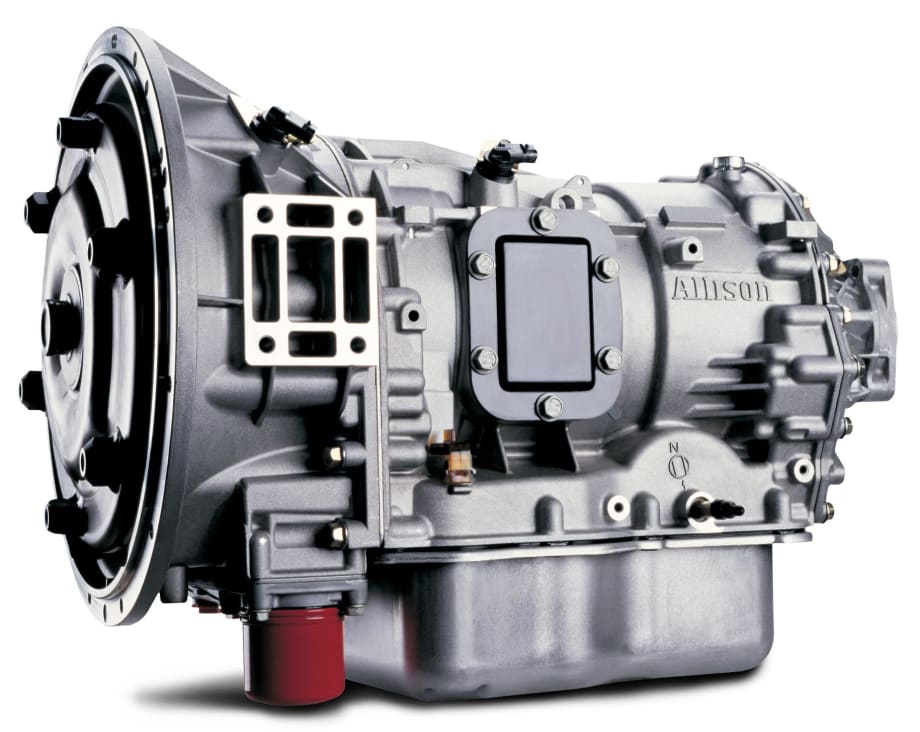
Photo of 1000/2000 Series transmission courtesy of Allison.
1 min to read
Photo of 1000/2000 Series transmission courtesy of Allison.
Allison Transmission has begun offering its xFE fuel-saving technology on two more of its medium-duty transmissions, including the 1000 Series and 2000 Series, the company has announced.
The xFE technology, which stands for extra fuel economy, can improve fuel efficiency by 7% when compared to baseline models. The technology was previously available on select 3000 Series models.
The 1000 Series and 2000 Series transmissions are usually paired with smaller medium-duty trucks and buses. They offer the same ratings as current models and incorporate a redesigned torque converter damper coupled with the FuelSense 2.0 Max package. The damper enables first range lock up and delivers significantly more lock up operation, according to the company. They operate at lower engine speeds in higher ranges to further improve fuel economy. The xFE transmissions are compatible with alternative fuel engines.
Allison debuted its xFE transmissions in 2015 for 3000 Series buses. FuelSense 2.0 with DynActive shifting debuted in March. Allison employs a series of software enhancements to provide a variable combination of shift points and learning algorithm that searches for the ideal balance of fuel economy and performance.
Allison transmissions also use Continuous Power Technology to smoothly multiple engine torque and deliver more power to the wheels.
More Fuel Smarts

Why Diesel Price Relief Efforts May Fall Short
Diesel prices have eased from September’s record high, but doubts about additional Russian supply and limits on dyed-diesel tax relief mean trucking fleets still face expensive fuel. And prices could go higher.
Read More →
Why Small Fuel Savings Matter in Trucking
Can better fuel economy help pay for driver raises? In this podcast, GP Transco explains how small efficiency gains create room to reinvest in its people.
Read More →
How GP Transco Cuts Trucking Fuel Costs, a Tenth of a Gallon at a Time
What’s another tenth of a mile per gallon worth? GP Transco shares how equipment upgrades and driver coaching turn small gains into meaningful fuel savings.
Read More →
Electric Yard Tractors Move Beyond Pilots
Operating-cost savings have overtaken sustainability goals as the leading reason surveyed fleets are adopting battery-electric terminal tractors, according to new NACFE research.
Read More →
Geotab Links Fleet Card to Vehicle Data
The new card combines fuel discounts with telematics-based purchase controls. Geotab’s analysis also points to potential savings from choosing lower-priced fuel stops.
Read More →
Fleet Economics Shape Electric Truck Outlook
ACT Research expects costs, charging infrastructure, and technology improvements to drive zero-emission commercial vehicle adoption as federal regulations and incentives retreat.
Read More →
Wex Adds Cardless Fuel Payments for Over-the-Road Customers
A new fuel card feature for Wex customers offers convenience and security.
Read More →
New California Law Could Shed Light on Electric Truck Prices
Why do battery-electric Class 8 trucks remain so expensive? A California bill signed by Gov. Gavin Newsom would give fleets and state agencies more visibility into what manufacturers charge.
Read More →
How Volvo Updated Its D13 for EPA 2027 [Watch]
Volvo’s updated D13 promises lower emissions without sacrificing performance or fuel economy. Take a closer look at what changed inside the engine in this HDT Spotlight video.
Read More →
Diesel Price Spike Shortens Payback for Natural Gas Trucks, Report Says
Energy Vision estimates fleets could recover the higher purchase price of an RNG-fueled Class 8 tractor in 1.3 to 2.8 years under current fuel-price scenarios.
Read More →