





Daimler Truck Plans to Create Nationwide Truck Charging Network
Administration Announces $5 Billion Program to Jumpstart EV Charging Network
How will the Biden administration's $5 billion EV charging infrastructure plan work? Will heavy-duty trucks be included?
February 10, 2022
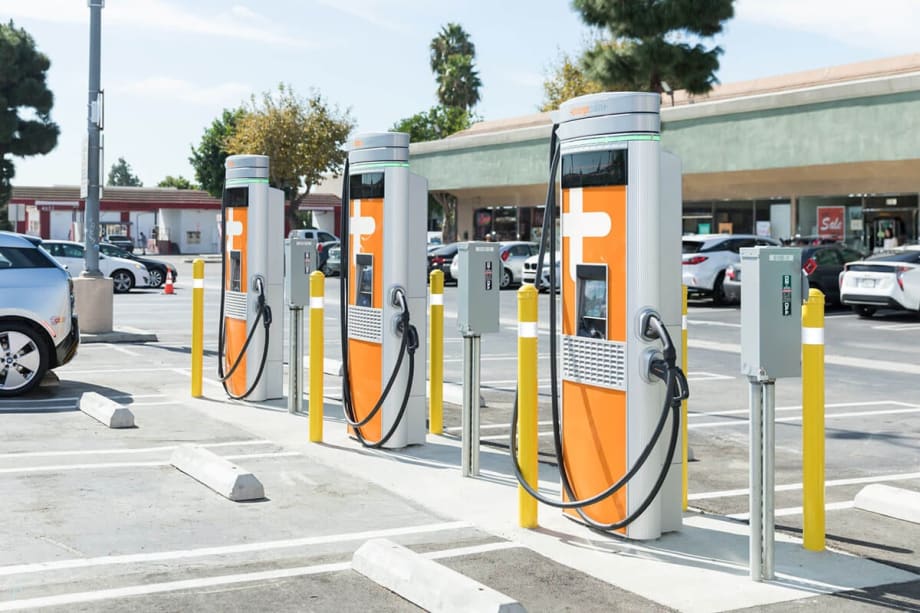
The new EV infrastructure funding program encourages states to work with private enterprise. ChargePoint is working with truckstop/travel plaza group NATSO to install DC fast chargers.
Photo: Maria Hedrick, Courtesy ChargePoint
4 min to read
The Biden administration is making nearly $5 billion available to states to start building out a national electric-vehicle charging network.
The Feb. 10 announcement from the Departments of Transportation and Energy followed President Biden’s announcement that Tritium will break ground on its first U.S. manufacturing facility, which will produce up to 30,000 Buy America-compliant DC fast chargers per year at peak production.
The new National Electric Vehicle Infrastructure (NEVI) Formula Program to build out a national electric vehicle charging network was established by President Biden’s Bipartisan Infrastructure Law. The program will provide nearly $5 billion over five years to help states create a network of EV charging stations along designated Alternative Fuel Corridors, particularly along the Interstate Highway System.
NEVI Formula Program funds are restricted to projects that are open to the public or to authorized commercial motor vehicle operators from more than one company. The total available to states in FY-2022 under the NEVI Formula Program is $615 million. States must submit an EV Infrastructure Deployment Plan before they can access these funds.
All EV charger infrastructure installed as part of the NEVI Formula Program should be Direct-Current (DC) fast chargers, according to NEVI guidance from the Federal Highway Administration. Stations should be designed to provide at least four Combined Charging System (CCS) ports capable of simultaneously charging four EVs. Station power capability should be no less than 600 kW (supporting at least 150 kW per port simultaneously across four ports) for charging. Maximum charge power per DC port should not be below 150 kW and should consider design and construction practices that allow for 350kW or greater charging rates through future upgrades.
Station designs should also consider the potential for future expansions needed to support the electrification and charging demands of medium- and heavy-duty trucks, including station size and power levels.
Partnering with the private sector
Traditional fuel stops, such as truckstops, were happy that the plan will include the private sector.
In its NEVI program guidance, FHWA said it anticipates that in most instances, states will elect to contract with private entities for the installation, operation, and maintenance of EV charging infrastructure.
FHWA’s guidance specifically says, “States should consider locations at or immediately adjacent to land uses with publicly accessible restrooms, appropriate lighting, and sheltered seating areas such as travel centers, food retailers, convenience stores” and others.
“The purpose of public funding is not to discourage private investment, but instead to catalyze additional private investment and supplement and fill gaps to provide a convenient, reliable, affordable, and equitable national EV charging network.” States are encouraged to develop programs with cost-share requirements or rebates to leverage private investment in EV charging.
The associations NATSO, representing America’s truckstops and travel plazas, and SIGMA: America’s Leading Fuel Marketers, have previously expressed concerns that such a plan might focus on EV charging facilities at rest areas and other public facilities at the expense of private businesses.
“We applaud the Biden administration for deploying funds under the electric vehicle formula program in a manner that directs states to contract with the private sector to install and operate electric vehicle charging to create a network of EV charging stations along designated Alternative Fuel Corridors,” the two groups said in a statement.
Some forward-thinking truckstops and travel centers have already been working on installing EV charging infrastructure, at least for passenger vehicles. For instance, Electrify America in 2020 announced it would work with Love’s Travel Stops to bring public ultra-fast electric vehicle charging stations to seven locations in six U.S. states. Also in 2020, ChargePoint and NATSO said they would work together to build high-speed charging stations at more than 4,000 truck stops and travel plazas across the country by 2030. In its first year, the public-private collaboration funded more than 150 DC fast charging spots in at least eight states.
In December, the DOT and DOE announced the creation of the Joint Office of Energy and Transportation, which will support deployment of the national EV charging network, including providing technical assistance to states as they develop their EV charging plans. A new website, DriveElectric.gov, will support states in their planning.
A second grant program designed to increase EV charging access in locations throughout the country, including in rural and underserved communities, will be announced later this year.
More Fuel Smarts

How Volvo Updated Its D13 for EPA 2027 [Watch]
Volvo’s updated D13 promises lower emissions without sacrificing performance or fuel economy. Take a closer look at what changed inside the engine in this HDT Spotlight video.
Read More →
Diesel Price Spike Shortens Payback for Natural Gas Trucks, Report Says
Energy Vision estimates fleets could recover the higher purchase price of an RNG-fueled Class 8 tractor in 1.3 to 2.8 years under current fuel-price scenarios.
Read More →
Calstart Becomes Catalyst Mobility, Reflecting Broader Focus
Calstart is now Catalyst Mobility, reflecting the nonprofit’s growing national role in clean transportation, including zero-emission trucks, infrastructure and incentive programs.
Read More →

Record Diesel Prices Squeeze Trucking Fleets
Average U.S. diesel prices have climbed to nearly $6 a gallon, surpassing the 2022 record as tight refinery capacity and Middle East disruptions keep fuel costs elevated.
Read More →
Sponsored•September 9, 2026
How Fuel Delivery Shapes Engine Performance
Fuel delivery depends on more than what happens at the injector. For fleet, maintenance and technical professionals, looking at the full path from pump to injector can provide useful context for understanding engine performance.
Read More →
East Coast Port Launches $45M Electric Truck Push
The Port Authority of New York and New Jersey announced millions in incentives for zero-emission drayage trucks, yard tractors, and new charging hubs near the port.
Read More →
California Bill Could Shed Light on Electric Truck Prices
Why do battery-electric Class 8 trucks remain so expensive? A California bill headed to Gov. Gavin Newsom would give fleets and state agencies more visibility into what manufacturers charge.
Read More →
Detroit Opens Orders for EPA 2027 Engines
Detroit isn’t starting from scratch to meet EPA 2027 diesel emissions standards. Its Gen 6 DD13 and DD15 engines keep much of today’s platform while updating the fuel and aftertreatment systems.
Read More →
Zero-Emission Truck Corridor Planned for West Coast
California, Oregon, Washington, British Columbia and Baja California are coordinating plans for truck charging and hydrogen fueling from Canada to Mexico.
Read More →
A Closer Look at Kenworth’s Electric T880E Vocational Truck [Video]
Learn more about Kenworth's T880E battery-electric vocational truck at the Paccar Technical Center, including its range, applications, upfitting considerations, and PTO options, in this HDT Spotlight video.
Read More →