





Related: How to Speed Up the Shop
6 Ways Truck Fleets Can Reduce Downtime
Uptime’s a never-ending challenge for fleets, but there are tactics maintenance managers can use to reduce unscheduled downtime, according to a panel discussion at the American Trucking Associations’ Technology & Maintenance Council Annual Meeting in Atlanta on Feb. 25.
February 25, 2020
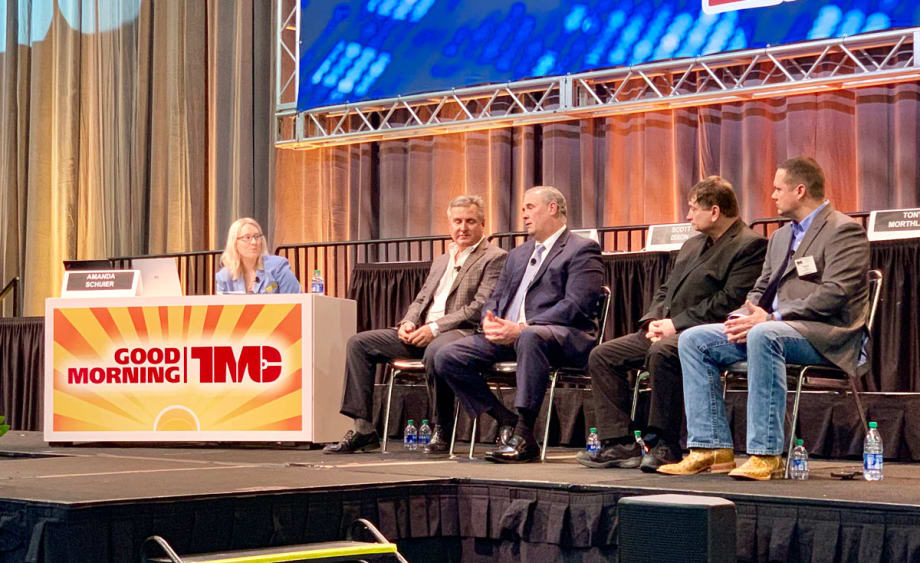
Moderator Amanda Schuier, Quality Transport, with from left, Benny Whitehead, Benny Whitehead Trucking; Scott Dixon, Four Star Freightliner; Tony Morthland, Nussbaum Transportation; and Travis Dunn, Truck Centers.
Photo: Deborah Lockridge
6 min to read
Uptime’s a never-ending challenge for fleets, but there are tactics maintenance managers can use to reduce unscheduled downtime, according to a panel discussion at the Technology & Maintenance Council Annual Meeting in Atlanta on Feb. 25.
Benny Whitehead, president of Benny Whitehead Trucking, an Alabama-based fleet of about 100 trucks; and Tony Morthland, director of equipment and facilities for Illinois-based Nussbaum Transportation, took the stage along with representatives from their local dealers to talk about strategies such as building a relationship with your service providers, developing a robust preventive maintenance inspection program, and taking the time to delve into why breakdowns are happening in the first place.
1. Build a relationship
The panel emphasized the importance of building a relationship with your local dealer and other service providers – even those out on the road in lanes your trucks frequently travel.
The relationship with your local dealer also gives you someone who can get involved when you’re having trouble dealing with a service provider on the road.
Travis Dunn, GM of Truck Centers’ Troy, Illinois, location, advised fleets to “visit dealers or service providers, meet them at events like this, just reach out, say hello, know the team, let them know your team. We’re all going after the same goal – we want to keep the customer rolling.”
Morthland goes beyond his local dealer. “We’ve got certain areas where we heavily travel ,and between our local provider here, we decided to go out and get handshakes and faces right in front of them, talk to them, and just try to build something, so they know who it is when you’re calling. It definitely helps.”
On the other hand, he said, “we know places where we know we’re not going to get anywhere with them, so we work with dispatch to see if we can switch loads. We may be forced to get a rental truck, maybe even tow it somewhere else.”
Whitehead agreed. “Some shops you just know you can’t get it in. We do the same thing.”
2. Pick your battles
Morthland emphasized “picking and choosing” the situations where the company really needs to push the service provider to turn a truck around quickly.
Conversely, the dealers noted that when a fleet lets them know if a repair isn’t as urgent, if they’re able to get that load repowered, it’s appreciated – and helps build a relationship where the dealer is more likely to help when it is urgent.
Dunn said his dealership has a weekly call with Nussbaum, the OEM, and a customer advocate. “Any time his truck’s not at one of our stores, the customer advocate is on the phone trying to do what he can to get him back on the road.”
3. Be proactive in communicating
Technological tools such as Detroit’s Virtual Technician help fleets and dealers share information – but both fleets said that doesn’t take the place of other communication entirely.
“Emails come across if we have problems with the truck, sensors or whatever, and we go ahead and warn the guys at the shop, he’ll be here Friday, he’s gotta go back out Monday, and try to get it scheduled,” Whitehead said.
Scott Dixon, director of operations for 4 Star Freightliner, agreed. “Anytime you can schedule it coming in,” it will help the dealer manage the scheduling. “The good thing [with Virtual Technician] is a lot of the troubleshooting is already done – here’s the code, here’s the most common part that causes it, and you’ve got it in stock.” That gives the dealer a headstart. In fact, the dealers said, any additional information the fleet can provide about a problem they’re seeing will help in diagnosing and making repairs.
“If you can give us a little head's up on what’s going on, we can get that caliber of technician for that job,” said Dunn. “It makes a huge difference, instead of going in blind.”
4. Get the dealer to come to you
Both dealers use mobile maintenance technicians to help serve their fleets’ needs. Truck Centers has technicians that work regularly in the Nussbaum shop.
“Before we had technicians in Nussbaum’s shop,” Dunn recalled, “Tony would call me and ask, ‘Are you growing a tomato patch over there?’ And that meant there were too many red trucks in the lot and we needed to fix them.”
Dixon said mobile maintenance is a great way to address scheduled maintenance, such as dealing with recalls. “A lot of times you might only have so many bays at your shop. The good thing is [as a dealer] you can put on as many [mobile maintenance] trucks as you want.”
Dunn agreed. “It’s all about the bay space at the store.”
5. Be proactive with preventive maintenance inspections
Whitehead said with today’s longer oil change intervals, they implemented a program where every truck, when it comes into the yard, goes into the shop for a quick check of common problem areas, such as tires and lights. Since it implemented this, “We’ve seen our tire problems on the road go drastically go away.” When it’s time for those oil drains, “we have our big PM and it’s an extended deal, they check everything.”
Morthland’s background is with a full-service leasing company that had a very strong PM system, and he’s brought that philosophy to Nussbaum. But there are many pieces to implementing a successful PM program. Technicians have to be trained. “And it’s constantly changing. You can’ just set up a PM program and let it go for 10 years. You’ve got to make adjustments.”
And you have to communicate beyond the maintenance department, he said. “It’s always a big struggle – dispatch doesn’t want to give you the time to do a PM. You have to coach them and teach them to understand that the truck needs to be down – it’s the old saying, pay me now or pay me later. If he breaks down on the road, they’re the first ones that complain. You’ve got to teach everyone else in your company how important it is and how much time it takes to do it. You needed six hours and they want to give you two.”
6. Find out what’s causing your downtime
The TMC/Fleetnet America benchmarking study, which tracks breakdown statistics, found that five systems accounted for 64% of roadside repairs: Tires, brakes, lighting, powerplant, and cooling system.
Morthland emphasized that PMs are not enough – you have to follow up on what technicians are finding, especially if there’s a pattern. Maybe it’s something where you need to look at spec’ing a different component, or maybe there’s an issue with the driver that needs to be addressed.
“It’s root cause analysis. If you can look at VMRS codes, drill down, find out what costs you the most money – then take one column at a time and try to solve the problems.”
More Maintenance

Sponsored•September 16, 2026
Color Match Smarter: Tools That Restore & Perform
For fleet managers and collision repair professionals keeping heavy-duty trucks on the road, getting the color right the first time isn't just about appearance — it's about efficiency, turnaround time, and bottom-line results. Discover how today's digital color tools are transforming the repair process from guesswork to precision.
Read More →
Wrong Repair Prompts Recall of Freightliner, Western Star 4x2 Trucks
DTNA is recalling more than 2,400 trucks that received an incompatible software fix instead of the hardware repair required to address brake valve corrosion.
Read More →
Truck Drivers Need More Than Another Alert
Fleets have more visibility into truck health, safety events, and driver activity than ever. The next challenge is turning all that information into useful guidance for the person who has to decide what to do next.
Read More →
The Maintenance Checks Trucking Fleets Should Prioritize Before Fall Freight Picks Up
Making it through August isn’t the same as being ready for the next several months of operation. Find out what systems may have suffered from summer heat and need to be checked out before fall.
Read More →
What Three Fleets Are Doing Differently When Buying Truck Parts in 2026
With freight improving but costs still climbing, fleet maintenance executives explain how they're balancing price, quality, and supplier relationships.
Read More →
Paccar Recalls 2027 Trucks Built This Summer for Possible Electrical Problem
The nearly 6,000 Kenworth and Peterbilt trucks in the recall could potentially lose engine power, among other things.
Read More →
Will API PC-12 Oil Change Trucking Fleet Maintenance?
The new API PC-12 heavy-duty engine oil category reflects the changing demands of modern diesel engines. But fleets like Foodliner are looking to getting their own data before making decisions on adopting the new oils and questions such as extending oil drain intervals.
Read More →
Brake Safety Week to Focus on Drums and Rotors
Commercial vehicle inspectors are focusing on truck brakes during CVSA's Brake Safety Week, August 23-29.
Read More →Possible Battery-Cable Fires Prompt Recall of 15,000+ International MV and HV Trucks
On the recalled vehicles, manufacturing variations can cause the battery interconnect cable to contact the auxiliary stud and hold down the bracket.
Read More →
Rush, MCT Team Up to Grow Refrigeration Service Network
The joint venture will operate MCT's network of Carrier Transicold dealerships and mobile service locations, with the companies promising greater service capacity and uptime for refrigerated fleets.
Read More →