





Inflation Reduction Act Will Spark Greater, Faster Switch to Electric Trucks
3 Critical Challenges to Electrifying America’s Truck Fleet
The roadblocks to full electric truck adoption are electricity supply and demand, production, and the status of truck-charging, according to ATRI research.
December 9, 2022
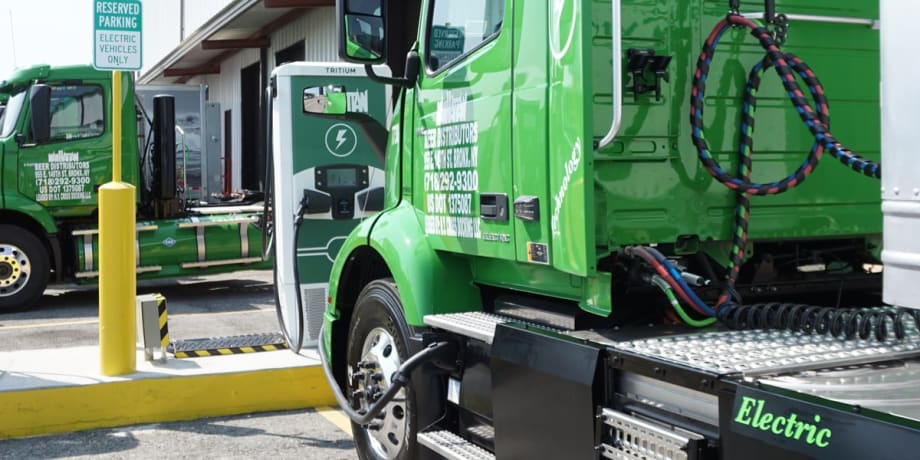
Fully electrifying America’s truck fleet will take a lot more than plugging in batteries.
Photo: Vesna Brajkovic
4 min to read
Three critical infrastructure-related challenges must be met to convert the U.S. truck fleet nationwide from gasoline and diesel power to battery-electric drive, according to a report released on Dec. 6 by the nonprofit American Transportation Research Institute.
ATRI sees the roadblocks to full electric truck adoption as assessing and addressing U.S. electricity supply and demand; the level of electric-vehicle (EV) production, and the status of truck-charging requirements.
The study found that full electrification of the U.S. vehicle fleet would require a significant percentage of the country’s present electricity generation.
Domestic long-haul trucking alone would consume more than 10% of the electricity generated in the country today.
An all-electric vehicle fleet would boost that demand to over 40%.
As a result, ATRI said some individual states would need to generate as much as 60% more electricity than is presently produced.
Years to Decades to Get to Truck Fleet Electrification
As to ramping up EV production, the report stated that the “tens of millions of tons” of cobalt, graphite, lithium, and nickel that will be needed to replace existing vehicles with battery-electric vehicles (BEVs) will place high demand on these raw materials. “Depending on the material, electrification of the U.S. vehicle fleet would require 6.3 to 34.9 years of current global production. This is the equivalent of 8.4 to 64.4% of global reserves for just the U.S. vehicle fleet.”
Truck-charging infrastructure will also have to be ramped up. ATRI found that charging the nation’s long-haul truck fleet “will prove challenging, partially due to the ongoing truck parking crisis.” As it stands, current technology will require more chargers than there are truck parking spaces in the U.S. And with hardware and installation costs of $112,000 per unit, the bill for that will run to more than $35 billion system wide.
Looking beyond BEV cars and light trucks, the report noted that “while there are certain applications for BEV trucks, a completely new charging infrastructure is critical to increasing BEV truck adoption by the trucking industry.” Also, ATRI indicates that existing raw material mining for BEV batteries will likely need to be re-sourced with an emphasis on domestic mining and production.”
A Daunting Task
“Carbon-emissions reduction is clearly a top priority of the U.S. trucking industry, and feasible alternatives to internal combustion engines must be identified,” Srikanth Padmanabhan, president of Cummins' engine business, remarked on the report.
“ATRI’s research,” he continued, “demonstrates that vehicle electrification in the U.S. will be a daunting task that goes well beyond the trucking industry – utilities, truck parking facilities and the vehicle production supply chain are critical to addressing the challenges identified in this research. Thus, the market will require a variety of decarbonization solutions and other powertrain technologies alongside battery electric.”
Top Challenges for What’s Ahead
Here are key details of the report concerning each of the three challenges cited by ATRI.
1. U.S. Electricity Supply and Demand.
To supply enough electricity to trucking, utilities will have to generate more electricity and transmit and distribute it to where trucks need to charge. Trucking will be but one of many new consumers of electricity, competing especially with car owners for access to low-cost, reliable electricity.
What’s more, this greater energy consumption is itself challenged by the country’s aging U.S. electricity infrastructure. Also, some states are better equipped to implement electrification than others. “Since trucking operates across all states and in both rural and urban settings, the industry will need affordable and reliable access to electricity in myriad locations throughout the country.”
2. Electric Vehicle Production.
There are more than 12 million freight trucks alone registered in the U.S. These vehicles almost exclusively run on diesel or gasoline. Those ICE engines will have to be replaced with battery-electric powertrains. And that in turn means “a major ramp-up of lithium-ion battery production. So, suppliers of the raw materials used in batteries will need to expand mining operations to meet demand, and battery manufacturers will likewise need to grow. “The ability of trucking companies to switch from ICE to BEV is dependent on reasonably priced and easily accessible BEV truck materials – without expanded mining and processing infrastructure to support battery demand, prices will likely increase.”
3. Truck Charging Requirements.
Vehicle refueling is done through a relatively quick transfer of gasoline or diesel sourced from well-established private fueling facilities. That model will change substantially for electric trucks to take into account recharging times and vehicle trip ranges. “At the very least, an entirely new set of infrastructure – in the form of vehicle charging stations – will be required. It is not yet clear how large this network will need to be nor the costs necessary to build it.”
A copy of the full 65-page report is available here at ATRI’s website.
More Fuel Smarts

How Volvo Updated Its D13 for EPA 2027 [Watch]
Volvo’s updated D13 promises lower emissions without sacrificing performance or fuel economy. Take a closer look at what changed inside the engine in this HDT Spotlight video.
Read More →
Diesel Price Spike Shortens Payback for Natural Gas Trucks, Report Says
Energy Vision estimates fleets could recover the higher purchase price of an RNG-fueled Class 8 tractor in 1.3 to 2.8 years under current fuel-price scenarios.
Read More →
Calstart Becomes Catalyst Mobility, Reflecting Broader Focus
Calstart is now Catalyst Mobility, reflecting the nonprofit’s growing national role in clean transportation, including zero-emission trucks, infrastructure and incentive programs.
Read More →

Record Diesel Prices Squeeze Trucking Fleets
Average U.S. diesel prices have climbed to nearly $6 a gallon, surpassing the 2022 record as tight refinery capacity and Middle East disruptions keep fuel costs elevated.
Read More →
Sponsored•September 9, 2026
How Fuel Delivery Shapes Engine Performance
Fuel delivery depends on more than what happens at the injector. For fleet, maintenance and technical professionals, looking at the full path from pump to injector can provide useful context for understanding engine performance.
Read More →
East Coast Port Launches $45M Electric Truck Push
The Port Authority of New York and New Jersey announced millions in incentives for zero-emission drayage trucks, yard tractors, and new charging hubs near the port.
Read More →
California Bill Could Shed Light on Electric Truck Prices
Why do battery-electric Class 8 trucks remain so expensive? A California bill headed to Gov. Gavin Newsom would give fleets and state agencies more visibility into what manufacturers charge.
Read More →
Detroit Opens Orders for EPA 2027 Engines
Detroit isn’t starting from scratch to meet EPA 2027 diesel emissions standards. Its Gen 6 DD13 and DD15 engines keep much of today’s platform while updating the fuel and aftertreatment systems.
Read More →
Zero-Emission Truck Corridor Planned for West Coast
California, Oregon, Washington, British Columbia and Baja California are coordinating plans for truck charging and hydrogen fueling from Canada to Mexico.
Read More →
A Closer Look at Kenworth’s Electric T880E Vocational Truck [Video]
Learn more about Kenworth's T880E battery-electric vocational truck at the Paccar Technical Center, including its range, applications, upfitting considerations, and PTO options, in this HDT Spotlight video.
Read More →