




2013 Cargo Thefts Tie Record High, Average Loss Falls
The number of cargo thefts in the United States last year remained the same as it was in 2013, tying the highest level on record, according to a newly released report.
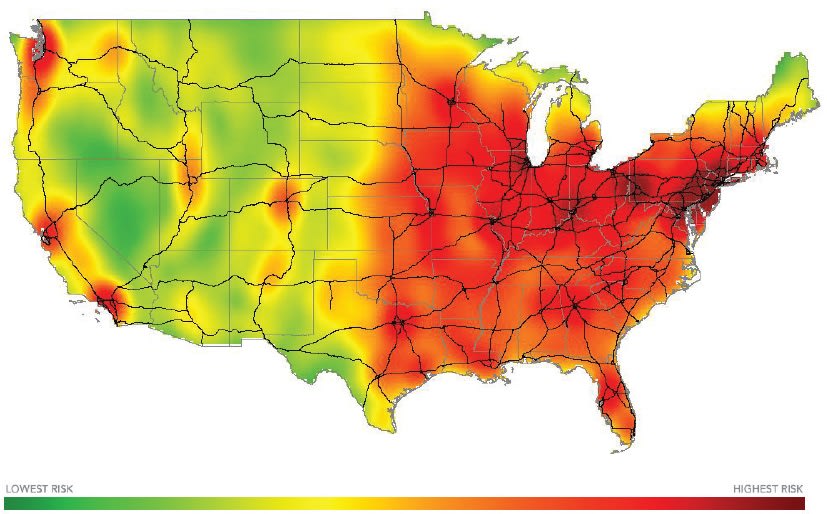
Credit: FreightWatch International
The number of cargo thefts in the United States last year remained the same as it was in 2013, tying the highest level on record, according to a newly released report.
The logistics security services provider, FreightWatch International, says even though the number of incidents remained steady at 951, the threat of cargo theft continues to grow in the United States due to increased organization and innovation on the part of cargo thieves.
Of the total number of cargo thefts thefts, 72.66% were full-truckload or container thefts and 6.83% were less-than-truckload losses. Deceptive pickups, which increased steadily from 2006 through 2012, reaching a record level of 62 incidents in 2012, dropped slightly in 2013 to 61 or 6.41% of incidents. Facility burglaries saw 2.84% of incidents. Incidents involving violence remained a very low portion of cargo thefts, representing just 1.26% of the total.
The average loss value per theft incident peaked in 2009 at $554,105. Since then it has been on a steady decline. The average value per incident in 2013 was $171,146, down 2.4% from 2012 and a new all-time low since the start of FreightWatch data collection.
The significant decrease in average loss value from 2012 to 2013 is largely due to the lack of thefts with losses topping $1 million. 2013 saw only eight thefts over $1 million, while there were 13 in 2012, 21 in 2011 and 30 in 2010.
Likely spurred by the release of several next-generation video game consoles, the electronics product type saw the highest average loss value per incident in 2013, at $413,550. In a close contest for second place, alcohol/tobacco and the clothing/shoes categories came in at $269,000 and $286,427, respectively.
For the fourth consecutive year, food/drinks was the product type most often stolen in 2013, accounting for 27% of all cargo theft. Electronics rose from third to second place, logging 14% of thefts, while metals fell from second to tie with home/garden in third with 10% of all thefts each.
In 2013, 76% of all thefts with a known location occurred in unsecured parking areas. The most frequently targeted unsecured parking areas were truck stops with 33% of the total, public parking with 22% and roadsides at 7% of all thefts. Theft from secured parking fell from 17% of known locations in 2012 to 10% in 2013.
While cargo theft broadened in 2012, expanding to new highs in some states with normally low theft levels, 2013 saw cargo theft activity wane again in some of these states. At the same time, six of the top 10 states saw a decrease in the number of thefts over 2012. California, however, saw a sharp 13% increase in thefts from 2012 to 2013 to retain the top spot with 28.77% of total thefts. Texas, having increased by four theft incidents, claimed the number two spot in 2013 with 123 thefts or 13.66% of national thefts. Florida dropped from second place to third in 2013 with 113 incidents, a 13.08% decrease from 2012 totals. New Jersey continued its dramatic slide from 120 thefts in 2011 to 78 in 2012 and only 69 in 2013, a 42.5% drop over two years.
More details are available on the FreighWatch International website.
More Drivers

Truck Drivers Need More Than Another Alert
Fleets have more visibility into truck health, safety events, and driver activity than ever. The next challenge is turning all that information into useful guidance for the person who has to decide what to do next.
Read More →
FMCSA Removes 110 Truck Driver Training Schools from Certified ELDT List
Federal regulators also are targeting more than 160 additional training providers and launching a nationwide audit of third-party CDL skills testers as part of a broader crackdown on trucking fraud.
Read More →
Hours of Service Pilot Programs: FMCSA Readies for 2027 Rollout
Two pilot programs could eventually reshape hours-of-service rules, giving truck drivers options to pause their 14-hour clock or use longer split sleeper rest periods.
Read More →
Medical Cards, English Proficiency Reshape Roadcheck Violations
Medical-card violations jumped to the top of the driver out-of-service list during CVSA’s 2026 International Roadcheck, while English-language proficiency violations appeared among the leading violations for the first time.
Read More →
Driver Trust Can Make or Break the Success of Fleet Safety Technology
New Teletrac Navman research suggests that onboarding, transparency about driver data, and positive feedback can play a significant role in how commercial drivers respond to safety and coaching technology.
Read More →
EEOC Sues KLLM Over Alleged Sex Discrimination in Driver Training
KLLM is facing a federal sex-discrimination lawsuit over policies the EEOC alleges put female truck driver trainees at a disadvantage.
Read More →
FMCSA Moves to Codify English Language Requirements for Commercial Drivers
By changing regulations on English-language proficiency requirements for commercial drivers, rather than relying on a guidance memo, the FMCSA said future administrations won't be able to walk back the Trump administration's stricter enforcement with just a memo.
Read More →
Drivers Put Western Star Trucks to the Test at Star Nation Experience
Watch to get an inside look at the Western Star trucks, technology, and community behind the Star Nation Experience 2026!
Read More →
Trump Administration Looks to Put More Veterans Behind the Wheel
The Freedom Haulers program pulls together existing and expanded programs at several federal agencies to recruit veterans to drive commercial heavy-duty trucks and cut the red tape for them to get a CDL, training, and employment.
Read More →
Putting Mack’s Command Steer to the Test
A test drive of Mack’s Command Steer active steering system evaluates how it can make truck driving easier and less tiring.
Read More →