




2011 NAT GAS Act Introduced
The New Alternative Transportation to Give Americans Solutions of 2011, or NAT GAS, Act, was introduced Wednesday to provide incentives for the use of natural gas as a vehicle fuel, the purchase of natural-gas-fueled vehicles, and the installation of natural gas vehicle refueling infrastructure
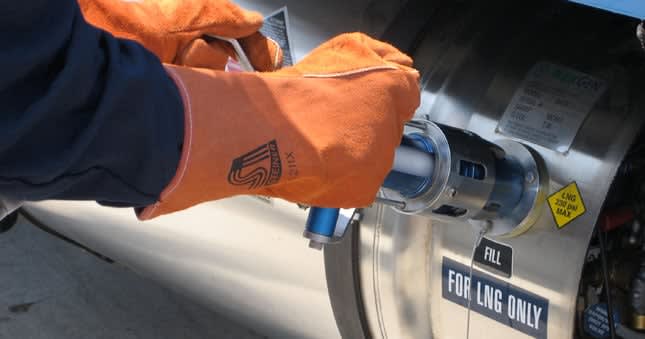
A PG&E truck refuels with liquified natural gas. Companies like PG&E would have more incentives to invest in natural gas equipment under the NAT GAS Act.
The New Alternative Transportation to Give Americans Solutions of 2011, or NAT GAS, Act, was introduced Wednesday to provide incentives for the use of natural gas as a vehicle fuel, the purchase of natural-gas-fueled vehicles, and the installation of natural gas vehicle refueling infrastructure.
The bill was introduced by Representives John Sullivan, R-Okla., Dan Boren, D-Okla., John Larson, D-Conn., and Kevin Brady, R-Texas. The bill had 76 original co-sponsors when it was introduced.
The five-year bill is a targeted jump-start for natural gas penetration into the vehicle market, said Congressman Sullivan at a press conference following the introduction.
He stressed the fact the bill does not provide subsidies, nor does it choose a particular technology, but only provides tax credits. He also said the bill is meant to create a basis on which long-term energy policy can be built.
The proposed legislation focuses on heavy-duty trucks, both urban and over-the-road. According to Sullivan, replacing a single diesel garbage truck with natural gas is equivalent to taking 300 passenger vehicles off the road. However, the bill also provides tax incentives for passenger vehicles as well as home refueling stations.
Specifically, provisions include:
- A tax credit for up to 80 percent of the incremental cost of buying a natural gas vehicle, with a maximum value ranging from $7,500 for a light-duty passenger vehicle to $64,000 for the heaviest trucks. Bi-fuel and duel-fuel vehicles are permitted.
- A 50-cent-per-gallon fuel tax credit that is in place in 2011.
- An infrastructure tax credit of 50 percent of the cost up to a maximum tax credit of $100,000 per station. For stations built in 2011, there is an existing infrastructure tax credit of 30 percent with a maximum credit of $30,000. This credit would also extend to home refueling units, where purchases would be eligible for a $2,000 tax credit.
- A tax credit to the manufacturer for the production of natural gas vehicles. The bill also includes other provisions that will facilitate the production and use of natural gas vehicles.
The NAT GAS Act has received strong bipartisan support during a bitterly partisan budget fight. Both President Obama and Speaker of the House John Boehner have expressed their support for the bill. In the face of fuel prices which could top $5 per gallon later this year, Sullivan said that bill could potentially be signed into law by summer.
Larson, who is also optimistic, said the bill stands a greater chance of passing because it is far narrower than previous iterations and was shortened from 17 years to five years. Last year's bill introduced by Rahm Emanuel was far more comprehensive, he said, which led to much partisan disagreement.
The recent events in the Middle East and the crisis in Japan have bolstered support for the bill and interest in breaking our national dependence on foreign oil. The Congressmen introducing the bill all said this bill will help reduce that dependence by providing a viable fuel which can be sourced in our own backyard. According to Brady, "It is a no-brainer."
More Drivers

Platform Science Adds Dispatch and Safety Tools
Four additions to PS Fleet help fleets monitor loads, manage driver coaching, share truck locations and adjust video system settings.
Read More →
When Language Stops the Truck: The Return of ELP Out-of-Service Orders
English language proficiency rules for commercial drivers aren’t new, but renewed out-of-service enforcement has raised the stakes. Here’s what carriers need to know before a driver reaches a roadside inspection.
Read More →
Samsara Launches Custom AI Agent Builder
Agent Studio lets fleets create AI tools for hours-of-service monitoring, reporting and driver support, including agents that communicate by phone.
Read More →
Trucker Path Expands Reserved Parking Network
Trucker Path has added close to 6,000 more truck parking spaces to its Trucker Path Reserved Parking Network with the addition of Safe Truck Parking.
Read More →
EEOC Sues Texas Trucking Company Over Driver Age Limits
The agency says Trancasa USA rejected applicants over 65 and applied tougher driving-record standards to those over 60.
Read More →
Nussbaum, Roehl Announce Second Driver Pay Increase This Year
This year has seen a swath of major truck driver pay increases as freight capacity has tightened.
Read More →
From One Generation to the Next: How Mentorship Builds Safer Truck Drivers
After three decades in trucking, Harold Perry shares what he's learned about driver safety, mentorship, and helping the next generation build confidence behind the wheel.
Read More →
Truck Drivers Need More Than Another Alert
Fleets have more visibility into truck health, safety events, and driver activity than ever. The next challenge is turning all that information into useful guidance for the person who has to decide what to do next.
Read More →
FMCSA Removes 110 Truck Driver Training Schools from Certified ELDT List
Federal regulators also are targeting more than 160 additional training providers and launching a nationwide audit of third-party CDL skills testers as part of a broader crackdown on trucking fraud.
Read More →
Hours of Service Pilot Programs: FMCSA Readies for 2027 Rollout
Two pilot programs could eventually reshape hours-of-service rules, giving truck drivers options to pause their 14-hour clock or use longer split sleeper rest periods.
Read More →