




Related: Medium-Duty Orders Fall 1.1% in 2016
December Heavy Truck Orders Hit 6-Month High
North American Class 8 retail sales rose to a six-month high of 21,281 units and Classes 5-7 had another banner year, according to ACT Research.
by Staff
January 19, 2017
2 min to read

North American Class 8 retail sales ended the year on a good note, rising to a six-month high of 21,281 units, according to final numbers from ACT Research.
With December in the books, Class 8 truck orders for all of 2016 totaled 249,952 units while Class 8 production hit 228,347 units. ACT noted a seasonal weakness in production, with a reduced December build amounting to only 14,145 units for the month.
Strong December sales and modest production reduced the industry’s inventory overhang by 6,300 units, bringing the full-year inventory correction to nearly 21,000 units. Last year ended with a 36-month low 44,865 inventory units.
“Going forward, the big inventory pulldown into the end of the year, and the full-year inventory correction, will allow industry production to more closely align itself with demand,” said Kenny Vieth, ACT Research president and senior analyst.
Thanks to school buses and recreational vehicles, the Class 5-7 truck market had a banner year for the second consecutive time, with December medium-duty orders rising above 20,000 units for only the second time since April. Net orders for the month totaled a nine-month high of 22,083 units. While the consistency in medium-duty vehicle orders the past two years is almost unheard of, ACT Research expects to see the trend continue for 2017.
“Full-year 2016 saw orders fall 0.7% from 2015 to 229,403 units. School bus and RV orders were up incrementally in 2016, while trucks and step vans saw volumes fall incrementally,” said Vieth. “Given that consumer-related MD economic drivers remain largely unchanged, our expectations are for more of the same in terms of MD demand in 2017.”
More Equipment

Kodiak: Driverless Long-Haul Truck Launch on Track for 2026
Kodiak AI says its driverless long-haul safety case is 93% complete and it remains on track to begin commercial operations by year-end 2026.
Read More →
What DOT’s Automated Vehicle Strategy Means for Trucking
The U.S. Department of Transportation issued a new automated-vehicle strategy that outlines plans for driverless-truck regulations, cross-state freight corridors, and federal safety standards.
Read More →
East Coast Port Launches $45M Electric Truck Push
The Port Authority of New York and New Jersey announced millions in incentives for zero-emission drayage trucks, yard tractors, and new charging hubs near the port.
Read More →
PlusAI Going Public to Fund Autonomous Truck Launch
A SPAC deal could provide PlusAI with up to $300 million as it works toward a 2027 commercial launch of factory-built autonomous trucks.
Read More →
NHTSA Moves to Rewrite Truck Fuel-Economy Rules
The National Highway Traffic Safety Administration says it lacks authority to regulate medium- and heavy-duty truck engines separately from complete vehicles, but the existing standards have not yet been eliminated.
Read More →
Detroit Opens Orders for EPA 2027 Engines
Detroit isn’t starting from scratch to meet EPA 2027 diesel emissions standards. Its Gen 6 DD13 and DD15 engines keep much of today’s platform while updating the fuel and aftertreatment systems.
Read More →
Carrier Transicold Adds All-Electric TRU for Stationary Cold Storage
Carrier Transicold’s new Vector 8200 all-electric transport refrigeration unit gives fleets a diesel-free option for temporary refrigerated and frozen trailer storage.
Read More →
A Closer Look at Kenworth’s Electric T880E Vocational Truck [Video]
Learn more about Kenworth's T880E battery-electric vocational truck at the Paccar Technical Center, including its range, applications, upfitting considerations, and PTO options, in this HDT Spotlight video.
Read More →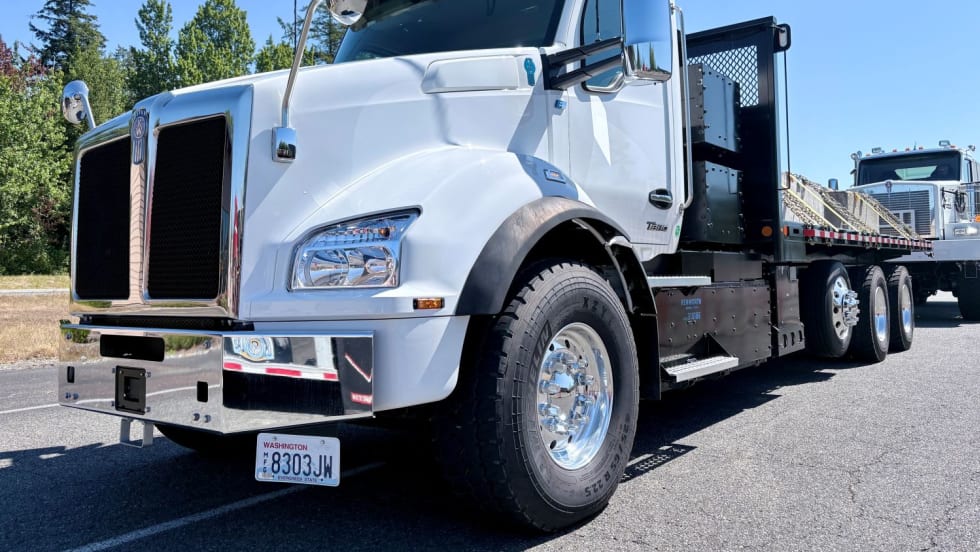
Kenworth T880E Brings EV Power to Vocational Trucks
A closer look at the Kenworth T880E’s range, charging, powertrain and upfit options — and where fleets are showing the most interest.
Read More →
What the U.S.-Canada Trade War Means for Trucking
Escalating U.S.-Canada tariffs could disrupt cross-border freight, reduce truck volumes, raise costs, and create new uncertainty for carriers on both sides of the border.
Read More →