




When Cummins Went to Indy
Cummins Engine Co. founder Clessie Cummins knew a thing or two about making engines. As it turns out he had a twisted genius for marketing too.


Bruce Watson, driver and caretaker of the Cummins #28 Special. Photo by Jim Park
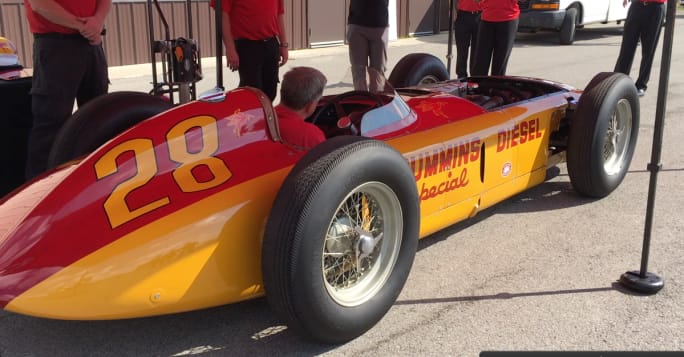
Photo by Jim Park
When Cummins entered its #28 Special race car in the 1952 Indianapolis 500 Race, the company wasn't looking to get into the racing business. It was trying to prove a point about diesel engines, and boy, did they succeed.
Cummins has quite a history at the Brickyard, dating back to the very first race called the Indianapolis 500 in 1911. Cummins has raced diesel engines there four time since then, but none took the racing world quite so by surprise as the 1952 entry, the #28 Cummins Special.
In the days and weeks leading up the qualifying rounds, everyone was suspicious of the diesel car. Few expected it to even qualify. Driver Fred Agabashian and the team knew they had a fast car, but he wasn't giving away any secrets. History recalls Agabashian sandbagged it right 'till the big day, not driving the car with everything it had and never completing a entire lap at full power so as not to give anything away. The competition's spies with their stopwatches weren't getting the whole story.
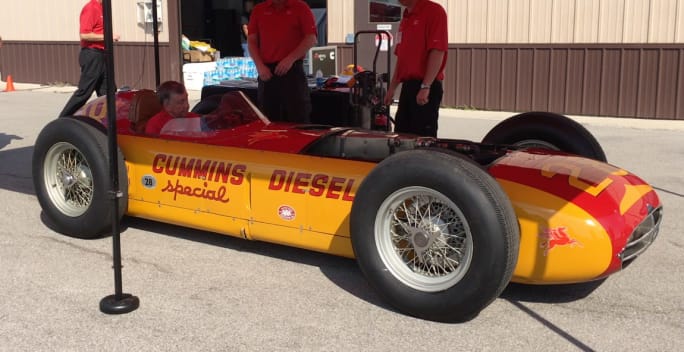
Photo by Jim Park
The rules for the race allowed for diesel engine as large as 6.6 liters, compared with a 3-liter limit for supercharged gasoline engines. The Cummins JT-600 was heavy compared to the smaller gas engines, and that was thought to be a built-in handicap. On race day, the turbocharged JT-600 was turning 4,600 rpm and cranking out 430 hp.
The engine was an in-production truck engine modified somewhat for the race, but not drastically. Some of the parts were milled from aluminum or magnesium rather than cast iron for weight reduction, and it was installed in the car laying just a few degrees from flat on its side. That necessitated modification to the normally wet-sump lubrication system.
It also gave the car a considerable handling advantage. The horizontally mounted engine forced a much wider stance than usual and gave it a very low center of gravity.
The engine used an early version of Cummins' innovative PT fuel system, with a low-pressure pump, common rail and high-pressure unit injectors. That technology was also employed in Cummins' truck engines of the day, and would provide a significant edge over the competition for years to come.
The car ran its qualifying laps for the 1952 race at a 4-lap average of 138 mph, following a record-setting first lap of 139 mpg. That earned it a pole-position start for the race. Unfortunately, the car didn't complete the 500-mile event. It had to retire after 70 laps with the engine's air intake clogged with tire rubber from the track.
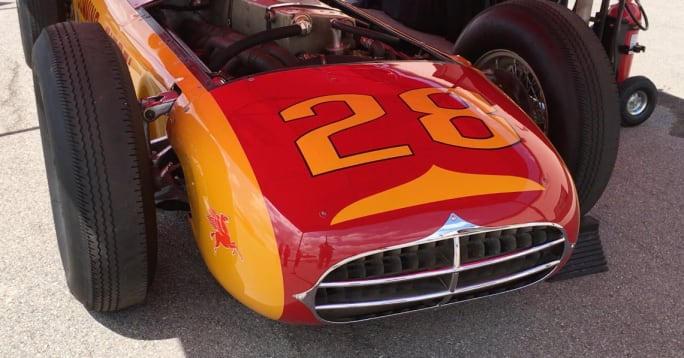
Photo by Jim Park
Cummins at The Brickyard
It never raced again, and nor did Cummins ever enter another diesel race car at the Indy 500. Cummins made its mark at The Brickyard with four entries prior to 1952 -- and one very special race 35 years later in 1987.
1911: Company founder Clessie Cummins served as a member of the pit crew for the Marmon Wasp and Driver Ray Harroun. That was the inaugural running of the Indy 500, and Cummins -- the original Cummins -- was there at the finish line.
1931: Diesels were not allowed to race at Indy, but organizers made an exception because during the depths of the depression there were few other cars entering the race. The #8 Cummins Special qualified with an average speed of 97 mph. Two days later, with Dave Evans behind the wheel, it became the first entry ever to run the entire race nonstop, finishing 13th on just $1.40 worth of “furnace oil.” Cummins didn’t expect to win, but wanted to show the world the efficiency and durability of the diesel engine.
1934: Cummins entered two cars that year; one with a 4-stroke engine, the other with a 2-stroke engine to test durability and fuel efficiency. During the race, the 2-cycle engine had numerous issues while the 4-stroke Number 6 car ran smoothly -- until the 270-mile mark, when the driver stripped the gears pulling out of his very first pit stop. That test may have sealed the fate of the 2-cycle engine at Cummins as its diesels have been 4-cycle ever since. The marketing campaign for the recently launched X12 and X15 engines paid homage to that particular race with the slogan, "Four Strokes of Genius."
1950: By this time, Cummins engines were a staple of the trucking industry. Cummins entered the Green Hornet, a car powered by a 345 hp aluminum JS-600 engine with a supercharger. The car started in 33rd position with a qualifying speed of 129 mph and had worked its way to 16th spot when a mechanical failure forced it out of the race. Later that year, the same car set six U.S. and international land speed records at the Bonneville Salt Flats.
1952: Cummins #28 Special shatters a track qualifying record and starts the race from the pole position.
1987: Cummins finally wins at Indy, not with a diesel but with a car that had been mothballed and was on display in a hotel lobby just two weeks before the race. Cummins and Penske Racing teamed up to sponsor the #25 Cummins Holset car, and they hired an experienced hand to drive it -- three-time Indy 500 winner Al Unser Sr. He spent the race steadily moving up through the pack and finally into first position on the white-flag lap for a very dramatic win.
For many years after the record-setting qualifying run in the 1952 Indy 500, the #28 car was seen in parades and at various company functions. At some point, it wound up in a display case at Cummins headquarters in Columbus, Indiana.
In 1999, now retired engineer Bruce Watson convinced his bosses to let him and his team begin restoring the car. In May of 2015, after rebuilding a few parts that had deteroirated over time, they started it for the first time in 17 years and it ran like a top.
A Closer Look at Cummins' Indy Racer
I had the chance to meet Bruce and get a close look at the car in July at the launch event for Cummins' 2017 engine lineup.

Bruce Watson, driver and caretaker of the Cummins #28 Special. Photo by Jim Park
On the bus trip from the hotel in Dublin, Ohio, to the site of the event, The Transportation Research Center in East Liberty, Ohio, organizers showed us a video on the race car, from the origins of the idea to the end of the race. It was fascinating, but it all came to life upon our arrival at TRC where, lo and behold, the #28 Special led a convoy of trucks powered by 2017 diesels around the 7-mile oval track at TRC.
Cummins had the car on the tarmac during the event, and it was then I had the opportunity to shoot some video and do an interview with Watson.
There's nearly 70 years between the JT-600 engine that took the Pole position at the 1952 Indy 500 and the 2017 version of the X15, and the bloodline is unmistakable.
More Blog Posts
Truck Driver’s Dilemma: Click, Twist or Swipe?
Whether 'tis safer to twist a knob or press a button than to swipe right then swipe down to scan the menu for your favorite playlist...? That's a question for the age.
Read More →
Even the Swedes are Doing Turnpike Doubles
The government doesn't seem to mind asking trucking to invest a trillion dollars toward a greener future. But they won't let us pull turnpike doubles making 30% less CO2. Which is insanity, says HDT's Jim Park in his On the Road blog.
Read More →
Is Your Recruiting Message on Point?
How does your recruiting and retention messaging compare with the reality at your company? Would your drivers agree with your own assessment? Jim Park explores those questions in his On the Road blog.
Read More →
You Can’t Blame Trucks for the Highland Rest Area Bus Crash [Commentary]
The causes of the Highland Park rest area crash go far beyond the parking shortage and the need for flexibility in hours of service — but those issues must be addressed, too, says Jim Park in his On the Road blog.
Read More →
Electric Trucks Seem Far Down the Road for Fleets Dealing with Today's Maintenance Challenges
While the push for zero-emissions trucks rings clear for regulators, advocates and even a small crowd of suppliers, ZEVs seem to have run out of steam down on Main Street, says HDT Equipment Editor Jim Park in his latest On the Road blog.
Read More →
Guinea Pigs 2.0: Can Trucking Comply with a Near Impossible NOx Reduction?
The EPA’s Final Rule on NOx reduction will be incredibly difficult if not nearly impossible for trucking to comply with. Rather than endure another round of equipment failures, downtime and loss of customer faith, industry needs to rally ‘round the OEMs and seek a solution to this wrong-headed rule.
Read More →
Is Downspeeding Bad for Brakes?
Is there a connection between downsped drivetrains and increased brake wear? There shouldn’t be. Downsped fleets seeing increased brake wear are probably not letting the technology do its job, explains HDT Equipment Editor Jim Park.
Read More →
Dig for the Gold Behind CVSA’s Out-of-Service Numbers
Published out-of-service rates don’t mean much until you dig into the why. With brake problems consistently placing in two of the top five spots, maybe we’re missing something in brake maintenance, writes HDT Equipment Editor Jim Park.
Read More →
Things That Go Poof in the Night
We’re in electric-truck heydays now. But like another famous heyday, the 1849 California Gold Rush, there will be a lot fewer winners than losers, says Jim Park in his On the Road blog.
Read More →
Do Your Truck Drivers Know How to Descend a Mountain Grade?
Where do drivers learn mountain-driving techniques? It's sure not from the typical state CDL manual. Jim Park shares what he learned following a deadly 2019 Colorado crash.
Read More →