




We still haven't come to terms with brake adjustment
Today is the beginning of Brake Safety Week in North America. CVSA inspectors will be doing a lot of brake stroke inspections this week, and also working with drivers, mechanics and others to improve awareness of brake systems and regulatory compliance. Its one of the best things CVSA does
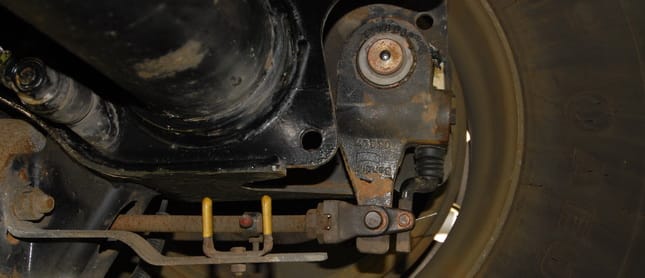
Automatic brake adjusters are poorly understood by driver and mechanics alike. Photo by Jim Park
Today is the beginning of Brake Safety Week in North America. CVSA inspectors will be doing a lot of brake stroke inspections this week, and also working with drivers, mechanics and others to improve awareness of brake systems and regulatory compliance. Its one of the best things CVSA does.
Unfortunately, drivers -- and I'm sure some fleets sometimes -- see Brake Safety Week and Operation Air Brake as just another cash grab. But the fact that more than 50% of commercial motor vehicle out-of-service violations cited during roadside inspections are for brake-related violations indicates there is a major knowledge gap there somewhere.
Vehicle users either do not know what constitutes proper brake adjustment or can't identify certain brake related problems, or they just aren't doing sufficiently thorough vehicle inspections and the problems are going undetected. Either way, the industry has to pull up its socks, or the creeper cops will pull them up for us.
Automatic Brake Adjusters
While brake violations account for most of the OOS citations written at roadside, the vast majority of those are for brakes beyond their adjustment limit. Aside from the hassle of lying under the truck and visually inspecting brake stroke -- which usually requires that the driver mark and measure applied brake stroke -- brake stroke violations should be the easiest tickets in the world to avoid.
In the days prior to ABAs, drivers routinely adjusted their brakes, yet back then, the OOS rate for brake adjustment was much higher than it is today. ABAs have no doubt contributed to the lower numbers, but as current OOS figures indicate, there's still a problem.
I think it has a lot to do with the term "automatic." I think it creates the impression that the adjuster will somehow keep brake stroke within limits under any circumstance, and that's clearly not the case.
I asked Ron Plantan, the principle engineer for the wheel-end group at Bendix Spicer Foundation Brake why, given the prevalence of ABAs today, we're still seeing a relatively high number of trucks sidelined by poor brake adjustment.
"Truck brakes are a system. You have a brake chamber, a slack adjuster, and what we call the foundation brake, which includes the drums, shoes, linings, rollers, cams, etc., [all the stuff at the end of the axle]. The problem of over-stroking can originate in any one of those," he says. "The easiest thing to do is blame the most obvious suspect, the automatic adjuster."
In the days prior to automatic brake adjusters, there was a good chance the culprit was the slack adjuster simply because it hadn't been checked recently.
"ABAs are designed to compensate for wear of the brake linings and brake drums," Plantan says. "If there's a problem somewhere else in the brake system, the ABA can compensate only to a point. An overstroking ABA is a good indicator of a brake problem that needs attention."
As an industry, we have a problem with brake adjustment -- a few of them actually.
* We have a brake component whose name suggests it doesn't require much attention;
* In bygone days, the solution to an out-of-adjustment condition was to adjust the slack adjuster and make the brake stroke measurement right. That's not the correct approach with ABAs; and
* We appear to have a demonstrated lack of awareness of the role and function of ABAs.
Never Adjust an Automatic Brake Adjuster
Measuring pushrod travel is the accepted way of gauging brake system condition at roadside, but many of today's ABAs are designed to operate very close to their legal adjustment limit. When you have problems anywhere in the foundation brake, worn bushings, or if it's not returning properly to its zero-stroke position, any of those situations can result in an overstroke condition, even though the ABA itself is functioning perfectly.
With automatic adjusters, adjusting the brake may alleviate the symptom, but it may not cure the problem.
"It's real easy for someone to say, 'aw just adjust it and let it go and save the money. I can do that in a couple of minutes.' In reality, they are just covering up a problem and actually making it worse," Plantan says. "We caution drivers and mechanics not to continue adjusting the ABA if it continuously is in an overstroke condition. The fact that it won't stay properly adjusted is an indication of a problem. If you continue to adjust the brake, not only are you covering up the problem, but you could get to a point where, if you're adjusting the ABA all the time, you'll wear out the mechanism prematurely.
ABAs, under normal circumstances, should not be manually adjusted. The adjustment mechanism is there for the initial installation. They are not meant to be adjusted regularly as the older manual slack adjusters were. Continual adjustment of an ABA will cause premature wear to the clutches and ratchets inside the device, eventually rendering it unable to hold its adjustment.
A key indicator of a brake system problem on a truck with ABAs is an overstroke condition. If it's going out of adjustment constantly, it's telling you there is a problem somewhere. It could be the ABA itself, but chances are there is excessive wear or an out-of-tolerance condition somewhere in the wheel-end portion of the brake system.
And of course, the easiest way of determining proper brake system condition is to get under the truck and inspect it regularly -- including checking pushrod travel.
For more on the perils of manually adjusting automatic brake adjusters, read this report from the National Transportation Safety Board on a fatal wreck in Glen Rock, Penn. The executive summary tells the story, but the details are worth reading and sharing with shop personnel and drivers.
Click here for more information on www.operationairbrake.com.
More Blog Posts

Truck Driver’s Dilemma: Click, Twist or Swipe?
Whether 'tis safer to twist a knob or press a button than to swipe right then swipe down to scan the menu for your favorite playlist...? That's a question for the age.
Read More →
Even the Swedes are Doing Turnpike Doubles
The government doesn't seem to mind asking trucking to invest a trillion dollars toward a greener future. But they won't let us pull turnpike doubles making 30% less CO2. Which is insanity, says HDT's Jim Park in his On the Road blog.
Read More →
Is Your Recruiting Message on Point?
How does your recruiting and retention messaging compare with the reality at your company? Would your drivers agree with your own assessment? Jim Park explores those questions in his On the Road blog.
Read More →
You Can’t Blame Trucks for the Highland Rest Area Bus Crash [Commentary]
The causes of the Highland Park rest area crash go far beyond the parking shortage and the need for flexibility in hours of service — but those issues must be addressed, too, says Jim Park in his On the Road blog.
Read More →
Electric Trucks Seem Far Down the Road for Fleets Dealing with Today's Maintenance Challenges
While the push for zero-emissions trucks rings clear for regulators, advocates and even a small crowd of suppliers, ZEVs seem to have run out of steam down on Main Street, says HDT Equipment Editor Jim Park in his latest On the Road blog.
Read More →
Guinea Pigs 2.0: Can Trucking Comply with a Near Impossible NOx Reduction?
The EPA’s Final Rule on NOx reduction will be incredibly difficult if not nearly impossible for trucking to comply with. Rather than endure another round of equipment failures, downtime and loss of customer faith, industry needs to rally ‘round the OEMs and seek a solution to this wrong-headed rule.
Read More →
Is Downspeeding Bad for Brakes?
Is there a connection between downsped drivetrains and increased brake wear? There shouldn’t be. Downsped fleets seeing increased brake wear are probably not letting the technology do its job, explains HDT Equipment Editor Jim Park.
Read More →
Dig for the Gold Behind CVSA’s Out-of-Service Numbers
Published out-of-service rates don’t mean much until you dig into the why. With brake problems consistently placing in two of the top five spots, maybe we’re missing something in brake maintenance, writes HDT Equipment Editor Jim Park.
Read More →
Things That Go Poof in the Night
We’re in electric-truck heydays now. But like another famous heyday, the 1849 California Gold Rush, there will be a lot fewer winners than losers, says Jim Park in his On the Road blog.
Read More →
Do Your Truck Drivers Know How to Descend a Mountain Grade?
Where do drivers learn mountain-driving techniques? It's sure not from the typical state CDL manual. Jim Park shares what he learned following a deadly 2019 Colorado crash.
Read More →