




Twin-Sticks to No-Sticks (Trucks have sure come a long way, Baby)
It's easy to look back nostalgically at trucks that our grandfathers drove. Spend a day in one like Equipment Editor Jim Park did recently and say you wouldn't kill for an an automated transmission and an air-ride seat. Read more in Park's "On the Road" blog.

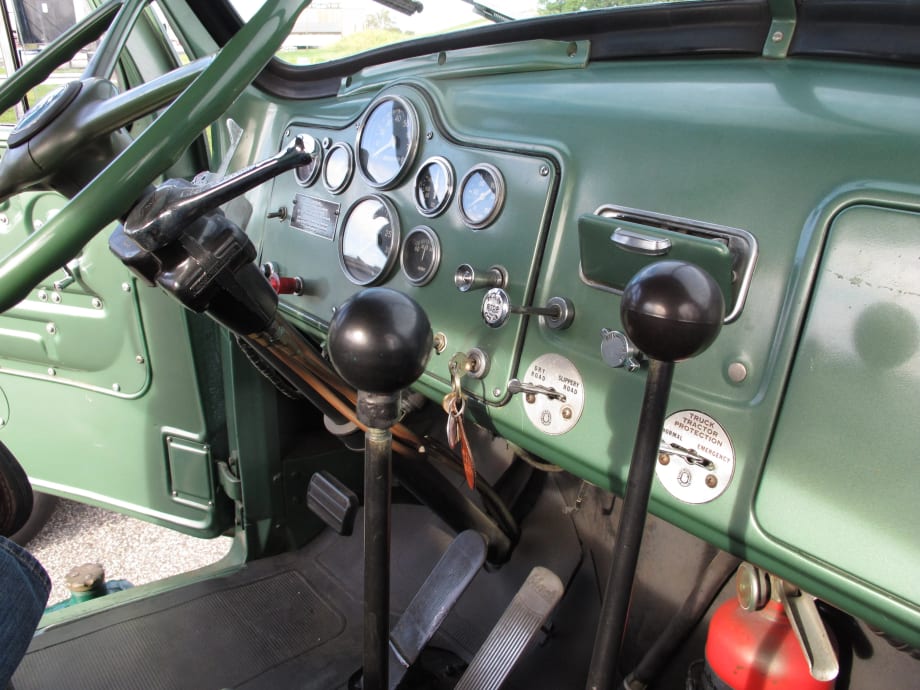
Back before they invented automated manuals with dash displays, driver had to remember which gear they were in.
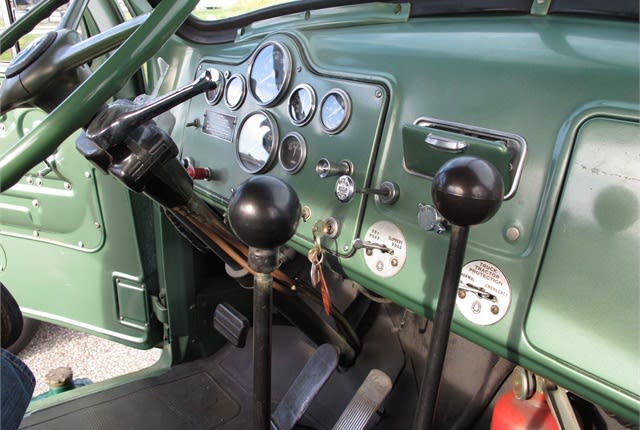
Back before they invented automated manuals with dash displays, driver had to remember which gear they were in.
New truck drivers don't know how easy they have it today. Air suspensions, power steering, climate control, air ride seats, no gear shift ... Today's big trucks are Cadillacs in every way compared to the trucks industry pioneers worked with. I had many opportunities to reflect on how far trucks have come in the past half-century when, over the past two weeks, I spent a few days at Mack's Customer Center in Allentown, Penn, driving one of their prized restorations -- a 1957 B61 Mack -- and then a week later, I found myself Orlando, Fla. judging the 2014 Truck of the Year contenders for the American Truck Dealers.
You simply can't compare today's trucks to their predecessors. They are as different as a DC3 aircraft and a Boeing 767. Alternatively, the Phillips console radio our grandparents (or great grandparents) had in their living rooms and an iPod. And let me be perfectly clear; I'm not denigrating the B61. It was state of the art in its time and remains an iconic reminder of trucking's early days. Mack produced the B-model between 1957 and 1966 in all sorts of configurations for many different applications. Lots of them are still running today -- most as restoration projects but there are a few still working. I wonder how many Cascadias, Pinnacles or ProStars will still be running in 2065?
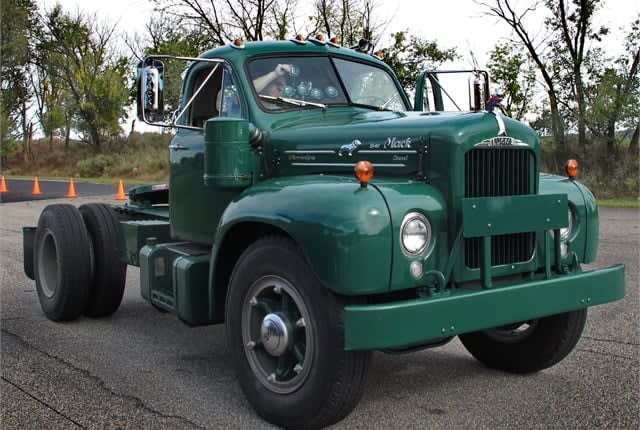
Mack's 1957 B61 can be seen at the Customer Center in Allentown, Penn.
The truck Mack entrusted to me that day rolled off the assembly line 1957, making it a year older than I am. It's probably in better condition than I am too, but that another story. One of the earlier versions of the truck, it had a 170 hp / 600 lb-ft Thermodyne engine mated to a 5-speed main transmission and a 2-speed auxiliary -- a duplex in other words. They came with 5x3 and 5x4 transmissions as well. The seat had no suspension save for a thick foam cushion full of springs. There was no heater or air conditioner, and the beefy steel springs on the front and rear axles ensured the driver became vividly aware of every pebble, crack or pothole on the road.
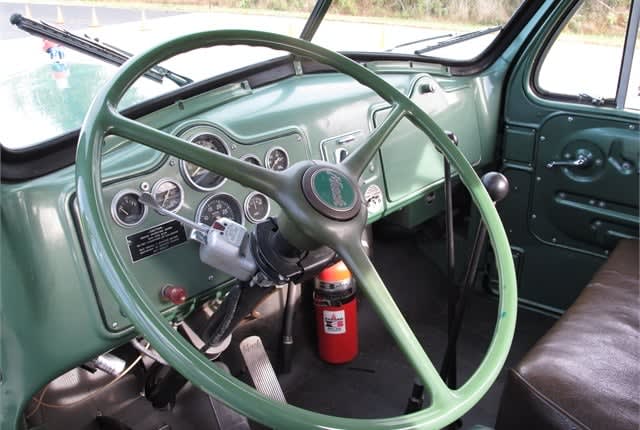
The giant steering wheel provided leverage to help with tight turns.
The steering wheel is gigantic -- part of the armstrong steering system. For those too new to get the gag, 'armstrong steering' means the driver reefs really hard on the big wheel to turn it. It was of necessarily large diameter to give the driver some extra leverage in tight spots. And don't kid yourself, the big wheel was of little advantage. When the truck isn't moving, it's near impossible to turn the wheel. When reversing into a dock, the tight maneuvering often required even with the much shorter trailers of the day meant the driver had to inch the truck forward or backward to even begin turning the wheel. Palming the wheel as we do today wasn't even a possibility. You got a real workout just alley-docking the truck.
Two Sticks -- One for Each Hand
Then there are the transmissions -- yes, plural. The main and the auxiliary. Today, they are bundled together in the same box, roughly speaking, with the two gearshifts replaced by the shift lever and a hi-lo range selector, roughly equal to today's 9- or 10-speeds. The triplex and quadraplex transmissions (5x3 and 5x4) roughly parallel today's 13-and 18-speed gearboxes.
In principal, they are easy enough to command. First gear on the main box, low then into high on the auxiliary. That's the easy part. Next, shift the main into second, but before engaging the clutch, you pull the auxiliary out of high, rev the engine, slip it into low and engage the clutch. Now you're in second low. Depending on the load, you might have to do that all the way up through the gears 'till you get to top speed. More likely, you'll cheat and run through a few gears in low before you have to start splitting them. It only gets worse when you get into the 3- and 4-speed auxiliaries.
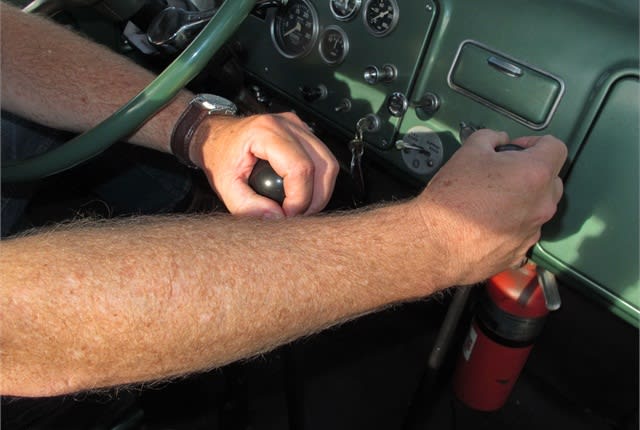
Talk about distracted driving. Both hands on the wheel -- even one hand on the wheel -- wasn't always possible.
Shift timing had to be impeccable, and good drivers could often skip shift and even split odd gears. If you missed a shift, the old bulldog would bite you but good. The teeth on the gears were spaced pretty widely apart, so there was a good chance that a partially engaged gear would kick the shifter back. If you were lucky, the meaty part of the palm of your hand took the brunt of it. Drivers have had wrists and fingers broken by the kickback.
If you happened to miss a split shift, you wound up in what they called double-nothin' -- both transmissions in neutral. That often meant a full stop to get the thing back into gear, though some of the better drivers could finesse them back into gear, if they could remember which gear they were in.
You've no doubt seen pictures of drivers with one arm wrenched through the steering wheel gripping a shifter while to other arm grapples with the other stick. God forbid you happen to hit a pothole at that moment, because the big steering wheel with all its leverage could whip around and easily break an arm.
The first tractor-trailer I drove back in '78 was an R-model Mack with a twin-stick 6-speed and a 283 horsepower Maxidyne engine. A relatively simple transmission to sort out -- the taller stick was hi-lo and the shorter was 1 through 5. It usually only required one range shift from lo to hi, usually in fourth. Often, you could start in hi forget about a range shift.
Getting the hang of the duplex Mack let me drive wasn't much of a chore, but I'm glad I was careful to get out of hearing range of its caretaker before attempting a range shift. I ground a few gears, but didn't cause any permanent damage I don't think. After all, it's a Mack. The palm of my tender, keyboard-toughened right hand continues to remind me of my lack of shifting finesse.
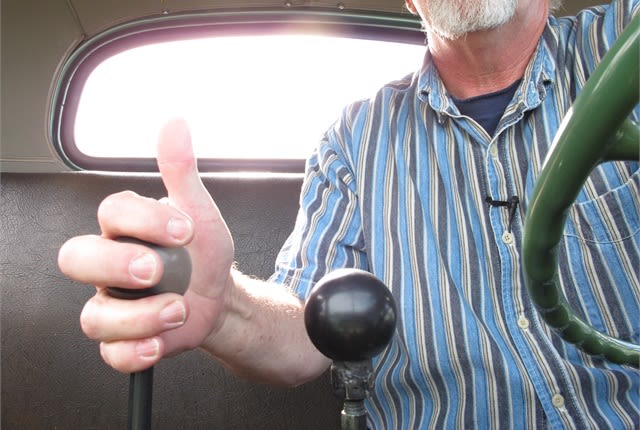
Drivers had two shifts to make before revs and momentum were lost.
Off with the Rose Colored Glasses
It was a noisy, rough and physically demanding truck to drive, and I was just bobtailing around the course at the now-retired proving grounds at Mack's Customer Center. My shoulders were a little stiff at the end of the day, and still ached the next morning when I went in to drive a couple of Mack's contemporary models. It was a good way to illustrate how far truck technology has come. I can only imagine how drivers would feel after eight or ten hours of banging around the city in one of those trucks. We look at them nostalgically today, but they beat drivers up pretty good.
The other makes and models of that vintage were the same. There was almost no suspension to speak of, drivers baked in the summer and froze in the winter and there was barely enough room behind the wheel for even a 200-lb driver. Sharp metal edges were everywhere in the cab. There were no seatbelts or air bags, no adaptive cruise control or stability control systems and certainly none of the comforts drivers enjoy today like upholstery, air conditioning, lumbar supports, automated transmissions, subwoofers, GPS, etc.
The old trucks were primitive mechanically, too. They lacked the massive torque and horsepower we take for granted today (hence the larger number of gear ranges). I recall reading the spec sheet on a Caterpillar engine from the 60s. I can't remember the model, but compared to Cat's recent C13 engines, the old engine was more than twice the weight for less than half the horsepower.
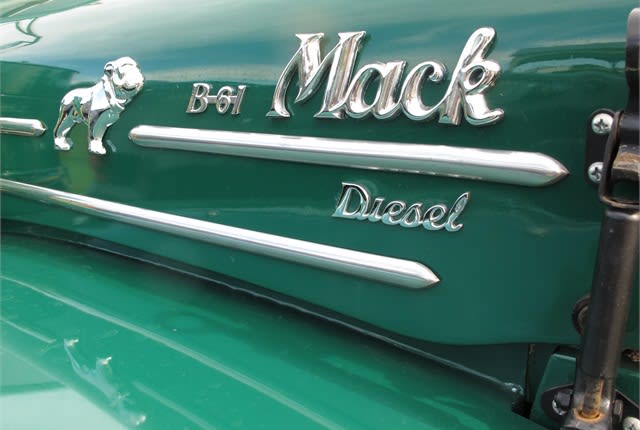
Under the hood purrs a 170-hp, 600 lb-ft, 6-cylinder naturally aspirated Thermodyne engine.
But primitive wasn't necessarily bad in all respects. It wasn't uncommon for drivers to tear an engine down at roadside if they threw a bearing or something. Most of what could go wrong with them could be fixed or jimmied with a bit of whiskey and some baling wire. Sadly, that's no longer the case. With today's telematics capabilities, the truck can self-detect a fault, notify a nearby shop and book itself an appointment. But they can still sit for days waiting for parts.
Say what you want about them, I love the old trucks. They smelled like trucks -- hot oil, grease, diesel, sweat, etc. I guess they didn't invent those stinky little Christmas tree air fresheners 'till sometime later. And while I really like new trucks too, I doubt many of today's trucks will still be running 50 years from now, so enjoy them while you can. The upside is few of them are likely to break your arm just because you missed a shift. That has to be seen as an improvement.
For a video of me grappling with the old Mack, and comparing it to the newest Mack mDrive automated manual transmissions, click here.
A friend and fellow gearhead sent along this link to a video of a guy driving a B-model with a 5x3 triplex. He really knows what he's doing. I emphasize, the fellow in the video is not me.
More Blog Posts

Truck Driver’s Dilemma: Click, Twist or Swipe?
Whether 'tis safer to twist a knob or press a button than to swipe right then swipe down to scan the menu for your favorite playlist...? That's a question for the age.
Read More →
Even the Swedes are Doing Turnpike Doubles
The government doesn't seem to mind asking trucking to invest a trillion dollars toward a greener future. But they won't let us pull turnpike doubles making 30% less CO2. Which is insanity, says HDT's Jim Park in his On the Road blog.
Read More →
Is Your Recruiting Message on Point?
How does your recruiting and retention messaging compare with the reality at your company? Would your drivers agree with your own assessment? Jim Park explores those questions in his On the Road blog.
Read More →
You Can’t Blame Trucks for the Highland Rest Area Bus Crash [Commentary]
The causes of the Highland Park rest area crash go far beyond the parking shortage and the need for flexibility in hours of service — but those issues must be addressed, too, says Jim Park in his On the Road blog.
Read More →
Electric Trucks Seem Far Down the Road for Fleets Dealing with Today's Maintenance Challenges
While the push for zero-emissions trucks rings clear for regulators, advocates and even a small crowd of suppliers, ZEVs seem to have run out of steam down on Main Street, says HDT Equipment Editor Jim Park in his latest On the Road blog.
Read More →
Guinea Pigs 2.0: Can Trucking Comply with a Near Impossible NOx Reduction?
The EPA’s Final Rule on NOx reduction will be incredibly difficult if not nearly impossible for trucking to comply with. Rather than endure another round of equipment failures, downtime and loss of customer faith, industry needs to rally ‘round the OEMs and seek a solution to this wrong-headed rule.
Read More →
Is Downspeeding Bad for Brakes?
Is there a connection between downsped drivetrains and increased brake wear? There shouldn’t be. Downsped fleets seeing increased brake wear are probably not letting the technology do its job, explains HDT Equipment Editor Jim Park.
Read More →
Dig for the Gold Behind CVSA’s Out-of-Service Numbers
Published out-of-service rates don’t mean much until you dig into the why. With brake problems consistently placing in two of the top five spots, maybe we’re missing something in brake maintenance, writes HDT Equipment Editor Jim Park.
Read More →
Things That Go Poof in the Night
We’re in electric-truck heydays now. But like another famous heyday, the 1849 California Gold Rush, there will be a lot fewer winners than losers, says Jim Park in his On the Road blog.
Read More →
Do Your Truck Drivers Know How to Descend a Mountain Grade?
Where do drivers learn mountain-driving techniques? It's sure not from the typical state CDL manual. Jim Park shares what he learned following a deadly 2019 Colorado crash.
Read More →