




Truck Tire Blowouts Don't Have to Be Deadly
A fatal accident in New Mexico is a sobering reminder that proper reaction and proven driving techniques are key to ensuring that a truck remains under the driver's control in the event of a tire blowout — even a steer tire failure.

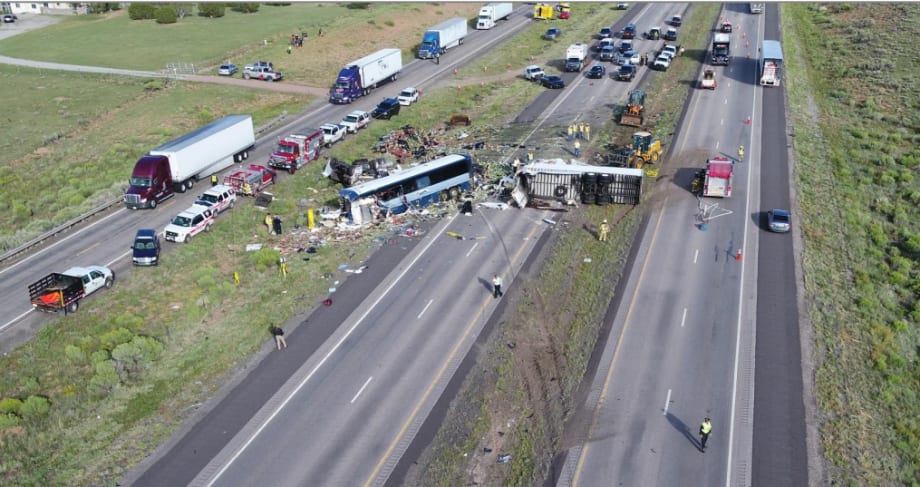
Authorities suspect a steer-tire blowout was the root cause of a spectacular and deadly collision in New Mexico just ahead of the Labor Day weekend.
Source: New Mexico State Police via NTSB report
Authorities suspect a steer-tire blowout was the root cause of a spectacular and deadly collision in New Mexico on August 30, just ahead of the Labor Day weekend. The crash took place on Interstate 40 near the town of Thoreau, close to the Arizona state line.
A truck heading eastbound on I-40 allegedly suffered a blowout of the right-hand steer tire, which appears to have caused the truck to veer across the highway, down through the median and directly into the path of a westbound Greyhound bus carrying 49 passengers.
Seven people were killed in the crash, including the bus driver. The truck driver survived and was hospitalized with non-life-threatening injuries.
The incident received nationwide coverage from many media outlets and it's reported that the National Transportation Safety Board will investigate the crash. That means there will soon be a great deal of discussion about tire maintenance and probably driver training too.
We know that tires seldom, if ever, blowout arbitrarily. We also know that something like 80% of all tire blowouts are caused by deterioration of the tread and/or casing related to the heat caused by sidewall flexing of the underinflated tire. Most of the remaining 20% are road-hazard related.
In this case, news camera images of the failed tire show tell-tale signs of an inflation-related failure.
As for the driver's reaction to the sudden loss of air pressure in his left-hand steer tire, the apparent path of the truck following the blowout strongly suggests he handled the incident improperly.
I want to stress here, I know nothing more about this crash than what has been reported in the media, and so whatever conclusions I can draw from what I have read and seen are pure but fairly well-informed speculation.
I certainly do not know what happened at the moment the tire blew, but the reactions of a truck under such circumstances have been well-researched and documented, and this incident seems to bear witness to what can happen if the driver does not react properly.
What to do When a Steer Tire Blows on a Truck
A blowout on a steer tire will cause the truck to drop to the side of the blown tire and to begin pulling in that direction.
An untrained driver's natural instinct when they feel that pull at the steering wheel is probably to pull the wheel back in the opposite direction and apply the brakes. Depending on the driver's reaction, the steering-wheel pull and brake application could be severe.
Those two actions are exactly the wrong things to do.
The correct approach is to apply full acceleration and adjust the steering wheel to maintain a straight-forward course, keeping the truck in the lane. Applying full power will accomplish most of that work, with a gentle correction of the steering required only to maintain directional control.
The video below demonstrates this pretty clearly.
While it may seem counter-intuitive, it makes sense once you break it down.
You have one steer tire, and a floppy one at that, pulling in the direction of the blowout, but you have four drive wheels pushing the truck in a straight line, presumably forward. By applying power, you increase the forward thrust from the drive wheels, which helps overcome the sideways pull of the blown tire. The steering correction necessary is minor.
That's easy to say from the comfort of my office chair. What about the driver suddenly jolted to his or her senses by a loud bang and sudden change in direction?
It's to this point that I have often compared truck drivers to pilots. Pilots have it much easier, as they often have the benefit of altitude to make a correction and figure out what just happened. It takes a long time to fall from 40,000 feet. The poor truck driver has a fraction of a second to decide and only about 12 feet (2 feet on either side of the truck) to work with.
Obviously, these situations call for fast reaction time, but the correct reaction too.
Truck Steer Tire Blowouts: Speaking From Personal Experience
I have experienced two steer tire blowouts in my career.
The first was a piece of metal that had fallen from a truck ahead of me. It was a trailer landing gear pad that was flipping and bouncing along the road. I wasn't able to steer around it, and it caught the left steer tire, cutting a big gash in the tread face.
I was expecting this and reacted properly applying throttle and maintaining straight-ahead steering. Once the truck was stable, I slowed it down and pulled onto the shoulder ... and then waited three hours for a service truck.
The second was, I'm slightly ashamed to admit, a pressure loss failure.
The right tire blew, shredding the tread and the casing. It took me a bit longer to react and I did lose lane position because I took my foot off the accelerator pedal. I drifted onto the shoulder, fortunately not into another vehicle.
After a moment of drifting right, I got back onto the throttle and pulled the wheel left to get centered in the lane once again before slowing and pulling over.
Few drivers ever get the chance to practice such a maneuver in a less than game-on situation, although sophisticated driver simulators can replicate such an event for driver training.
Check out these two videos about handling truck tire blowouts. One is ancient, but still relevant, and the other covers blowouts on all three wheel positions; steer, drive and trailer. The corrective action for each is the same.
There are a few videos on YouTube that illustrate what can happen when a steer tire blows out. They all follow a pattern: the tire blows, the truck drifts in the direction of the blowout, the driver applies the brakes and loses control of the truck, or (alternate ending) the driver applies throttle and recovers control. Search "truck tire blowout" and see for yourself.
Such an event can really rattle your cage, but it's completely manageable if you do it right. Think about it from time to time while you're driving to keep the process straight in your head.
- Apply full throttle
- Correct for the steering drift
- Once the truck is stable, decelerate slowly and pull over when it's safe to do so.
*CORRECTION: The story originally stated that the blown-out tire was in the right-hand steer position. The blown-out tire was, in fact, in the left-hand steer position.
More Blog Posts

Truck Driver’s Dilemma: Click, Twist or Swipe?
Whether 'tis safer to twist a knob or press a button than to swipe right then swipe down to scan the menu for your favorite playlist...? That's a question for the age.
Read More →
Even the Swedes are Doing Turnpike Doubles
The government doesn't seem to mind asking trucking to invest a trillion dollars toward a greener future. But they won't let us pull turnpike doubles making 30% less CO2. Which is insanity, says HDT's Jim Park in his On the Road blog.
Read More →
Is Your Recruiting Message on Point?
How does your recruiting and retention messaging compare with the reality at your company? Would your drivers agree with your own assessment? Jim Park explores those questions in his On the Road blog.
Read More →
You Can’t Blame Trucks for the Highland Rest Area Bus Crash [Commentary]
The causes of the Highland Park rest area crash go far beyond the parking shortage and the need for flexibility in hours of service — but those issues must be addressed, too, says Jim Park in his On the Road blog.
Read More →
Electric Trucks Seem Far Down the Road for Fleets Dealing with Today's Maintenance Challenges
While the push for zero-emissions trucks rings clear for regulators, advocates and even a small crowd of suppliers, ZEVs seem to have run out of steam down on Main Street, says HDT Equipment Editor Jim Park in his latest On the Road blog.
Read More →
Guinea Pigs 2.0: Can Trucking Comply with a Near Impossible NOx Reduction?
The EPA’s Final Rule on NOx reduction will be incredibly difficult if not nearly impossible for trucking to comply with. Rather than endure another round of equipment failures, downtime and loss of customer faith, industry needs to rally ‘round the OEMs and seek a solution to this wrong-headed rule.
Read More →
Is Downspeeding Bad for Brakes?
Is there a connection between downsped drivetrains and increased brake wear? There shouldn’t be. Downsped fleets seeing increased brake wear are probably not letting the technology do its job, explains HDT Equipment Editor Jim Park.
Read More →
Dig for the Gold Behind CVSA’s Out-of-Service Numbers
Published out-of-service rates don’t mean much until you dig into the why. With brake problems consistently placing in two of the top five spots, maybe we’re missing something in brake maintenance, writes HDT Equipment Editor Jim Park.
Read More →
Things That Go Poof in the Night
We’re in electric-truck heydays now. But like another famous heyday, the 1849 California Gold Rush, there will be a lot fewer winners than losers, says Jim Park in his On the Road blog.
Read More →
Do Your Truck Drivers Know How to Descend a Mountain Grade?
Where do drivers learn mountain-driving techniques? It's sure not from the typical state CDL manual. Jim Park shares what he learned following a deadly 2019 Colorado crash.
Read More →