




Misclassification Battle Continues at Ports
Every few months, it seems, we report on a strike or protest at the ports about the alleged practice of "misclassifying" drivers as owner-operators rather than employees. Deborah Lockridge has the latest update on this issue in her "All That's Trucking" blog.

Photo: Ed Alfaro
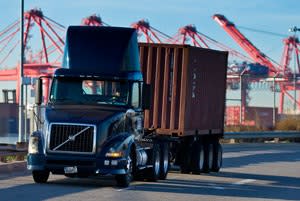
Photo: Ed Alfaro
In the fall of 2014, Hub Group announced it would change its operations at the Southern California ports of Los Angeles and Long Beach to an employee, rather than owner-operator, model, following lawsuits as well as increasing state regulator scrutiny of the “misclassification” of employees as independent contractors.
“It appears that the legal climate in California is becoming unfavorable to the common trucking industry practice of using independent truck drivers,” the company said at the time.
Now the company says it has found the employee model to be too expensive and is pulling out of the ports altogether, according to the Wall Street Journal.
The Journal reports that Hub Group will now employ “a core group of high-service outside carriers” to bring container loads from the ports to nearby warehouses and rail yards, aka drayage. Why? Hub’s costs “have been unsustainable and substantially higher than our outsourced core carriers’ costs" since switching to the employee model.
In a separate story, the paper noted that Hub Group, which reported record earnings for the most recent quarter, plans to diversify beyond its core rail-based shipping business by expanding its truck brokerage and logistics arms and adding other services through acquisition.
Meanwhile, three subsidiaries of XPO Logistics are being sued for misclassification of drivers. The suit, seeking class-action status, alleges that XPO subsidiaries Pacer Cartage Inc., Harbor Rail Transport and PDS Transportation Inc. failed to pay minimum wage, provide meal breaks and rest breaks and reimburse business expenses, among other things.
XPO told the paper it believes the case “is without merit” and the company plans “to litigate it vigorously. We are in constant dialogue with our independent-contractor carriers and believe the vast majority of them value the significant benefits that operating independently can bring.”
Every few months, it seems, we report on a strike or protest at the ports about this issue. It mostly has been centered at the California ports, but it's an issue at other ports as well.
The Teamsters union has supported efforts at the ports to turn drayage drivers into employees rather than contractors. This, of course, would allow them to organize the drivers and add to the union’s ranks. It’s against federal law for independent contractors to unionize.
In addition, California’s government has been actively pursuing misclassification on a case-by-case basis. In 2012, California awarded 38 truck drivers $6.9 million in back pay after ruling that the drivers had been improperly classified as independent contractors by Pacific 9 Transportation.
Meanwhile, states such as New Jersey and New York have tried to pass state laws making all port drivers automatically employees.
It’s a sticky situation. There seems to be little doubt that some port drivers are independent contractors in name only. Yet others say they prefer to be owner-operators and resent the way the Teamsters are pushing the misclassification issue.
As I wrote last summer, one of them is Jim Stewart, a longtime port owner-operator in Savannah.
If some drivers want to be employees, fine, Stewart says, they can sign on with a company as an employee. "Why change laws that affect the majority of truckers out here who are perfectly happy in an ownership situation?
"I see hundreds of locally owned trucks leased to companies with the individuals own name on the baggage compartment door or elsewhere. I see that as pride of ownership - individualism - entrepreneurship - not mis-classification!"
More Blog Posts

Beyond the Central Transport Settlement: Lessons on Hiring and Risk
The $5.5 million discrimination settlement raises broader questions about hiring practices, safety performance, and the hidden risks that can lurk in a fleet's recruiting process.
Read More →
Are Diesel Shortages Something to Worry About Again?
There’s a certain déjà vu when tensions flare in the Middle East and diesel price spikes can give you panic attacks. What parallels are there between the current situation and the 1970s energy crisis?
Read More →
NOx Isn’t Laughing Gas. Let’s Clear That Up.
A recent EPA reference mixed up NOx and nitrous oxide. It’s an easy mistake. Just not one you expect to see in emissions policy. Let’s look at the difference.
Read More →
TMC 2025 Takeaway 2: Buy... or Subscribe?
TaaS. Does that mean trucks as a service, trailers as a service, or tires as a service? HDT's Deborah Lockridge has another takeaway from the Technology & Maintenance Council meeting in her blog.
Read More →
TMC 2025 Takeaway: The Journey Toward Vertical Integration
HDT's Deborah Lockridge on how the trucking industry has moved toward "vertical integration" over the past 25 years.
Read More →
Trucks Are For Girls!
HDT Editor and Associate Publisher Deborah Lockridge is a longtime Girl Scout leader and loves to connect her passion for inspiring girls with her love of the trucking industry.
Read More →
Trucking Advocacy: Impact Beyond the 2024 Elections
No matter who wins the election, trucking continues to work to educate the people who pass the laws and make the rules that affect the industry. HDT's Deborah Lockridge shares insights from two major trucking associations in her All That's Trucking blog.
Read More →
Recharge Your Brain for Better Business
Skimping on vacation may be the worst thing you can do for your business, your career, and your mental health. In her All That's Trucking blog, Deborah Lockridge writes about the importance of giving your brain what it needs to be innovative.
Read More →
Trucker Pre-Trip Leads to Mission 'Im-paw-sible'
See what happened when a truck driver found an unexpected stowaway during his pre-trip inspection.
Read More →
HDT Editor: 2023's Most Important Trucking Topics
Read Deborah Lockridge's picks for the most significant stories we covered at HDT in 2023: freight recession, zero-emission trucks, drivers and marijuana, and more.
Read More →