




Magical Thinking Won’t Take Trucking to Net Zero Emissions
Jack Roberts ponders the state of zero-emission trucking transition while at the Advanced Clean Transportation Expo.

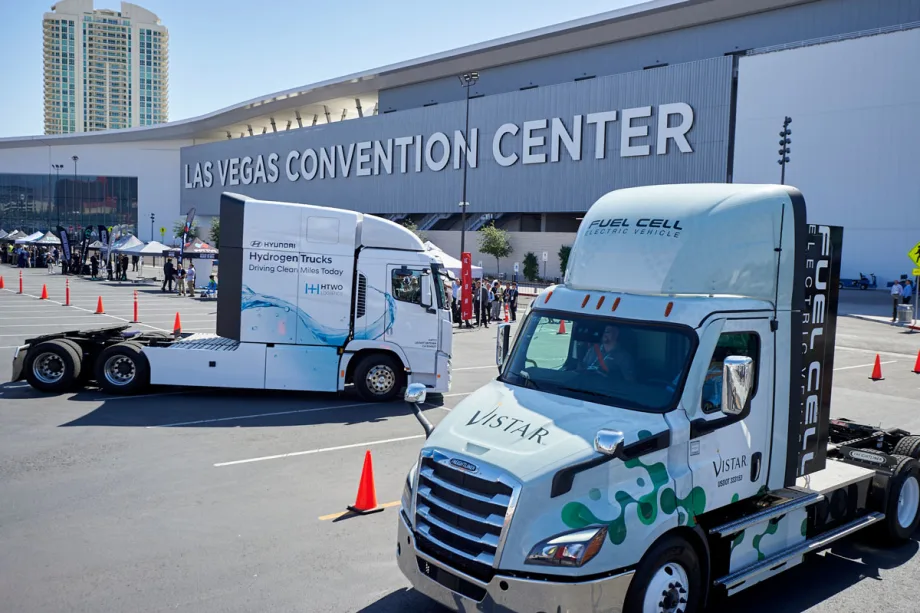
Battery-electric and fuel-cell trucks dominated the ride-and-drive, but it also included other emissions-reduction technologies, such as renewable natural gas.
Photo: ACT Expo/TRC Companies
Welcome to Las Vegas.
I’m at the Advanced Clean Transportation Expo. It’s Day Three of the show. And I’m sitting in the media room, looking down at the show floor — which will begin filling up with trucking industry attendees in another hour or so.
A weird mix of optimism and pessimism seems to be in the air this year.
The show floor is jammed with attendees. And, as usual, there is glittering new technology and futuristic trucks everywhere you look.
There’s a definite sense of accomplishment among suppliers and particular OEMs. They’ve done incredible work over the past decade bringing amazing, alternative-fuel-and-drivetrain vehicles to life. And they have every reason to be proud.
But there also seems to be a growing sense that this massive shift to a net-zero transportation industry isn’t going to happen — not on the timeline that CARB the EPA are insisting on. That we’re going about this all wrong.
Time for a Reality Check on Zero-Emission Trucking
At the end of a high-watt press conference yesterday, I was chatting with a friend and well-known industry insider when he offhandedly patted the Class 8 truck we were standing next to and said, “You know, this is probably a half-million dollar truck, right here…”
And that's a big problem.
Combined with J.B. Hunt CEO Shelley Simpson’s remarks yesterday about being better able to reduce emissions with renewable natural gas, better scheduling, and shifting some freight to intermodal, I thought my friend’s remark sort of perfectly sums up where things stand at the moment.
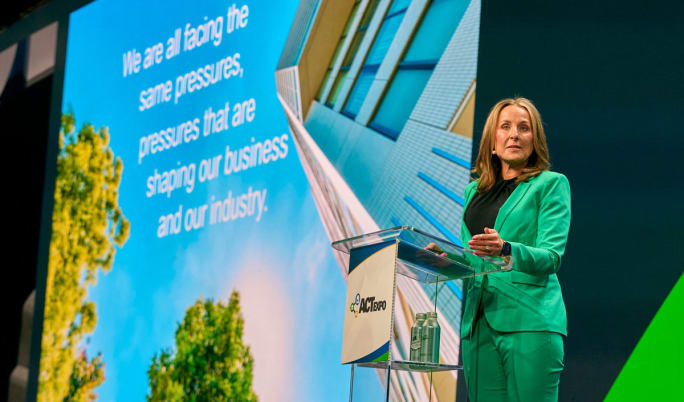
Shelly Simpson, president of J.B. Hunt Transport Services, told the audience at ACT Expo about the company's sustainability successes — which didn't need electric trucks.
Photo: ACT Expo/TRC Companies
Yes, battery-electric and hydrogen fuel cell trucks can perform the jobs fleets need them to do. But they’re still prohibitively expense. Deploying them requires substantially reorganizing fleet operations. And you may very well have to purchase two of the trucks to maintain the efficiency and productivity you get from a single diesel truck — driver shortage and price tags notwithstanding.
This morning, Robert Sanchez, CEO and chairman of the board for Ryder System, was adamant that the business case for zero-emission vehicles, infrastructure and productivity simply isn’t here yet.
Speaking to ACT Expo attendees, Sanchez compared currently available ZEV technology to massive “brick” cell phones in the late 1970s: wildly expensive, difficult to charge and use, and barely capable of performing the tasks it was designed to do.
More reliable, cheaper and more capable ZEVs will come, Sanchez said. But the hard, cold truth is we’re just not there yet.
And then there’s the 800,000-pound gorilla in the room: Charging infrastructure. Despite the large number of charging providers at ACT Expo, the sobering reality is that even if the entire country went all-in on building green electric and hydrogen infrastructure today, we’re still about a decade away from having the grid capacity and brick-and-mortar facilities required to support a zero-emission North American commercial vehicle population.
We Need More Realistic Emissions Transition Plans
And, as I’ve already noted, the expectation seems to be that fleets will fund this massive transition all by themselves. But there’s not nearly enough money flowing in to accelerate real change.
My sense is that we’re fast approaching a point where more pragmatic, realistic transition plans need to be adopted.
By all means, put electric trucks to work as soon as possible in urban and regional fleet applications.
But as I argued in another recent Truck Tech blog, it’s time to revisit proven technologies like clean diesel engines, renewable fuels, natural gas and hybrid-drive powertrains for heavy-duty trucks and electric trailers that can provide additional propulsion when starting out or climbing grades.
We also need to seriously look at new ways of hauling freight: A new emphasis on intermodal transport; heavier, longer combination trailers; and the adoption of autonomous truck technology.
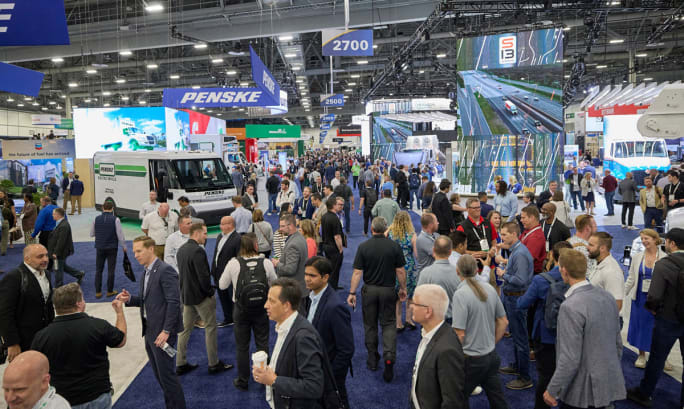
The ACT Expo show floor was busy, but which technology path is best?
Photo: ACT Expo/TRC Companies
Enter Regulators' Magical Thinking
As is often the case, a big part of the problem is that many of the people dictating the current slate of regulations and rules don’t understand the realities of running a trucking fleet.
This is a governmental manifestation of something I’ve observed many times over the course of my career. An affliction I call “Magical Thinking.” The idea that — for reasons that are never clearly explained — whatever obviously unviable plan we’re all supposed to blindly buy into and enthusiastically support will just somehow miraculously work out the way we want it to.
Increasingly, that’s what I’m seeing with regards to trucking’s great transition to net-zero emissions. Lots of magical thinking. But very little in the way of reasoned, rational, sober plans based in reality.
Trucking needs a new transition plan. Because unless something magical happens soon, the one we have right now isn’t going to work.
More Blog Posts

That Time Mack Trucks Threw Me a Birthday Party
Sometimes the best birthdays are the ones you never planned. Mine happened courtesy of one of America's oldest truck manufacturers, and it reminded me why I still love this industry after more than three decades.
Read More →
Trucking Should Prepare for Long Siege of High Fuel Prices
Many in trucking are treating today's fuel-price surge as a temporary disruption. History suggests they may be making a costly mistake.
Read More →
30 Days on the Road: April 2026
There was a glut of good news for the North American trucking industry. HDT's Jack Roberts takes a look back at our major stories from the month.
Read More →
30 Days on the Road: HDT's Monthly News Roundup for March 2026
HDT's Monthly News Roundup takes a look at the major North American trucking industry news stories from March, 2026.
Read More →
The Major Autonomous News No One is Talking About
Both Aurora Innovation and PlusAI have made under-the-radar announcements that signal a massive game-changer for trucking is coming soon.
Read More →
HDT's Monthly News Roundup: February 2026
February was dreary and dull -- as usual. But the North American trucking industry finally showed some signs of life. But how long that will last is anybody's guess.
Read More →
Like it or Not, The New Year is Here!
HDT's Monthly Trucking Newsletter looks back on the top stories from January, 2026.
Read More →
The Robots are Here
After a bruising year for trucking, CES 2026 felt subdued. Until it suddenly offered a glimpse of trucking's next disruption and reminded everyone that technology never waits for the next freight cycle.
Read More →
Robots and Road Rage
Computers never get angry. And that's a good thing on crowded stretch of interstate.
Read More →
For the Love of Old Trucks
Old trucks generally get ignored in classic car circles. Maybe that's changing.
Read More →