




HOS, windmills, dropped balls and the DOT
What do the Federal Motor Carrier Safety Administration and the Federal Aviation Administration have in common -- aside from coming under the purview of the Department of Transportation? They both apparently have a penchant for dropping the ball on rulemaking
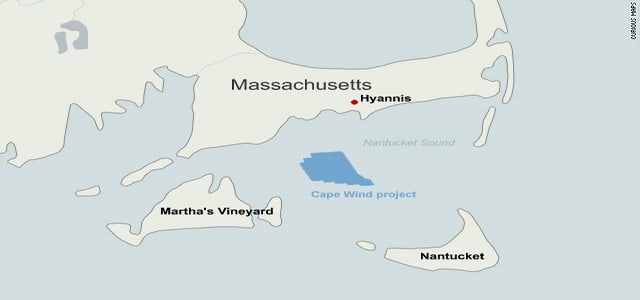
More than 100 windmill pilons standing 440 tall in the middle of Nantucket Sound pose no threat to navigation, the FAA says. Tell that to a VFR pilot on approach to Martha's Vinyard in crummy weather.
What do the Federal Motor Carrier Safety Administration and the Federal Aviation Administration have in common -- aside from coming under the purview of the Department of Transportation? They both apparently have a penchant for dropping the ball on rulemaking.
As we in trucking know only too well, our beloved Hours of Service regs have been in and out of court and thus in and out of regulatory limbo for seven years now. Two challenges, two court rulings, and two findings that the agency either ignored some part of the rulemaking process or just dropped the ball in developing the rules. A third court challenge filed in 2009 was more or less pre-empted when the courts directed FMCSA to redraft the rule rather than vacate it yet again.
As we await the outcome of that politically fired fiasco, we learned that the FAA isn't much better than FMCSA at following its own rules. The agency apparently overlooked the threat to general aviation in deciding, last year, that construction of an offshore wind farm could proceed in the federally regulated waters of Nantucket Sound.
A project called Cape Wind has been in development there for more than a decade that would see 130 440-foot wind turbines erected in a 25-square-mile area roughly centered in a triangular arrangement between Barnstable, Nantucket, and Martha's Vineyard, Mass.
The Boston-based developer has $2.5 billion tied up in Cape Wind already, but opponents of the plan took advantage of FAA's fumbling to stall the project yet again.
You see, there are three General Aviation airports at located at Barnstable, Nantucket and Martha's Vineyard, and in a botched safety assessment of the area conducted in 2010, FAA concluded that the cluster of 440-foot towers posed no threat to air navigation provided they were suitably marked.
Opponents to the plan went to court, arguing the FAA hadn't sufficiently considered the impact on flights under Visual Flight Rules -- where pilots actually look out the windscreen to see where they are going, as opposed to Instrument Flight Rules (IFR), which electronically put aircraft on predetermined paths much like freeways.
The town of Barnstable, Mass., and a group of opponents to the project challenged FAA's opinion, arguing that the agency "violated its governing statute, misread its own regulations, and arbitrarily and capriciously failed to calculate the dangers posed to local aviation."
Sounds eerily familiar, doesn't it?
Managers of GA airports at Barnstable, Nantucket and Martha's Vineyard told the court that the "finely balanced airspace over Nantucket Sound is already one of the most congested, foggy, and dangerous airspaces on the eastern seaboard." Adding turbines to the area, they said, would create a "disaster waiting to happen."
The FAA-commissioned study found that 425 planes under VFR rules passed near the Cape Wind project zone in a 90-day period.
"Once the turbines are built, many of these flights may be forced to be rerouted or to proceed in violation of the FAA's own regulation ... which requires a 500-foot distance between an aircraft and any structure," the court said.
The FAA now must review and re-submit its findings in the case.
Was it simply a blunder on FAA's part? Incompetence? Or political interference?
Divisive Issues
As is the case with our HOS tribulations, camps on both sides of the issue are pulling out all the stops to influence the outcome of this case.
The Boston Herald reports that Cape Wind opponents cheered the ruling, while the Boston-based developer vowed to plow on with its $2.5 billion plan.
"It's a key victory and an important step toward Cape Wind's ultimate failure," Audra Parker, president of the Alliance to Protect Nantucket Sound, was quoted by the paper. "With this decision, Cape Wind can't begin construction or move forward."
And that's precisely the point.
When a federal agency doesn't do its job with appropriate regard to the law, and fumbles critical aspects of its decision-making process, it tosses everyone into the spin cycle -- and at tremendous cost both in financial terms and in terms of long-term planning requirements.
The Cape Wind project has been in the works for more than a decade now, and the developer must be feeling pretty much the same way trucking feels about FMCSA's handling of HOS in recent years.
Government agencies shouldn't be allowed to get away with that kind of ineptitude.
The potential impact of a significant change to HOS would cost billions in systems overhauls, lost productivity, and the inevitable retraining and eventual fines resulting from yet another overhaul to HOS, all because the regulators left a door open that diligent opponents found and charged straight through.
I can't even imagine what all the uncertainty -- created in July 2004 when the court threw out the first major overhaul to HOS since 1939 -- has cost the industry, the HOS opponents, the courts, or indeed, the agency itself. It would be staggering. And I'll bet not even a single civil servant lost a job over it.
For what it's worth, there's some comfort in knowing we're not alone in our struggles.
For those interested, a far more thorough analysis of the FFA decision -- or lack thereof -- can be found here.
More Blog Posts

Truck Driver’s Dilemma: Click, Twist or Swipe?
Whether 'tis safer to twist a knob or press a button than to swipe right then swipe down to scan the menu for your favorite playlist...? That's a question for the age.
Read More →
Even the Swedes are Doing Turnpike Doubles
The government doesn't seem to mind asking trucking to invest a trillion dollars toward a greener future. But they won't let us pull turnpike doubles making 30% less CO2. Which is insanity, says HDT's Jim Park in his On the Road blog.
Read More →
Is Your Recruiting Message on Point?
How does your recruiting and retention messaging compare with the reality at your company? Would your drivers agree with your own assessment? Jim Park explores those questions in his On the Road blog.
Read More →
You Can’t Blame Trucks for the Highland Rest Area Bus Crash [Commentary]
The causes of the Highland Park rest area crash go far beyond the parking shortage and the need for flexibility in hours of service — but those issues must be addressed, too, says Jim Park in his On the Road blog.
Read More →
Electric Trucks Seem Far Down the Road for Fleets Dealing with Today's Maintenance Challenges
While the push for zero-emissions trucks rings clear for regulators, advocates and even a small crowd of suppliers, ZEVs seem to have run out of steam down on Main Street, says HDT Equipment Editor Jim Park in his latest On the Road blog.
Read More →
Guinea Pigs 2.0: Can Trucking Comply with a Near Impossible NOx Reduction?
The EPA’s Final Rule on NOx reduction will be incredibly difficult if not nearly impossible for trucking to comply with. Rather than endure another round of equipment failures, downtime and loss of customer faith, industry needs to rally ‘round the OEMs and seek a solution to this wrong-headed rule.
Read More →
Is Downspeeding Bad for Brakes?
Is there a connection between downsped drivetrains and increased brake wear? There shouldn’t be. Downsped fleets seeing increased brake wear are probably not letting the technology do its job, explains HDT Equipment Editor Jim Park.
Read More →
Dig for the Gold Behind CVSA’s Out-of-Service Numbers
Published out-of-service rates don’t mean much until you dig into the why. With brake problems consistently placing in two of the top five spots, maybe we’re missing something in brake maintenance, writes HDT Equipment Editor Jim Park.
Read More →
Things That Go Poof in the Night
We’re in electric-truck heydays now. But like another famous heyday, the 1849 California Gold Rush, there will be a lot fewer winners than losers, says Jim Park in his On the Road blog.
Read More →
Do Your Truck Drivers Know How to Descend a Mountain Grade?
Where do drivers learn mountain-driving techniques? It's sure not from the typical state CDL manual. Jim Park shares what he learned following a deadly 2019 Colorado crash.
Read More →