




Getting Guidance on Electric Trucks
The first-ever Guidance Report issued by NACFE seeks to clear the air on both the myths and realities of battery electric vehicles in fleet operations today and in the near future. Blog commentary by Jack Roberts.

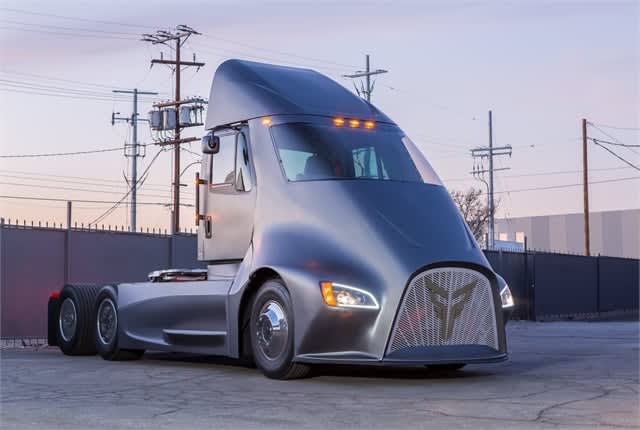
A new NACFE report on electric vehicles says Class 7 and 8 operations will be possible, but not for all applications. Photo: Thor Trucks
As fast-moving as pretty much everything is in trucking today, I have to admit that the speed with which electric trucks and vans are gaining ground caught me off guard. A little over a decade ago, I got my first chance to drive an electric truck around a frozen city block in Indiana at The Work Truck Show. And every EV at that show was built by small start-up companies.
Today, we see traditional industry suppliers such as Dana, Meritor, and Cummins going all-in on electric vehicles, big-name new companies with serious big money and outsized personalities pushing hard to corner a rapidly coalescing EV market, as well as global OEMs like Daimler, Volvo, and Hino working equally hard to get their own EVs to market first.
At the same time, while moderating a panel on future transportation technology at WasteExpo in Las Vegas last month, I watched with raised eyebrows while seasoned refuse fleet professionals peppered electric-truck builders such as Jim Castalez, CEO of Motiv, and Ian Wright, CEO of Wrightspeed, with sharp, knowledgeable questions about EV cost, maintenance and capabilities in real-world fleet operations.
We’re not quite at the boiling point when it comes to EVs. After all, there are still very few of them actually working out there in the real world. But we are getting close. Which is a big reason the North American Council for Freight Efficiency issued its first-ever Guidance Report on battery-electric vehicles to help clear the air surrounding this new technology and – as with anything NACFE – give fleet managers real-world information to help them make informed decisions about acquiring and operating BEVs.
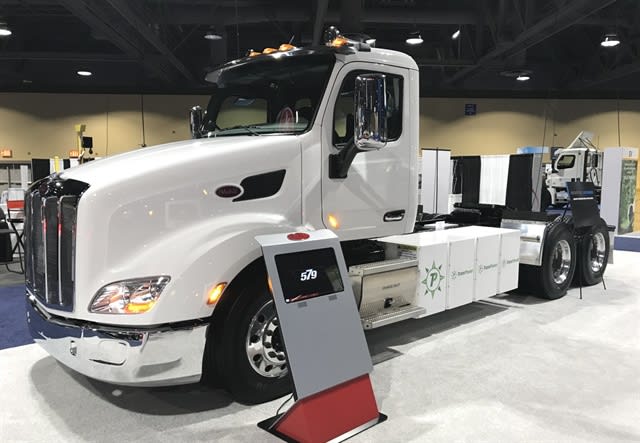
This all-electric Peterbilt Model 579 drayage tractor is one of 12 built in collaboration with Transpower, the California Resources Board, and the Port of Long Beach. Photo: Peterbilt
Top Takeaways on Battery-Electric Commercial Vehicles
Among the more pertinent findings, NAFCE says that:
BEVs will not be a solution for every application or market, but commercial BEVs will have an increasing role in freight transportation in Classes 3 through 8.
The rapid pace of battery energy density improvement will spur increases in BEV efficiency that likely cannot be matched by evolutionary changes to the internal combustion engines.
The transition in specific market segments will be drawn out over decades, sharing space with traditional gasoline, diesel, and other alternative-fuel powertrains and also competing with other emerging technologies like fuel cells and hybrids.
Mixed fleets (including diesel, natural gas, hybrid, and BEV products) optimized for specific routes and duty cycles will likely be the norm through 2050.
Early adopters will be in the urban delivery Class 3 through 6 segments with fairly stable route definitions, loads that tend to cube out, and vehicles that run on shift and return to the same base location.
BEVs require new electrical charging infrastructure, which will take time and capital to build.
Battery electric commercial vehicles must be reliable to gain market confidence.
Maintenance and service cost reduction is an open question at this time.
Longer ranges and heavier weights in Classes 7 and 8 are possible in specific operations, but may not be viable in all roles.
More Complicated ROI Calculations for Electric Commercial Vehicles
Most striking, however, is NAFCE’s contention that parsing the net costs and benefits of BEVs require more effort than traditionally limited ROI calculations for diesel or gasoline powered fleet vehicles. NAFCE researchers concluded that multiple factors need to be included when determining ROI, from straightforward starter issues such as grants, incentives and taxes, to hard-to-dollar-quantify items such as emissions credits, brand image, liability costs, disposal costs, indirect costs, driver/technician retention or attraction, potential customers, and other opportunity costs/benefits buried in overhead or ignored in traditional ROI calculations.
Still, NAFCE is adamant that BEVs are coming and will be a viable solution for many fleets operating today. It notes in the report that automotive and bus battery-electric vehicles have been in production for years and advancing on their learning curves in real world use. Battery capacities are expected to increase, while charging time, cost, and weight are expected to decrease. The technology is on the steep part of the development S-curve, where big improvements are regularly expected.
An executive summary of the NACFE BEV Guidance Report can be downloaded for free at NACFE.org.
Related: Anheuser-Busch Orders 800 Nikola Hydrogen-Electric Trucks
More Blog Posts

That Time Mack Trucks Threw Me a Birthday Party
Sometimes the best birthdays are the ones you never planned. Mine happened courtesy of one of America's oldest truck manufacturers, and it reminded me why I still love this industry after more than three decades.
Read More →
Trucking Should Prepare for Long Siege of High Fuel Prices
Many in trucking are treating today's fuel-price surge as a temporary disruption. History suggests they may be making a costly mistake.
Read More →
30 Days on the Road: April 2026
There was a glut of good news for the North American trucking industry. HDT's Jack Roberts takes a look back at our major stories from the month.
Read More →
30 Days on the Road: HDT's Monthly News Roundup for March 2026
HDT's Monthly News Roundup takes a look at the major North American trucking industry news stories from March, 2026.
Read More →
The Major Autonomous News No One is Talking About
Both Aurora Innovation and PlusAI have made under-the-radar announcements that signal a massive game-changer for trucking is coming soon.
Read More →
HDT's Monthly News Roundup: February 2026
February was dreary and dull -- as usual. But the North American trucking industry finally showed some signs of life. But how long that will last is anybody's guess.
Read More →
Like it or Not, The New Year is Here!
HDT's Monthly Trucking Newsletter looks back on the top stories from January, 2026.
Read More →
The Robots are Here
After a bruising year for trucking, CES 2026 felt subdued. Until it suddenly offered a glimpse of trucking's next disruption and reminded everyone that technology never waits for the next freight cycle.
Read More →
Robots and Road Rage
Computers never get angry. And that's a good thing on crowded stretch of interstate.
Read More →
For the Love of Old Trucks
Old trucks generally get ignored in classic car circles. Maybe that's changing.
Read More →