




Are Airless Tires the Way of the Future?
Imagine a hybrid tire that can change tread patterns to suit the application, from a deep block lug for traction to a smooth rib for fuel efficiency, or a tire that runs just on its shoulders for optimum fuel efficiency or on a full tread face for better traction. How about a tire/wheel assembly that leans into a turn for better traction and stability? Equipment Editor Jim Park has a fun look at possible tires of the future in his "On the Road" blog.

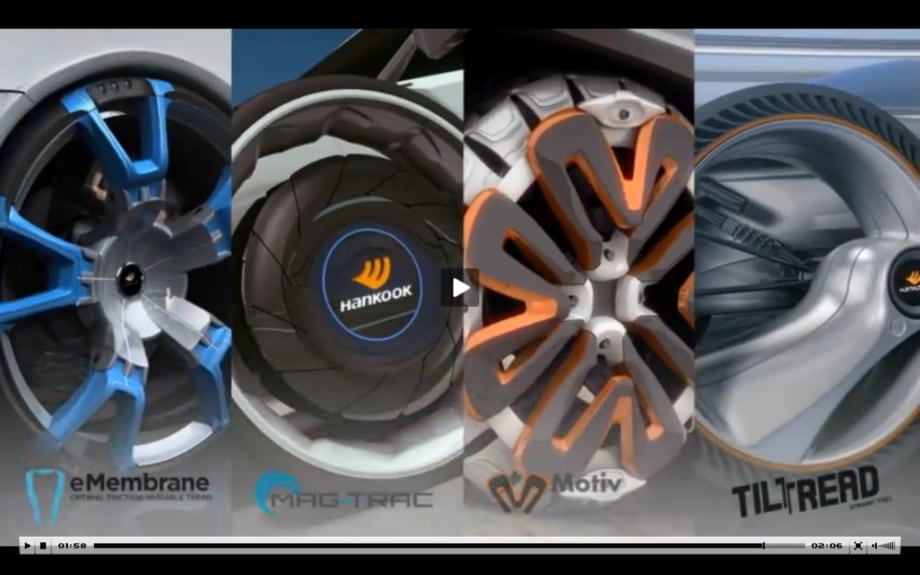
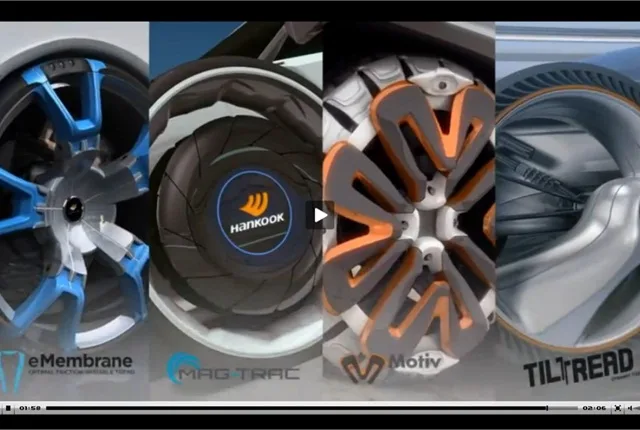
Imagine a hybrid tire that can change tread patterns to suit the application, from a deep-block lug for traction to a smooth rib for fuel efficiency, or a tire that runs just on its shoulders for optimum fuel efficiency or on a full tread face for better traction. How about a tire/wheel assembly that leans into a turn for better traction and stability? Or an electromagnetic suspension that is actually part of the tire and wheel assembly rather than part of the vehicle?
Those are some futuristic tire designs showcased by Hankook in a fun little video I found on YouTube Sunday morning. That they will ever come to pass in the versions presented in the video seems doubtful, but recalling various Popular Mechanics magazine articles of the '50s and '60s, there were some pretty far-out concepts presented then that have since materialized -- though maybe in a slightly different form. So, I'm not going to dismiss the tires in Hankook's video as out of the question.
We already have mechanical tires -- as opposed to pneumatic -- in many forms and applications. We see them on bicycles, wheeled machinery, and even in some automotive applications. Who hasn't seen the videos of the military Humvee with the honeycomb wheels (below)?
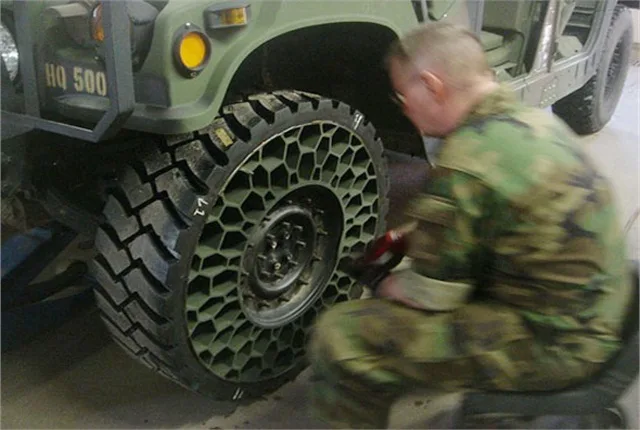
Who wants a flat tire when people are shooting at you?
Michelin makes a tire/wheel for fork-lift trucks that while small in stature is rated for large loads. That wheel also has possibilities in off road applications where punctures are a problem, such as on construction sites.
And in 2005, Michelin unveiled its Tweel, an airless hybrid of tire and rim that uses composite spokes and deformable rim onto which they attach the tread.
A variation on the Tweel could find a home in applications such as refuse trucks, where speed usually isn't a factor and flats are a constant threat.
Published reports from various test drives indicated the Tweel has a great deal more lateral stiffness than a traditional tire, making it extremely responsive in cornering maneuvers. Among the reported downsides are that you can't control the feel of the tire using various inflation pressures, and it's said to be quite noisy at speeds over 50 mph.
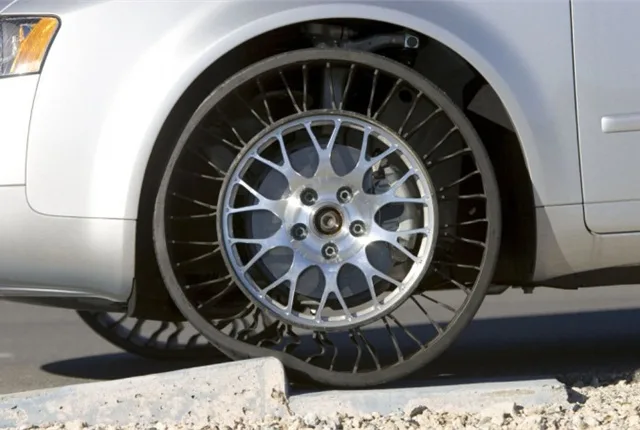
Tires that don't go flat would save hours of downtime.
Which brings me to the tires in the Hankook video. As the science and practice of mechatronics -- the melding of electronics and mechanical systems -- becomes more sophisticated, it becomes easier to imagine tires that can change shape or compensate for different driving conditions.
I can see the advantage of a tire whose tread face changes shape so that when traction isn't required, the tire seems to run on the shoulders of the tread face. That would lower rolling resistance considerably, while in times when better traction was required, the tire could reconfigure itself accordingly.
As illustrated in the video, they would use a lot less rubber than a conventional tire, offering a cost savings -- which no doubt be eaten up several times over in the cost of the system to control the tread. But what if that tire/wheel assembly could last 10 years with the replacement of two or three tread faces -- like retreading.
And think of the savings in maintenance and downtime: no more flat tires, no more pressure checks, no more ... . Maybe there would be some cost effectiveness in such a tire after all.
These are just the musings of a Sunday morning gander at YouTube, and they certainly aren't grounded in fact or even remote probability, but like the folks in the '60s flipping through their Popular Mechanics magazines, there are hours of amusement to be had in speculating.
Here's the Hankook video:
More Blog Posts

Truck Driver’s Dilemma: Click, Twist or Swipe?
Whether 'tis safer to twist a knob or press a button than to swipe right then swipe down to scan the menu for your favorite playlist...? That's a question for the age.
Read More →
Even the Swedes are Doing Turnpike Doubles
The government doesn't seem to mind asking trucking to invest a trillion dollars toward a greener future. But they won't let us pull turnpike doubles making 30% less CO2. Which is insanity, says HDT's Jim Park in his On the Road blog.
Read More →
Is Your Recruiting Message on Point?
How does your recruiting and retention messaging compare with the reality at your company? Would your drivers agree with your own assessment? Jim Park explores those questions in his On the Road blog.
Read More →
You Can’t Blame Trucks for the Highland Rest Area Bus Crash [Commentary]
The causes of the Highland Park rest area crash go far beyond the parking shortage and the need for flexibility in hours of service — but those issues must be addressed, too, says Jim Park in his On the Road blog.
Read More →
Electric Trucks Seem Far Down the Road for Fleets Dealing with Today's Maintenance Challenges
While the push for zero-emissions trucks rings clear for regulators, advocates and even a small crowd of suppliers, ZEVs seem to have run out of steam down on Main Street, says HDT Equipment Editor Jim Park in his latest On the Road blog.
Read More →
Guinea Pigs 2.0: Can Trucking Comply with a Near Impossible NOx Reduction?
The EPA’s Final Rule on NOx reduction will be incredibly difficult if not nearly impossible for trucking to comply with. Rather than endure another round of equipment failures, downtime and loss of customer faith, industry needs to rally ‘round the OEMs and seek a solution to this wrong-headed rule.
Read More →
Is Downspeeding Bad for Brakes?
Is there a connection between downsped drivetrains and increased brake wear? There shouldn’t be. Downsped fleets seeing increased brake wear are probably not letting the technology do its job, explains HDT Equipment Editor Jim Park.
Read More →
Dig for the Gold Behind CVSA’s Out-of-Service Numbers
Published out-of-service rates don’t mean much until you dig into the why. With brake problems consistently placing in two of the top five spots, maybe we’re missing something in brake maintenance, writes HDT Equipment Editor Jim Park.
Read More →
Things That Go Poof in the Night
We’re in electric-truck heydays now. But like another famous heyday, the 1849 California Gold Rush, there will be a lot fewer winners than losers, says Jim Park in his On the Road blog.
Read More →
Do Your Truck Drivers Know How to Descend a Mountain Grade?
Where do drivers learn mountain-driving techniques? It's sure not from the typical state CDL manual. Jim Park shares what he learned following a deadly 2019 Colorado crash.
Read More →