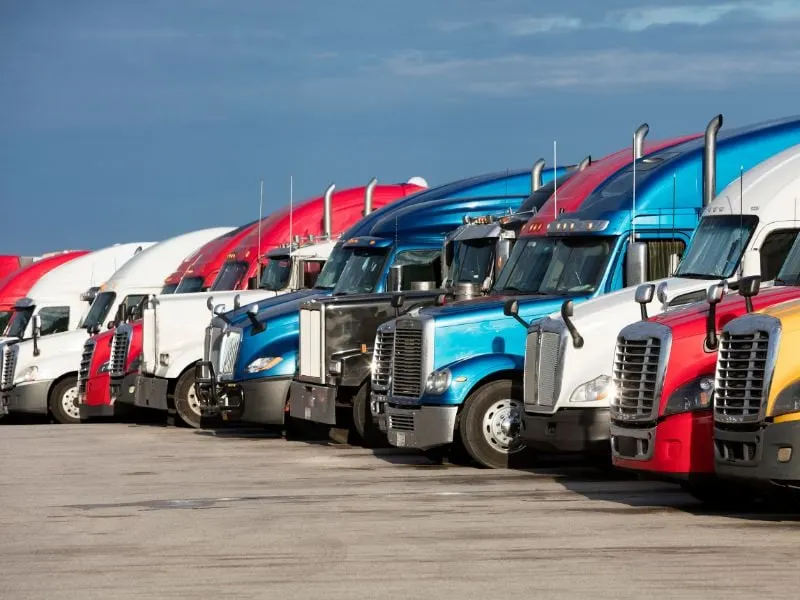
There’s no question about it— there’s a lack of available truck parking nationwide and it’s a daily headache for drivers and trucking companies. And it’s a big challenge as well.
According to a 2021 survey conducted by the Federal Highway Administration (FHWA), the American Trucking Associations (ATA), and the Owner-Operator Independent Drivers Association (OOIDA), there is just one parking spot for every 11 drivers. Do the math and what that tells you is that on any given day, about 90% of drivers might not have a place to park.
Our own data illustrates the daily challenge as well. In a 2023 report based on information supplied by Trucker Path mobile app users, truckers found “no parking available” as often as 36% of the time in various parts of the country.
Regardless of how you measure parking availability and considering the number of trucks on the road on any given day, it’s probably not possible to add enough parking spaces to solve the problem, or even to put more spaces in the right places. It’s particularly challenging around metropolitan areas where higher demand for goods delivered by truck is at odds with regulatory roadblocks and pressure against the construction of additional truck parking.
Nationwide Problem
For most drivers, in fact, the biggest challenge is finding available spaces where and when they are needed. An ATA study put the time it takes to look for parking even higher at an average of 56 minutes every day.
For any real solution to take hold, it’s time to start thinking about solving this problem on a large, nationwide scale. Truck parking must be more than just available; it has to be discoverable.
The industry actually started addressing that issue in 2019. After identifying the need for more consistency in disseminating truck parking availability information to drivers, the American Transportation Research Institute (ATRI) Research Advisory Committee set “Standardizing Truck Parking Information Systems” as a top priority. Their goal was to identify how drivers receive truck parking availability information and their preferences for how that information is disseminated.
API Infrastructure
Public and private entities have worked to help drivers identify parking spots by deploying technologies that monitor availability and provide information. Those solutions, however, are at best building blocks. What is needed to truly provide an effective approach is a technology strategy that eliminates silos of information.
One of the most viable possibilities is to take advantage of an open API infrastructure that makes it possible for all the sources of truck parking information to be consumed into in a single, central repository. A good example are the highly popular travel sites that allow access to flight, and hotel and rental car information from hundreds of sources in one place.
Searching for Parking
The key advantage for drivers is obvious—easier, faster, more accurate and current access to information on available parking. It is also widely known that the lack of available truck parking creates safety issues for drivers who have to park in undesignated spaces or on highway shoulders or ramps.
Drivers could realize measurable value in other ways as well.
Annually, according to the FHWA, ATA, and OOIDA study, the time spent looking for parking adds up to 12% in lost earnings, and those losses are compounded when drivers stop earlier to ensure they have a place to park before running out of Hours-of-Service (HOS) time.
For trucking companies, according to ATA, lost time spent searching for parking drives up lost revenue to the tune of $5,500 per driver each year. And with the industry needing an estimated 78,000 drivers (as of 2022), that also creates the need for even more operators, raising recruiting and retention costs as well.
For parking locations and providers of apps that offer access to parking information, there would be increased exposure to a wider audience of drivers, not just customers who use their proprietary platforms. Through innovative offerings, they could also become more competitive, using the technology to draw in drivers to their facilities where a range of other services are also available.
Top Priority
The lack of available truck parking has been a top-five issue in the annual ATRI Critical Issues in the Trucking Industry survey since 2015. In 2022, it was ranked third overall and for the third year in a row was the top concern for drivers, above compensation. In 2023, ATRI included expanding truck parking in its list of top research priorities.
Truck parking concerns are getting increased attention at federal and state levels, including grants to expand capacity in publicly available areas and at freight-centric locations. Strategies also focus on encouraging governments to remove regulatory barriers limiting the construction and expansion of truck parking facilities.
While that activity and private efforts to create more parking as well are important and necessary, the answer is not just about more spaces; it’s about finding them.
Can the truck parking problem truly be solved? With the visibility offered by a widely accessible, truck parking availability information clearinghouse, it can be.