





Related: Discussing DME with Oberon Fuels Co-Founder Elliot Hicks
Will Global Interest Spur DME Adoption in North America?
Low oil and diesel prices have dampened interest in alternative fuels, and dimethyl ether, more commonly known as DME, is no exception. But will global interest in DME hasten its adoption as a fuel in North America?
January 22, 2016
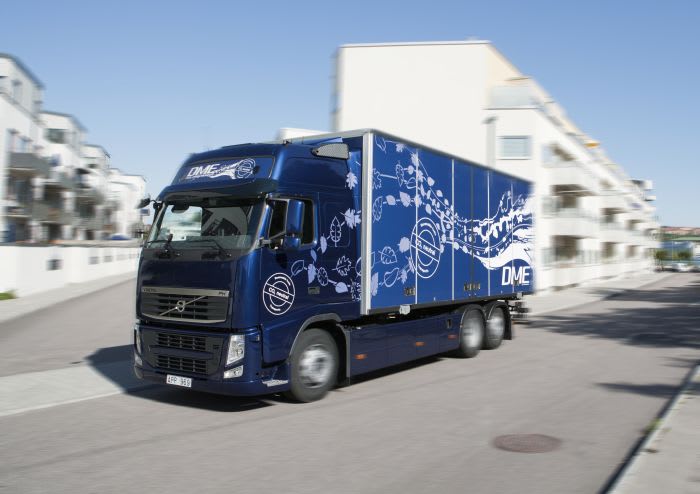
DME was one of a number of alternative fuels tested in Europe by Volvo in real-world service with hauling firms. Photo: Volvo
6 min to read
DME was one of a number of alternative fuels tested in Europe by Volvo in real-world service with hauling firms.Photo: Volvo
Low oil and diesel prices have dampened interest in alternative fuels, and dimethyl ether, more commonly known as DME, is no exception. Volvo and Mack in early 2013 announced they would begin limited production in 2015 of DME-powered trucks, but by late 2014 had put those plans on pause.
Proponents believe DME’s ability to be made from a variety of feedstocks, its clean-burning properties and the fact that it doesn’t need ultra-high pressure or cryogenics make it a natural replacement for diesel. Critics, however, say don’t realistically expect any real movement in adoption in the current price environment.
DME is a clean, colorless gas at ambient temperatures. It has been used for decades in the personal care industry, mainly as an environmentally benign propellant in aerosols.
It can be liquefied under a moderate pressure, similar to propane (liquified petroleum gas or LPG), to be used as vehicle fuel. Unlike propane, however, DME can be compression-ignited like diesel. DME can also be blended with LPG, which allows the DME-LPG blend to displace diesel fuel on compression engines.
DME can be produced from coal or natural gas, as well as from renewable sources such as paper waste, forest and agricultural byproducts, municipal waste, and dedicated fuel crops. In Sweden, where the Volvo Group is based, DME is made from “black liquor,” a waste product from the country’s forestry industry. In this country, the focus is on making it from natural gas.
We checked with Volvo about the status of DME. Magnus Koeck, vice president of marketing and brand management for Volvo Trucks North America, responded that “Volvo Trucks continues to believe that DME holds promise as a vehicle fuel for a number of reasons, including its diesel-like performance and a faster ROI for truck customers compared to other alternative fuels. Ongoing field tests are demonstrating encouraging results, and we continue to make the types of refinements to our technology as you’d expect in early prototypes.
“With that said, the commercial introduction of our DME-powered engine remains on hold, as we do not think the market is ready.”
The fuel for the two pilot projects Volvo still has running, one in California and one in Texas, is provided by Oberon Fuels. Oberon’s DME production facility has been producing fuel-grade DME southern California since 2013. It can produce up to 10,000 gallons of DME per day.
Oberon President Rebecca Boudreaux, chair of the International DME Association, told HDT that DME now can legally be used as fuel in all 50 states, and it’s eligible for the federal Renewable Fuel Standard if you make it from waste gas.
And while she couldn’t offer any details, she said to expect an announcement in the next six to nine months regarding more DME-powered vehicles in North America.
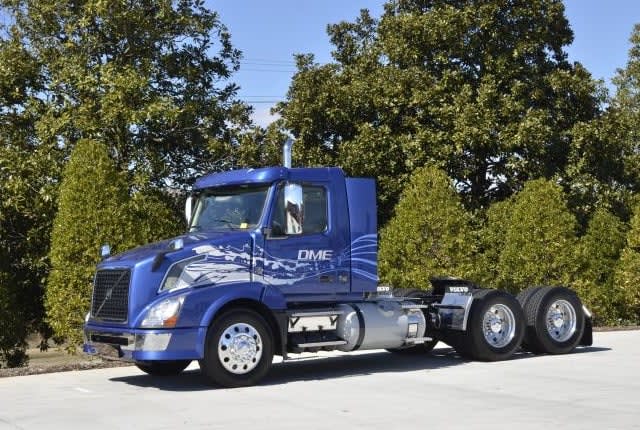
Volvo Trucks North America has put its work on a DME-powered truck on pause, saying the market is not ready.Photo: Volvo
Global action
DME is seeing more interest globally than in North America, Boudreaux says. “DME is both a solution for fuel and energy challenges, but also for our waste problems, because it can be made from waste, from landfill gas. As our population increases we’ll have more waste to deal with as well as dealing with energy needs.”
Rohit G. Vedhara, with Singapore-based energy project developer Aum Energy, points out, “There’s a lot of pressure to improve air quality around the world.” Options that work for lighter-duty vehicles, such as electric cars, aren’t always a good fit for heavy trucks, he notes, given the load-carrying requirement over distance. Vedhara adds that the lower levels of nitrogen oxides (NOx) and the absence of sulfur oxides and particulate matter from DME combustion can be a critical factor in adoption in urban areas that want to improve air quality.
In September, Ford and the German government announced they are teaming up to develop and test the world’s first production passenger car to run on DME. Oberon Fuels is another partner in the venture and will be shipping the fuel from its Brawley, Calif., facility. The three-year, 3.5 million euro project focuses on the passenger car side, Boudreaux said, but she pointed out that lighter-duty diesels are used in commercial light trucks in North America as well.
With over 60 plants in operation to produce DME to blend with propane, China is now the largest producer of DME in the world, Vedhara says. An academic and industrial consortium in China last summer received government certification for a DME-fueled heavy-duty diesel engine satisfying Euro 6 emissions standards. The modified 6-liter common rail injection diesel engine is being demonstrated on short-haul heavy-duty street sweeper and garbage trucks.
“We don’t believe that oil is going to stay low forever,” Boudreaux says. “With political volatility around the world, there is growing momentum for people to be energy independent and not rely on the Middle East, but rather domestic production. So we really do see this driving force. we see that ongoing dynamic even with current low oil prices.”
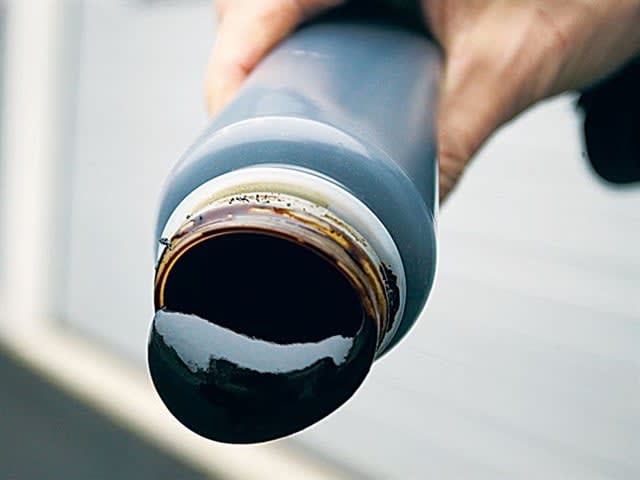
DME can be made from a variety of feedstocks. This “black liquor,” a timber industry waste product, is used in Sweden. In China, it’s mostly coal. In the U.S. it would likely be natural gas or waste methane from landfills.Photo: Sven-Erik Lindstrand
The chicken and the egg
What is it going to take to get to a commercialization level where a fleet can go out and buy and run a DME-powered vehicle?
“We have fuel grade DME available, we have the regulatory framework, we have a certified dispenser,” Oberon’s Boudreaux says. “We need to get more vehicles on the road.”
As Vedhara says, “Volvo Trucks is on the cusp of designing trucks — I think they’re already there. But they need someone to stand up and say, ‘Will you sell me a hundred trucks?’“
The other leg of the stool, Vedhara says, is the fuel supply. “It doesn’t help Volvo to do the work on the truck if no one’s building a DME plant in North America.”
Vedhara’s company believes that in order to drive the market, a larger-scale DME plant needs to be built in the U.S. — at least 300 tons a day (enough to fuel 2,500 trucks). But with oil prices currently low, companies remain in planning and due diligence mode.
“It’s a catch-22,” he says. “The more that people get interested in DME and want to be part of a project, the greater the momentum and scale benefits.”
Jon T. Gabrielsen doesn’t expect that kind of momentum in the next few years, at least not in North America.
The engineer and MBA is president and CEO of J.T. Gabrielsen Consulting, and recently completed a research project due to be published this spring that looks at the potential for various alternative fuels. He looked at what the breakeven point would have to be for each fuel to offer a payback in three years.
“In Europe, almost anything is still competitive” at lower oil prices, he says, because higher taxes mean fuel prices are much higher. “In North America, almost nothing is currently.” He also points out that Europe tends to have more interest in pursuing “green” initiatives, even if there isn’t a monetary return on investment, than we are in this country.
“I am not aware of any reason, if I own a truck or I’m a driver, that I’m getting something from DME that I find compelling as compared to any of the other alternatives,” Gabrielsen says.
One place DME may get a toehold in the U.S. is in California. “CARB already has said, ‘yes we like this,’” Vedhara says. “So maybe the low carbon fuel standards states will go first, and you could say this is where DME will arrive in the U.S.”
Also on the West Coast, Washington State passed a law providing tax credits for clean alternative fuels, and DME was one of the fuels meeting the definition – the first state in the U.S. to provide incentives for DME, according to the International DME Association.
“As government agencies increasingly realize the air quality benefits of DME,» Vedhara summarizes, «the better the prevailing fiscal regime and the ability for developers to start working with industry partners to build scaled manufacturing and supply systems with competitive product pricing. Imagine cleaner cities with electric vehicles on one side and cleaner-fueled trucks on the other.’
Subscribe to Our Newsletter
More Fuel Smarts

How Volvo Updated Its D13 for EPA 2027 [Watch]
Volvo’s updated D13 promises lower emissions without sacrificing performance or fuel economy. Take a closer look at what changed inside the engine in this HDT Spotlight video.
Read More →
Diesel Price Spike Shortens Payback for Natural Gas Trucks, Report Says
Energy Vision estimates fleets could recover the higher purchase price of an RNG-fueled Class 8 tractor in 1.3 to 2.8 years under current fuel-price scenarios.
Read More →
Calstart Becomes Catalyst Mobility, Reflecting Broader Focus
Calstart is now Catalyst Mobility, reflecting the nonprofit’s growing national role in clean transportation, including zero-emission trucks, infrastructure and incentive programs.
Read More →

Record Diesel Prices Squeeze Trucking Fleets
Average U.S. diesel prices have climbed to nearly $6 a gallon, surpassing the 2022 record as tight refinery capacity and Middle East disruptions keep fuel costs elevated.
Read More →
Sponsored•September 9, 2026
How Fuel Delivery Shapes Engine Performance
Fuel delivery depends on more than what happens at the injector. For fleet, maintenance and technical professionals, looking at the full path from pump to injector can provide useful context for understanding engine performance.
Read More →
East Coast Port Launches $45M Electric Truck Push
The Port Authority of New York and New Jersey announced millions in incentives for zero-emission drayage trucks, yard tractors, and new charging hubs near the port.
Read More →
California Bill Could Shed Light on Electric Truck Prices
Why do battery-electric Class 8 trucks remain so expensive? A California bill headed to Gov. Gavin Newsom would give fleets and state agencies more visibility into what manufacturers charge.
Read More →
Detroit Opens Orders for EPA 2027 Engines
Detroit isn’t starting from scratch to meet EPA 2027 diesel emissions standards. Its Gen 6 DD13 and DD15 engines keep much of today’s platform while updating the fuel and aftertreatment systems.
Read More →
Zero-Emission Truck Corridor Planned for West Coast
California, Oregon, Washington, British Columbia and Baja California are coordinating plans for truck charging and hydrogen fueling from Canada to Mexico.
Read More →
A Closer Look at Kenworth’s Electric T880E Vocational Truck [Video]
Learn more about Kenworth's T880E battery-electric vocational truck at the Paccar Technical Center, including its range, applications, upfitting considerations, and PTO options, in this HDT Spotlight video.
Read More →